 Back
Bio 1010 Exam 1 Study Guide – Step-by-Step Guidance
Study Guide - Smart Notes
 Tailored notes based on your materials, expanded with key definitions, examples, and context.
Q1. The chemical behavior of an atom depends primarily upon which of the following?
Background
Topic: Atomic Structure and Chemical Properties
This question tests your understanding of how atomic structure influences chemical reactivity, especially the role of electrons in the outermost shell (valence shell).
Key Terms:
Valence shell: The outermost electron shell of an atom.
Electrons: Negatively charged particles that orbit the nucleus and participate in chemical bonding.
Neutrons and protons: Subatomic particles found in the nucleus, affecting mass and identity but not directly chemical behavior.
Step-by-Step Guidance
Review the structure of an atom: nucleus (protons and neutrons) and electron shells.
Recall that chemical reactions involve the making and breaking of bonds, which depend on electron interactions.
Focus on the valence shell: Atoms with incomplete valence shells tend to react to achieve stability.
Compare the answer choices and identify which one relates to the electrons in the valence shell.
Try solving on your own before revealing the answer!
Final Answer: C) the number of electrons in the valence shell
The chemical behavior of an atom is determined by the electrons in its valence shell, as these are involved in chemical bonding and reactions.
Q2. Which of the following chemical equations best describes a dehydration reaction?
Background
Topic: Chemical Reactions – Dehydration and Hydrolysis
This question tests your understanding of how biological macromolecules are formed and broken down, specifically through dehydration (condensation) and hydrolysis reactions.
Key Terms:
Dehydration reaction: A process where two molecules are joined together by removing a molecule of water.
Hydrolysis: A process where a molecule is split into two by adding water.
Monosaccharide: Simple sugar molecule.
Disaccharide: Two monosaccharides joined together.
Step-by-Step Guidance
Recall that dehydration reactions build larger molecules by removing water.
Look for an equation where two smaller molecules combine to form a larger molecule plus water.
Compare the answer choices to see which one fits this pattern.
Try solving on your own before revealing the answer!
Final Answer: A) monosaccharide + monosaccharide = disaccharide + H2O
This equation shows two monosaccharides joining to form a disaccharide, with water released—a classic dehydration reaction.
Q3. A molecule with the formula C16H32O2 is most likely which of the following molecules?
Background
Topic: Biological Macromolecules – Structure and Function
This question tests your ability to recognize molecular formulas and relate them to the types of biological macromolecules.
Key Terms:
Fatty acid: Long hydrocarbon chain with a carboxyl group.
Carbohydrate: Typically has a formula (CH2O)n.
Steroid: Four fused carbon rings.
Polysaccharide: Many monosaccharides linked together.
Step-by-Step Guidance
Analyze the formula: C16H32O2.
Compare it to typical formulas for fatty acids, carbohydrates, steroids, and polysaccharides.
Recall that fatty acids often have long hydrocarbon chains and a carboxyl group, matching the formula given.
Try solving on your own before revealing the answer!
Final Answer: A) fatty acid
The formula C16H32O2 is characteristic of a fatty acid, which has a long hydrocarbon chain and a carboxyl group.
Q4. If a DNA sample were composed of 20% adenine, what would be the percentage of guanine?
Background
Topic: Nucleic Acids – Structure and Base Pairing
This question tests your understanding of Chargaff's rules and the base pairing in DNA.
Key Terms and Formulas:
Chargaff's rule: In DNA, %A = %T and %G = %C.
Total percentage of all four bases = 100%.
Step-by-Step Guidance
Recall that adenine pairs with thymine, and guanine pairs with cytosine.
If adenine is 20%, then thymine is also 20%.
Subtract the combined percentage of A and T from 100% to find the combined percentage of G and C.
Divide the remaining percentage equally between guanine and cytosine.
Try solving on your own before revealing the answer!
Final Answer: B) 30%
With 20% adenine and 20% thymine, 60% remains for guanine and cytosine, so guanine is 30%.
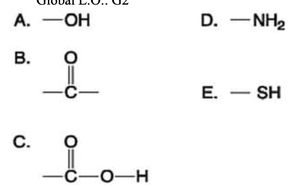
Q5. Which two functional groups shown in the figure above are present in all amino acids?
Background
Topic: Amino Acid Structure – Functional Groups
This question tests your knowledge of the basic structure of amino acids, which always contain two specific functional groups.
Key Terms:
Amino group:
Carboxyl group:
Other groups (hydroxyl, carbonyl, sulfhydryl) may be present in some amino acids, but not all.
Step-by-Step Guidance
Identify the functional groups in the diagram: hydroxyl (A), carbonyl (B), carboxyl (C), amino (D), sulfhydryl (E).
Recall that all amino acids have both an amino group () and a carboxyl group ().
Match these groups to the labels in the diagram.
Try solving on your own before revealing the answer!
Final Answer: C) B and D
All amino acids contain both a carboxyl group (B) and an amino group (D).
