 Back
BIO 1020 Exam #3 Study Guide – Fungi, Animal Evolution, and Phylogeny
Study Guide - Smart Notes
 Tailored notes based on your materials, expanded with key definitions, examples, and context.
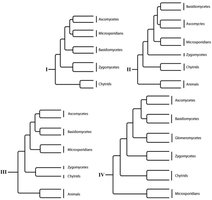
Q10. Which tree depicts all of the currently recognized major groups of fungi?
Background
Topic: Fungal Phylogeny
This question tests your understanding of the evolutionary relationships among the major groups of fungi. You need to recognize the main fungal clades and how they are represented in phylogenetic trees.
Key Terms and Concepts:
Phylogenetic tree: A diagram showing evolutionary relationships among organisms.
Major fungal groups: Chytrids, Zygomycetes, Glomeromycetes, Ascomycetes, Basidiomycetes, Microsporidians.
Step-by-Step Guidance
Examine each tree (I–IV) and identify which fungal groups are present in each.
Recall the currently recognized major groups of fungi: Chytrids, Zygomycetes, Glomeromycetes, Ascomycetes, Basidiomycetes, and Microsporidians.
Check if all these groups are represented as separate branches in the tree.
Eliminate any tree that is missing one or more of these groups or combines them incorrectly.
Try solving on your own before revealing the answer!
Q11. Which tree depicts the closest relationship between zygomycetes and chytrids?
Background
Topic: Fungal Evolutionary Relationships
This question asks you to interpret phylogenetic trees to determine which one shows zygomycetes and chytrids as most closely related.
Key Terms and Concepts:
Closest relationship: Two groups that share a more recent common ancestor with each other than with any other group.
Branching point: The node where two lineages diverge.
Step-by-Step Guidance
Look at each tree and find the branches for zygomycetes and chytrids.
Identify which tree shows these two groups branching from the same node or as sister taxa.
Compare the position of other groups to confirm the relationship is the closest in that tree.
Try solving on your own before revealing the answer!
Q12. In phylogenetic tree I, which group of organisms is most directly related to the common ancestor of the tree?
Background
Topic: Interpreting Phylogenetic Trees
This question tests your ability to read a phylogenetic tree and identify which group is closest to the root (common ancestor).
Key Terms and Concepts:
Root: The base of the tree, representing the most recent common ancestor of all groups shown.
Basal group: The group that branches off closest to the root.
Step-by-Step Guidance
Locate the root of tree I and follow the first branch point.
Identify which group is the first to diverge from the rest.
Check the labels to match the group with the options provided.
Try solving on your own before revealing the answer!
Q13. Among the organisms listed here, which are thought to be the closest relatives of fungi?
Background
Topic: Fungal Evolution and Animal Relationships
This question is about the evolutionary relationship between fungi and other eukaryotic groups, especially animals.
Key Terms and Concepts:
Closest relatives: The group that shares the most recent common ancestor with fungi.
Opisthokonts: The eukaryotic supergroup that includes fungi, animals, and some protists.
Step-by-Step Guidance
Recall that fungi and animals are both part of the opisthokont clade.
Review the evolutionary tree to see which group is most closely related to fungi.
Eliminate groups that are more distantly related, such as plants or slime molds.
Try solving on your own before revealing the answer!
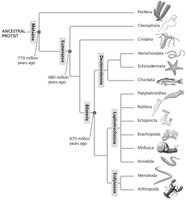
Q31. In the figure below, the Deuterostomia clade is most closely related to which two main clades?
Background
Topic: Animal Phylogeny
This question asks you to interpret a phylogenetic tree of animals and identify the two main clades most closely related to Deuterostomia.
Key Terms and Concepts:
Deuterostomia: A major clade of animals that includes echinoderms and chordates.
Lophotrochozoa and Ecdysozoa: The other two main clades of bilaterian animals.
Step-by-Step Guidance
Locate the Deuterostomia clade on the tree.
Identify the branches that are most closely related to Deuterostomia.
Check the names of these clades and compare them to the answer choices.
Try solving on your own before revealing the answer!
