 Back
BIO 132: Molecules, Cells, and Systems – Course Introduction and Syllabus Overview
Study Guide - Smart Notes
 Tailored notes based on your materials, expanded with key definitions, examples, and context.
Course Introduction
Overview of BIO 132
BIO 132: Molecules, Cells, and Systems is an introductory biology course designed to provide students with foundational knowledge in cellular and molecular biology, as well as an understanding of biological systems. The course emphasizes the importance of learning biological vocabulary, understanding the rules that govern biological processes, and applying this knowledge to solve biological problems. The central goal is to explore biology as a system, from the molecules that drive it to the cells that operate it.
Course Structure and Related Courses
BIO 130/131: Focuses on Biodiversity, Ecology, and Conservation.
BIO 132/133: Focuses on Molecules, Cells, and Systems.
Courses are offered in both spring and fall semesters and do not need to be taken in numerical order.
Each course is a stand-alone class requiring separate registration.
Laboratory Component
The laboratory class (BIO 133) begins in the same week as lectures and is required for Biology, Neuroscience, and Biochemistry majors, as well as for pre-health requirements.
Students on the waitlist will be contacted individually if spaces become available.
Course Objectives
Introduce students to the language and foundational concepts of biology.
Develop skills in applying biological knowledge to solve problems.
Foster an understanding of biology as an integrated system from molecules to organisms.
Course Organization and Expectations
Class Participation and Engagement
Active participation during lectures and office hours is expected.
Attendance is taken and contributes to the participation grade.
Students are encouraged to engage with classmates and the instructor.
Grading Breakdown
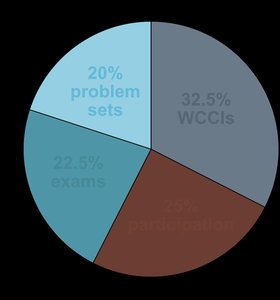
The course grade is based on several components, each contributing to the final score out of 1000 points:
Item | Number | Point Value (each) | Total Points |
|---|---|---|---|
Weekly Content Check-In (WCCI, drop lowest 3) | 13-3=10 | 32.5 | 325 |
Exams (EX) | 3 | 75 | 225 |
Class Participation | 25 | 10 | 250 |
Problem Sets (PS) | 4 | 50 | 200 |
Total | 1000 | ||
Extra Credit | Up to 3% (30 points) |
Weekly Content Check-In (WCCI)
Short, mostly multiple-choice quizzes held every Thursday at the beginning of class.
Students may use a one-sided, hand-written note sheet (8.5x11 inches) with graphics/schematics.
Lowest two scores are dropped.
Goal: Demonstrate understanding of assigned readings.
Exams
Three exams: one take-home online exam and two in-person exams (self-scheduled).
Partial credit is available for incorrect answers if a handwritten explanation is submitted.
Regrading requests must be submitted by the deadlines listed in the syllabus.
Problem Sets
Four problem sets designed to encourage big-picture thinking and synthesis of course material.
Graded on effort and completion; AI use is not allowed.
Format includes short essays, calculations, and diagram labeling.
Participation
Assessed through attendance, engagement, and self-assessment surveys administered twice during the semester.
Extra Credit
Earned by attending seminars or Lunch Bag series and submitting a one-page summary.
Each summary is worth 3 points, up to a maximum of 10 points (3% increase in grade).
Required Materials and Resources
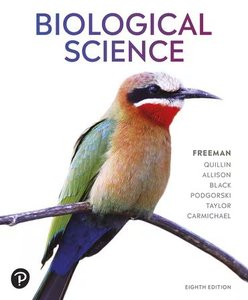
Textbook: Biological Science by Freeman et al., 8th edition (ISBN-13: 9780138276263).
Extra copies are available in the Nielson Library.
Weekly readings are assigned and are essential for success in the course.
Course Policies
Attendance and Absence Policy
Attendance is required and tracked via a sign-in sheet.
Students may miss two classes without penalty; additional absences require documentation.
WCCIs are held on Thursdays and cannot be made up without proper documentation.
Excessive tardiness will impact the participation grade.
Academic Integrity
All submitted work must be original; AI use is not permitted on problem sets.
Proper labeling and submission procedures must be followed for all assignments and regrade requests.
Tips for Success
Attend class regularly and participate actively.
Visit office hours and ask questions to clarify concepts.
Engage with classmates and form study groups.
Read the textbook, take notes, and practice drawing diagrams.
Attend seminars and utilize available resources.
Course Content Preview
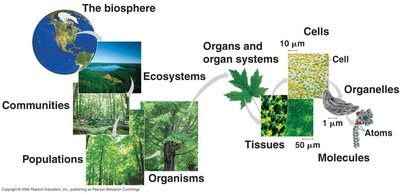
Levels of Biological Organization
Biology studies life at multiple levels of organization, from the smallest molecules to the entire biosphere. Understanding these levels is essential for grasping how biological systems function and interact.
Atoms and Molecules: The chemical building blocks of life.
Organelles: Specialized structures within cells.
Cells: The basic unit of life.
Tissues: Groups of similar cells performing a common function.
Organs and Organ Systems: Structures composed of tissues that perform specific functions.
Organisms: Individual living entities.
Populations: Groups of organisms of the same species in a given area.
Communities: Different populations interacting in a shared environment.
Ecosystems: Communities and their physical environment.
Biosphere: All ecosystems on Earth.
Instructor and Communication
Professor: Dr. Jackie Pelham
Research interests include circadian biology and intrinsically disordered proteins.
Contact via email (reply within 24 hours during business days); office hours are available for additional support.
Getting Started
Complete the introductory survey by the deadline provided in the course materials.
Prepare a name placard for class attendance and accessibility.
Familiarize yourself with the course schedule, grading policies, and required readings.
Summary
BIO 132 provides a comprehensive introduction to the molecular and cellular basis of life, emphasizing the integration of concepts across biological systems. Success in this course requires active participation, consistent engagement with readings and assignments, and utilization of available resources and support.
