 Back
BackBIO 201 Practice Exam Study Guidance: Genetics, DNA Structure, and Inheritance Patterns
Study Guide - Smart Notes
 Tailored notes based on your materials, expanded with key definitions, examples, and context.
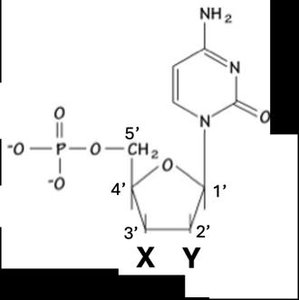
Q7. If you were told that this nucleotide could be found in either DNA or RNA, depending on the identity of the chemical groups labeled (X) and (Y), the nitrogen-containing ring structure would have to be ________.
Background
Topic: Nucleotide Structure and DNA/RNA Differences
This question tests your understanding of the chemical structure of nucleotides and how the identity of certain groups (X and Y) determines whether the nucleotide is part of DNA or RNA. It also asks you to identify the nitrogenous base present in the structure.
Key Terms and Formulas:
Nucleotide: The basic building block of nucleic acids, consisting of a phosphate group, a sugar (ribose or deoxyribose), and a nitrogenous base.
DNA vs. RNA: DNA contains deoxyribose (H at 2'), RNA contains ribose (OH at 2').
Nitrogenous Bases: Adenine, Guanine, Cytosine, Thymine (DNA), Uracil (RNA).
Step-by-Step Guidance
Examine the structure: Identify the sugar (ribose or deoxyribose) by looking at the group labeled Y at the 2' carbon. If Y is an OH, it's ribose (RNA); if Y is an H, it's deoxyribose (DNA).
Look at the nitrogenous base: The ring structure attached to the 1' carbon is a nitrogenous base. Compare its structure to known bases (adenine, guanine, cytosine, thymine, uracil).
Recall that thymine is only found in DNA, uracil only in RNA, while adenine, guanine, and cytosine are found in both.
Determine which base matches the structure shown, considering the possibility that the nucleotide could be in either DNA or RNA depending on X and Y.
Try solving on your own before revealing the answer!
Final Answer: C. Guanine
The nitrogen-containing ring structure shown is guanine, which can be found in both DNA and RNA depending on the sugar present (X and Y).
Guanine is a purine base present in both types of nucleic acids, unlike thymine (DNA only) or uracil (RNA only).
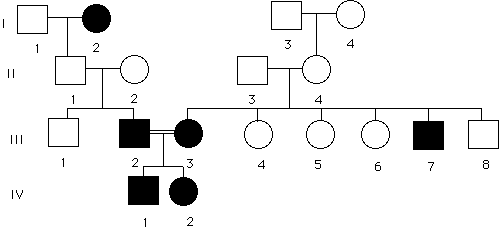
Q14. Based on this pedigree, Roberts Syndrome is inherited as a(n) ___________ trait?
Background
Topic: Pedigree Analysis and Inheritance Patterns
This question tests your ability to interpret a pedigree diagram and determine the mode of inheritance (autosomal dominant, autosomal recessive, sex-linked dominant, or sex-linked recessive).
Key Terms:
Pedigree: A diagram showing the inheritance of a trait across generations.
Autosomal: Trait is located on a non-sex chromosome.
Sex-linked: Trait is located on a sex chromosome (X or Y).
Dominant/Recessive: Dominant traits appear in every generation; recessive traits may skip generations.
Step-by-Step Guidance
Examine the pedigree: Identify affected and unaffected individuals across generations.
Look for patterns: Does the trait appear in both males and females? Does it skip generations?
If the trait appears in siblings but not in parents, consider autosomal recessive inheritance.
If the trait appears in every generation, consider autosomal dominant or sex-linked dominant.
Try solving on your own before revealing the answer!
Final Answer: B. Autosomal recessive
The pedigree shows affected individuals in siblings but not in every generation, consistent with autosomal recessive inheritance.
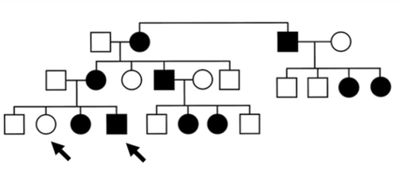
Q16. What is the most likely mode of inheritance for the disease tracked in the pedigree below?
Background
Topic: Pedigree Analysis and Modes of Inheritance
This question asks you to analyze a pedigree and determine whether the trait is autosomal or sex-linked, and whether it is dominant or recessive.
Key Terms:
Autosomal vs. Sex-linked: Autosomal traits are inherited via non-sex chromosomes; sex-linked traits are inherited via X or Y chromosomes.
Dominant vs. Recessive: Dominant traits appear in every generation; recessive traits may skip generations.
Step-by-Step Guidance
Examine the pedigree: Identify which individuals are affected and their relationship to each other.
Look for clues: Are both males and females affected? Does the trait skip generations?
If the trait appears in both sexes and skips generations, autosomal recessive is likely. If only males are affected, consider sex-linked recessive.
Consider the inheritance pattern for the grandchildren pointed to by arrows.
Try solving on your own before revealing the answer!
Final Answer: B. Autosomal recessive
The pattern of affected individuals in the pedigree, including both males and females and skipping generations, is consistent with autosomal recessive inheritance.
