 Back
BackBIO102 Spring 2026 Syllabus and Course Structure Overview
Study Guide - Smart Notes
 Tailored notes based on your materials, expanded with key definitions, examples, and context.
Course Overview: General Biology II (BIO102)
Course Description and Structure
General Biology II (BIO102) is a foundational course for biology majors, focusing on the diversity of life, evolutionary processes, and the integration of structure, function, and ecology. The course includes both lecture and laboratory components, emphasizing scientific inquiry and experimental methods.
Lecture Schedule: Tuesdays & Thursdays, 10:35 am–12:00 pm
Laboratory Sessions: Multiple sections throughout the week
Required Text: Campbell Biology, 12th Edition (Urry et al.)
Online Platform: Pearson MasteringBiology for homework and assessments
Course Objectives
Foster appreciation for biological diversity and the natural world
Link structure and function to ecology and evolution
Develop proficiency in formulating and investigating biological questions at the organismal level
Program Outcomes and Pillars of Learning
Integration of Scientific Method and Experimental Design
The course is structured around the application of the scientific method to develop questions and experimental methods that integrate all areas of biology. Students are expected to build foundational knowledge and demonstrate proficiency in the following pillars:
Outline and defend the role of evolution in all disciplines of biology
Read and critique primary literature research papers
Design experiments and develop hypotheses
Generate and interpret graphs displaying experimental data
Analyze data from laboratory and research activities
Communicate results in both oral and written formats
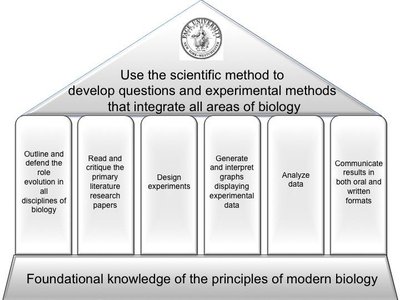
Additional info: These pillars are assessed through exams, lab quizzes, worksheets, oral presentations, and data analysis assignments. Mastery of these skills is essential for success in advanced biology courses and research.
Lecture and Laboratory Topics
Lecture Schedule and Major Topics
The course covers the following major topics, each aligned with chapters from the textbook:
Descent with Modification (Ch. 22)
Evolution of Populations (Ch. 23)
Origin of Species (Ch. 24)
Phylogeny and Classification (Ch. 25-26)
Diversity of Life: Bacteria, Archaea, Protists (Ch. 27-28)
Animal Diversity: Invertebrates and Vertebrates (Ch. 32-34)
Animal Form and Function (Ch. 40-42)
Fungi and Plant Diversity (Ch. 29-31, 35-36)
Conservation Biology and Global Change (Ch. 56)
Exams and review sessions are interspersed throughout the semester to reinforce learning and assess understanding.
Laboratory Schedule and Skills Development
Laboratory sessions are designed to reinforce lecture material and develop practical scientific skills. Key laboratory topics include:
Microscopy and data analysis using R and RStudio
Evolutionary concepts using model organisms (e.g., Darwin’s finches, tuco-tucos)
Genetic drift and phylogenetic analysis
Experimental design and hypothesis testing (e.g., crayfish dimorphism, tapeworm allometry)
Plant physiology and transpiration studies
Oral presentations and written lab reports
Each lab session includes pre-lab quizzes, worksheets, and opportunities for data collection and analysis.
Assessment and Grading
Grading Breakdown
Lecture (50%): Midterm exams, MasteringBiology homework, final cumulative exam
Laboratory (50%): Written and microscope exams, pre-lab quizzes, worksheets, oral presentation
Students must pass both lecture and laboratory components to pass the course. Attendance and participation are mandatory, especially for laboratory sessions.
Academic Integrity and Support Services
Academic Integrity
Students are required to adhere to the university’s Academic Integrity Code. Plagiarism and other forms of cheating will result in a zero for the assignment and may lead to failure in the course.
Support Services
Student Accessibility Services for accommodations
Learning Commons for tutoring and academic support
Resources for health, counseling, and academic advisement
Students are encouraged to seek help early and utilize available resources to ensure academic success and well-being.
