 Back
BIO110 Lecture 2 Notes: Chemical Foundations of Biology
Study Guide - Smart Notes
 Tailored notes based on your materials, expanded with key definitions, examples, and context.
Chemical Foundations of Biology
Atomic Structure and Elements
Understanding the structure of atoms and the nature of elements is fundamental to biology. Atoms are composed of protons, neutrons, and electrons, and their arrangement determines the chemical properties of an element.
Atom: The smallest unit of an element that retains its chemical properties.
Protons: Positively charged particles found in the nucleus.
Neutrons: Neutral particles found in the nucleus.
Electrons: Negatively charged particles orbiting the nucleus in electron shells.
Atomic Number: Number of protons in an atom, defines the element.
Mass Number: Sum of protons and neutrons in the nucleus.
Example: Carbon has 6 protons, 6 neutrons, and 6 electrons.
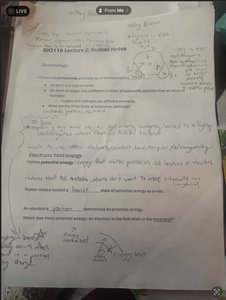
Electron Shells and Energy Levels
Electrons occupy specific energy levels or shells around the nucleus. The arrangement of electrons determines how atoms interact and bond with each other.
Electrons in the outermost shell (valence shell) are most important for chemical bonding.
Atoms are most stable when their valence shell is full.
Energy is required to move electrons to higher shells; energy is released when electrons fall to lower shells.
Potential Energy: Electrons further from the nucleus have higher potential energy.
Example: When an electron absorbs energy, it moves to a higher shell (excited state).
Chemical Bonds
Chemical bonds form when atoms interact to achieve stable electron configurations. The main types of bonds in biology are covalent, ionic, and hydrogen bonds.
Covalent Bonds: Atoms share pairs of electrons. These are strong bonds that form molecules.
Ionic Bonds: Electrons are transferred from one atom to another, creating charged ions that attract each other.
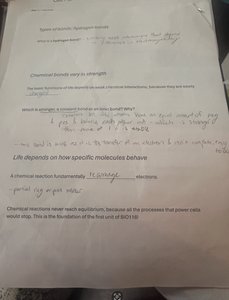
Hydrogen Bonds: Weak attractions between a hydrogen atom (covalently bonded to an electronegative atom like oxygen or nitrogen) and another electronegative atom.

Example: Water molecules are held together by covalent bonds, but interact with each other via hydrogen bonds.
Electronegativity and Bond Polarity
Electronegativity is an atom's ability to attract electrons in a bond. Differences in electronegativity lead to polar or nonpolar covalent bonds.
Nonpolar Covalent Bond: Electrons are shared equally (e.g., O2).
Polar Covalent Bond: Electrons are shared unequally, creating partial charges (e.g., H2O).
Ionic Bond: Large difference in electronegativity leads to electron transfer (e.g., NaCl).
Table: Types of Chemical Bonds
Bond Type | Electron Sharing | Relative Strength | Example |
|---|---|---|---|
Covalent | Shared | Strong | H2O, CH4 |
Ionic | Transferred | Moderate (weaker in water) | NaCl |
Hydrogen | Attraction between partial charges | Weak | Between H2O molecules |
Bond Strength and Biological Importance
Chemical bonds vary in strength, which affects biological processes. Covalent bonds provide stability to molecules, while weaker bonds (hydrogen, ionic in water) allow for dynamic interactions necessary for life.
Strong Bonds: Covalent bonds maintain the structure of biomolecules.
Weak Bonds: Hydrogen and ionic bonds facilitate molecular recognition and interactions (e.g., enzyme-substrate binding).
Example: DNA strands are held together by hydrogen bonds, allowing them to separate during replication.
Chemical Reactions and Energy
Chemical reactions involve the making and breaking of bonds, transforming reactants into products. Energy changes accompany these reactions.
Exergonic Reaction: Releases energy (e.g., cellular respiration).
Endergonic Reaction: Requires energy input (e.g., photosynthesis).
Equilibrium: In living cells, reactions rarely reach equilibrium; constant input/output of energy keeps processes going.
Equation: General chemical reaction
Example: ATP hydrolysis releases energy for cellular work.
Summary Table: Key Concepts in Chemical Foundations
Concept | Description | Biological Example |
|---|---|---|
Atom | Smallest unit of matter | Carbon atom in glucose |
Covalent Bond | Electron sharing | Peptide bonds in proteins |
Hydrogen Bond | Weak attraction between molecules | Base pairing in DNA |
Electronegativity | Atom's pull on electrons | Oxygen in water |
Additional info: These notes provide foundational chemistry concepts essential for understanding biological molecules and processes, including atomic structure, types of bonds, and the energetic basis of chemical reactions in cells.
