 Back
BIO112 General Biology 1: Exam 1 Study Guide (Chapters 1-2-3-4-5-8)
Study Guide - Smart Notes
 Tailored notes based on your materials, expanded with key definitions, examples, and context.
Chapter 1: Evolution, the Themes of Biology, and Scientific Inquiry
Hierarchy of Biological Organization
The biological hierarchy organizes life from the largest to the smallest units, illustrating the complexity and interconnectedness of living systems.
Biosphere: All life and environments on Earth.
Ecosystem: Communities and their physical environment.
Community: All organisms in an ecosystem.
Population: Individuals of the same species in an area.
Organism: A single living entity.
Organ system: Group of organs working together.
Organ: Structure with a specific function.
Tissue: Group of similar cells.
Cell: Basic unit of life.
Organelle: Specialized cell structure.
Molecule: Group of atoms bonded together.
Atom: Smallest unit of matter.
Prokaryotes vs. Eukaryotes
Cells are classified based on the presence or absence of a nucleus and membrane-bound organelles.
Prokaryotes: Lack nucleus and organelles; examples: Bacteria, Archaea.
Eukaryotes: Have nucleus and organelles; examples: Plants, Animals, Fungi, Protists.
Taxonomic Classification
The standard hierarchy used to classify organisms from broadest to most specific.
Domain → Kingdom → Phylum → Class → Order → Family → Genus → Species
Darwin's Theory of Evolution by Natural Selection
Darwin proposed that evolution occurs through natural selection, where individuals with advantageous traits survive and reproduce.
Natural selection: Mechanism of evolution.
Variation: Differences among individuals.
Adaptation: Traits suited to environment.
Survival of the fittest: Best-adapted individuals reproduce.
Components of a Controlled Scientific Experiment
Controlled experiments test hypotheses by manipulating variables and comparing groups.
Independent variable: Changed by researcher.
Dependent variable: Measured outcome.
Control group: Baseline for comparison.
Experimental group: Receives treatment.
Constants: Factors kept the same.
Positive vs. Negative Feedback
Feedback mechanisms regulate biological systems.
Negative feedback: Reduces change, maintains homeostasis (e.g., body temperature).
Positive feedback: Amplifies change (e.g., blood clotting, childbirth).
Chapter 2: The Chemical Context of Life
Elements of Life
Four elements make up most biological molecules.
Carbon (C)
Hydrogen (H)
Oxygen (O)
Nitrogen (N)
Atomic Structure Calculations
Atomic number and mass number determine the composition of atoms.
Protons: Atomic number
Electrons: Atomic number (neutral atom)
Neutrons: Mass number − atomic number
Electron Shells and Ions
Electrons fill shells in order, and ions have altered electron counts.
1st shell: 2 electrons max
2nd shell: 8 electrons max
3rd shell: 8 electrons max
Key Chemical Terms
Isotope: Same element, different neutrons.
Valence: Electrons in outer shell.
Ionic bond: Electron transfer.
Nonpolar covalent bond: Equal electron sharing.
Polar covalent bond: Unequal electron sharing.
Chapter 3: Water and Life
Hydrogen Bonds and Water Properties
Hydrogen bonds give water unique properties essential for life.
Cohesion: Water molecules stick together.
Surface tension: Resistance to breaking.
High specific heat: Resists temperature change.
Evaporative cooling: Heat loss as water evaporates.
Hydrophobic vs. Hydrophilic
Hydrophobic: Repels water.
Hydrophilic: Attracts water.
Properties of Water
Surface tension: Resistance to breaking.
Adhesion: Sticks to other surfaces.
Cohesion: Sticks to itself.
Evaporative cooling: Heat loss during evaporation.
High specific heat: Resists temperature change.
pH Calculations
pH measures hydrogen ion concentration. The relationship is:
Example: pH 3 → ,
Chapter 4: Carbon and the Molecular Diversity of Life
Valence of Carbon
Carbon's valence of 4 allows it to form four covalent bonds, enabling complex molecules.
Types of Isomers
Structural isomers: Different covalent arrangement.
Cis-trans isomers: Different spatial arrangement around double bond.
Enantiomers: Mirror images around asymmetric carbon.
Functional Groups
Hydroxyl: −OH
Carbonyl: C=O
Carboxyl: −COOH
Amino: −NH2
Sulfhydryl: −SH
Phosphate: −PO4
Methyl: −CH3
Chapter 5: The Structure and Function of Large Biological Molecules
Dehydration vs. Hydrolysis
These reactions build and break down biological polymers.
Dehydration: Removes water to form bonds (joins monomers).
Hydrolysis: Adds water to break bonds (splits polymers).
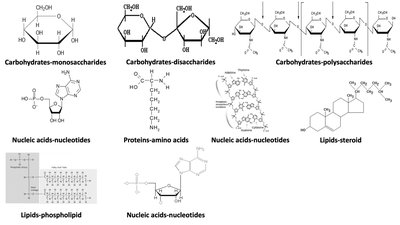
Classification of Biological Molecules
Biological molecules are classified by their structure.
Carbohydrates: Ring structures.
Lipids: Long hydrocarbon chains.
Proteins: Amino acid chains.
Nucleic acids: Nucleotide chains.
Saturated vs. Unsaturated Fatty Acids; Phospholipids
Saturated fatty acid: No double bonds.
Unsaturated fatty acid: One or more double bonds.
Phospholipid: Two fatty acid tails and a phosphate group (structurally different from fatty acids).
Amino Acid Structure and Protein Levels
Proteins have four structural levels, each essential for function.
Amino acid: Central carbon, amino group, carboxyl group, R group.
Primary structure: Sequence of amino acids (peptide bonds).
Secondary structure: Alpha helix, beta sheet (hydrogen bonds).
Tertiary structure: 3D folding (various bonds).
Quaternary structure: Multiple polypeptides.
Chaperonins: Assist in protein folding.
Nucleotide Structure
Phosphate group
Pentose sugar (5-carbon)
Nitrogenous base
Purines vs. Pyrimidines and DNA Base Pairing
Purine: Double-ring (adenine, guanine)
Pyrimidine: Single-ring (cytosine, thymine, uracil)
Base pairing: A-T, G-C in DNA
DNA vs. RNA Structure and Function
DNA: Double-stranded, deoxyribose, thymine; stores genetic information.
RNA: Single-stranded, ribose, uracil; involved in protein synthesis.
Chapter 8: An Introduction to Metabolism
Catabolism vs. Anabolism
Metabolic pathways are classified by their energy requirements.
Catabolism: Breakdown, releases energy (exergonic).
Anabolism: Building, requires energy (endergonic).
ATP Structure and Function
ATP is the cell's energy currency, storing energy in phosphate bonds.
Structure: Adenine, ribose, three phosphate groups.
Function: Energy transfer for cellular work.
Enzyme Structure and Function
Enzymes are proteins that lower activation energy, speeding up reactions.
Active site: Region where substrate binds.
Lower activation energy: Speeds up reactions.
Enzyme Denaturation
Extreme conditions disrupt enzyme structure and function.
Temperature
pH
Salt concentration
Enzyme Specificity and Optimum Activity
Enzymes have specific conditions for optimal activity, visible as peaks on activity graphs.
Stomach enzymes: Optimum at low pH (2).
Hot spring enzymes: Optimum at high temperature (78°C).
Enzyme Inhibition
Enzyme activity is regulated by inhibitors.
Competitive inhibitor: Binds active site.
Noncompetitive inhibitor: Binds elsewhere.
Allosteric inhibitor: Type of noncompetitive inhibitor.
