 Back
Biochemistry Study Guide – Step-by-Step Guidance for General Biology
Study Guide - Smart Notes
 Tailored notes based on your materials, expanded with key definitions, examples, and context.
Q1. Define the following terms:
Background
Topic: Chemical Bonds and Properties
This question tests your understanding of basic chemical concepts that are foundational in biology, including types of bonds and their properties.
Key Terms:
Chemical bond: The force that holds atoms together in molecules.
Covalent bond: A bond formed when two atoms share electrons.
Single bond: A covalent bond involving one pair of shared electrons.
Double bond: A covalent bond involving two pairs of shared electrons.
Valence: The number of chemical bonds an atom can form.
Electronegativity: The tendency of an atom to attract electrons.
Polar covalent bond: A covalent bond where electrons are shared unequally, resulting in partial charges.
Nonpolar covalent bond: A covalent bond where electrons are shared equally.
Step-by-Step Guidance
Start by defining each term in your own words, focusing on the key characteristics.
For bond types, consider how electrons are shared between atoms and what this means for molecular structure.
Think about how valence relates to the number of bonds an atom can form, and why electronegativity is important for bond polarity.
Compare polar and nonpolar covalent bonds by considering the distribution of electrons and resulting molecular properties.
Try solving on your own before revealing the answer!
Final Answer:
Chemical bond: An attraction between atoms that enables the formation of chemical substances.
Covalent bond: A bond formed by the sharing of electrons between atoms.
Single bond: A covalent bond with one pair of shared electrons.
Double bond: A covalent bond with two pairs of shared electrons.
Valence: The number of bonds an atom can form, based on its outer electrons.
Electronegativity: The ability of an atom to attract electrons in a bond.
Polar covalent bond: A bond where electrons are shared unequally, creating partial charges.
Nonpolar covalent bond: A bond where electrons are shared equally, resulting in no charge separation.
These definitions are fundamental for understanding molecular interactions in biology.
Q2. Why is water considered a polar molecule?
Background
Topic: Water Chemistry
This question tests your understanding of molecular polarity and how it relates to water's structure and function in biology.
Key Terms:
Polarity: The distribution of electrical charge over a molecule.
Electronegativity: Oxygen is more electronegative than hydrogen.
Polar covalent bond: Unequal sharing of electrons between atoms.
Step-by-Step Guidance
Consider the structure of a water molecule ($\text{H}_2\text{O}$) and the arrangement of its atoms.
Think about the difference in electronegativity between oxygen and hydrogen.
Explain how this difference causes electrons to be pulled closer to the oxygen atom.
Describe how this creates partial positive and negative charges within the molecule.
Try solving on your own before revealing the answer!
Final Answer:
Water is considered a polar molecule because oxygen is much more electronegative than hydrogen, causing the shared electrons to spend more time near the oxygen atom. This results in a partial negative charge on the oxygen and partial positive charges on the hydrogens, making the molecule polar.
Q3. For each of the below listed properties of water – briefly define the property and then explain how water’s polar nature and polar covalent bonds contribute to the water special property. Include an example in nature of each property also.
Cohesion
Adhesion
Surface tension
High specific heat
Heat of vaporization
Evaporative cooling
Background
Topic: Properties of Water
This question tests your understanding of how water's molecular structure leads to unique physical properties important in biology.
Key Terms:
Cohesion: Attraction between water molecules.
Adhesion: Attraction between water molecules and other substances.
Surface tension: The measure of how difficult it is to break the surface of water.
Specific heat: The amount of heat needed to raise the temperature of water.
Heat of vaporization: The energy required to convert water from liquid to gas.
Evaporative cooling: Cooling effect as water evaporates.
Step-by-Step Guidance
Define each property in your own words.
Explain how water’s polarity and hydrogen bonding contribute to each property.
Provide a real-world example for each property (e.g., cohesion: water droplets on a leaf).
For each property, relate the explanation back to the polar covalent bonds and partial charges in water.
Try solving on your own before revealing the answer!
Final Answer:
Cohesion: Water molecules stick together due to hydrogen bonding; example: water droplets.
Adhesion: Water molecules stick to other surfaces; example: water climbing plant stems.
Surface tension: Hydrogen bonds create a strong surface; example: insects walking on water.
High specific heat: Water resists temperature change; example: stable climate near oceans.
Heat of vaporization: Water requires much energy to evaporate; example: sweating cools the body.
Evaporative cooling: As water evaporates, it removes heat; example: evaporation from leaves.
Water’s polar nature and hydrogen bonds are responsible for these properties.
Q4. What is special about water and density?
Background
Topic: Water Density
This question tests your understanding of how water’s structure affects its density, especially in solid and liquid states.
Key Terms:
Density: Mass per unit volume.
Ice: Solid form of water.
Hydrogen bonding: Causes water molecules to arrange in a specific pattern.
Step-by-Step Guidance
Consider how hydrogen bonds affect the arrangement of water molecules in ice versus liquid water.
Think about why ice floats on water and what this means for density.
Relate this property to biological significance (e.g., aquatic life surviving under ice).
Try solving on your own before revealing the answer!
Final Answer:
Water is unique because ice is less dense than liquid water due to hydrogen bonds forming a lattice structure, causing ice to float. This is crucial for aquatic ecosystems.
Q5. Define the following terms:
Solute
Solvent
Aqueous solution
Hydrophilic
Hydrophobic
Background
Topic: Solutions and Solubility
This question tests your understanding of solution chemistry and how substances interact with water.
Key Terms:
Solute: The substance dissolved in a solution.
Solvent: The substance that dissolves the solute.
Aqueous solution: A solution where water is the solvent.
Hydrophilic: Water-loving; dissolves easily in water.
Hydrophobic: Water-fearing; does not dissolve in water.
Step-by-Step Guidance
Define each term, focusing on its role in a solution.
Explain the difference between hydrophilic and hydrophobic substances.
Relate these terms to biological examples (e.g., salt in water, oil in water).
Try solving on your own before revealing the answer!
Final Answer:
Solute: The substance that is dissolved.
Solvent: The substance that does the dissolving (often water).
Aqueous solution: A solution with water as the solvent.
Hydrophilic: Substances that dissolve well in water.
Hydrophobic: Substances that do not dissolve well in water.
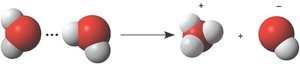
Q6. Label the diagram below to demonstrate the dissociation of the water molecule and then relate this diagram to pH.
Background
Topic: Water Dissociation and pH
This question tests your understanding of how water molecules dissociate and how this relates to the concept of pH in biology.
Key Terms and Formula:
Dissociation: The process by which a water molecule splits into ions.
pH: A measure of hydrogen ion concentration.
Formula: $\text{H}_2\text{O} \rightarrow \text{H}^+ + \text{OH}^-$
pH calculation: $\text{pH} = -\log_{10}[\text{H}^+]$
Step-by-Step Guidance
Examine the diagram showing water molecules splitting into ions.
Label the products as hydrogen ion ($\text{H}^+$) and hydroxide ion ($\text{OH}^-$).
Relate the presence of these ions to the concept of pH.
Explain how changes in $[\text{H}^+]$ affect pH values.
Try solving on your own before revealing the answer!
Final Answer:
The diagram shows water dissociating into $\text{H}^+$ (hydrogen ion) and $\text{OH}^-$ (hydroxide ion). The concentration of $\text{H}^+$ determines the pH of the solution: higher $\text{H}^+$ means lower pH (more acidic), lower $\text{H}^+$ means higher pH (more basic).
Q7. What defines an acid and a base?
Background
Topic: Acids and Bases
This question tests your understanding of the chemical definitions of acids and bases and their role in biological systems.
Key Terms:
Acid: Substance that increases $[\text{H}^+]$ in solution.
Base: Substance that decreases $[\text{H}^+]$ or increases $[\text{OH}^-]$.
Step-by-Step Guidance
Define acids and bases based on their effect on hydrogen ion concentration.
Relate these definitions to the pH scale.
Consider examples of acids and bases in biological contexts.
Try solving on your own before revealing the answer!
Final Answer:
An acid is a substance that increases the concentration of hydrogen ions ($\text{H}^+$) in solution, while a base decreases $\text{H}^+$ or increases hydroxide ions ($\text{OH}^-$). Acids have low pH, bases have high pH.
Q8. Why are “apparently” small changes in pH so important in biology?
Background
Topic: Biological Importance of pH
This question tests your understanding of how pH affects biological processes and why organisms must maintain stable pH levels.
Key Terms:
pH: Measure of hydrogen ion concentration.
Enzyme activity: Sensitive to pH changes.
Homeostasis: Maintaining stable internal conditions.
Step-by-Step Guidance
Consider how pH affects the structure and function of biological molecules.
Think about the impact of pH changes on enzyme activity and metabolic processes.
Relate this to the importance of homeostasis in living organisms.
Try solving on your own before revealing the answer!
Final Answer:
Small changes in pH can disrupt enzyme function and metabolic processes, leading to harmful effects in organisms. Maintaining stable pH is essential for life.
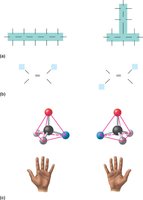
Q9. Use the diagram below to label and contrast the three types of isomers.
Background
Topic: Isomers in Biology
This question tests your understanding of structural, geometric, and enantiomer isomers and their significance in biological molecules.
Key Terms:
Isomer: Molecules with the same formula but different structures.
Structural isomer: Different covalent arrangements.
Geometric isomer: Different spatial arrangement around a double bond.
Enantiomer: Mirror-image isomers.
Step-by-Step Guidance
Examine the diagram and identify the three types of isomers.
Label each type and describe how their structures differ.
Contrast their biological significance (e.g., enantiomers in drug activity).
Try solving on your own before revealing the answer!
Final Answer:
Structural isomers: Differ in covalent arrangement of atoms.
Geometric isomers: Differ in spatial arrangement around a double bond.
Enantiomers: Mirror images; differ in spatial arrangement around an asymmetric carbon.
These differences can affect biological function and activity.
Q10. What does ATP stand for? What is its function? Sketch the reaction of ATP into ADP.
Background
Topic: ATP and Energy Transfer
This question tests your understanding of ATP’s role in cellular energy and the reaction converting ATP to ADP.
Key Terms and Formula:
ATP: Adenosine triphosphate.
ADP: Adenosine diphosphate.
Hydrolysis: Reaction breaking ATP to ADP and releasing energy.
Formula: $\text{ATP} + \text{H}_2\text{O} \rightarrow \text{ADP} + \text{P}_i + \text{energy}$
Step-by-Step Guidance
Define ATP and its function in cells.
Describe the hydrolysis reaction converting ATP to ADP.
Sketch or label the reaction, showing the release of a phosphate group and energy.
Try solving on your own before revealing the answer!
Final Answer:
ATP stands for adenosine triphosphate. Its function is to store and transfer energy in cells. The reaction: $\text{ATP} + \text{H}_2\text{O} \rightarrow \text{ADP} + \text{P}_i + \text{energy}$ shows ATP hydrolyzed to ADP, releasing energy.
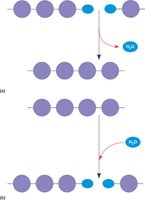
Q11. Label the diagram below – identify a monomer, polymer, condensation reaction, and hydrolysis.
Background
Topic: Macromolecules and Reactions
This question tests your understanding of how monomers and polymers are related and the chemical reactions involved in their synthesis and breakdown.
Key Terms:
Monomer: Small building block molecule.
Polymer: Large molecule made of monomers.
Condensation reaction: Joins monomers, releases water.
Hydrolysis: Breaks polymers, adds water.
Step-by-Step Guidance
Examine the diagram and identify the monomer and polymer.
Label the condensation reaction (joining monomers, releasing water).
Label the hydrolysis reaction (breaking polymers, adding water).
Try solving on your own before revealing the answer!
Final Answer:
Monomer: Single unit (blue shape).
Polymer: Chain of monomers (purple circles).
Condensation reaction: Joins monomers, releases water ($\text{H}_2\text{O}$).
Hydrolysis: Breaks polymer, adds water.
Q12. Compare and contrast the two storage polysaccharides.
Background
Topic: Carbohydrate Storage
This question tests your understanding of the structure and function of storage polysaccharides in plants and animals.
Key Terms:
Polysaccharide: Large carbohydrate made of many monosaccharides.
Starch: Storage polysaccharide in plants.
Glycogen: Storage polysaccharide in animals.
Step-by-Step Guidance
Identify the two main storage polysaccharides: starch and glycogen.
Compare their structure (branching, monomers).
Contrast their function and location in organisms.
Try solving on your own before revealing the answer!
Final Answer:
Starch: Storage in plants, less branched.
Glycogen: Storage in animals, highly branched.
Both are made of glucose monomers but differ in structure and storage location.
Q13. Compare and contrast the two structural polysaccharides.
Background
Topic: Structural Carbohydrates
This question tests your understanding of cellulose and chitin, their structure, and their biological roles.
Key Terms:
Cellulose: Structural polysaccharide in plants.
Chitin: Structural polysaccharide in fungi and animals.
Step-by-Step Guidance
Identify cellulose and chitin as structural polysaccharides.
Compare their monomers and structure.
Contrast their biological roles and where they are found.
Try solving on your own before revealing the answer!
Final Answer:
Cellulose: Found in plant cell walls, made of glucose.
Chitin: Found in fungal cell walls and exoskeletons, made of modified glucose.
Q14. Why are lipids grouped together?
Background
Topic: Lipid Classification
This question tests your understanding of the chemical properties that unify lipids as a group.
Key Terms:
Lipid: Hydrophobic biological molecule.
Hydrophobic: Repels water.
Step-by-Step Guidance
Consider the chemical properties of lipids (hydrophobicity).
Think about why lipids do not dissolve in water.
Relate this to their biological functions (e.g., membranes, energy storage).
Try solving on your own before revealing the answer!
Final Answer:
Lipids are grouped together because they are all hydrophobic and do not dissolve in water, due to their nonpolar structure.
Q15. What are the building blocks of fats?
Background
Topic: Fat Structure
This question tests your understanding of the molecular components of fats.
Key Terms:
Fat: Lipid molecule.
Glycerol: Backbone of fat.
Fatty acid: Long hydrocarbon chain.
Step-by-Step Guidance
Identify the two main building blocks: glycerol and fatty acids.
Describe how they combine to form a fat molecule.
Relate this to the structure and function of fats in biology.
Try solving on your own before revealing the answer!
Final Answer:
Fats are made from glycerol and fatty acids. Three fatty acids attach to one glycerol to form a triglyceride.
Q16. Contrast saturated and unsaturated fats – how does this relate to the concept that structure and function are linked?
Background
Topic: Fat Types and Structure-Function Relationship
This question tests your understanding of how the structure of fats affects their properties and biological roles.
Key Terms:
Saturated fat: No double bonds, straight chains.
Unsaturated fat: One or more double bonds, bent chains.
Step-by-Step Guidance
Compare the structure of saturated and unsaturated fats.
Explain how double bonds affect the shape and packing of fat molecules.
Relate this to their function and physical properties (e.g., solid vs. liquid at room temperature).
Try solving on your own before revealing the answer!
Final Answer:
Saturated fats have straight chains and are solid at room temperature; unsaturated fats have bent chains due to double bonds and are liquid. Structure affects function and physical properties.
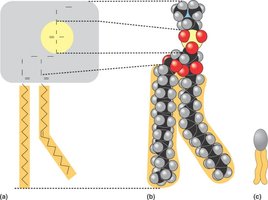
Q17. Label the molecule below.
Background
Topic: Lipid Structure
This question tests your ability to identify parts of a lipid molecule.
Key Terms:
Glycerol: Backbone.
Fatty acid: Long hydrocarbon chain.
Step-by-Step Guidance
Examine the diagram and identify the glycerol and fatty acid components.
Label the ester bonds connecting them.
Relate the structure to the function of fats.
Try solving on your own before revealing the answer!
Final Answer:
Glycerol: Backbone (left side).
Fatty acids: Long chains (right side).
Ester bonds: Connect glycerol to fatty acids.
Q18. How would you recognize a basic steroid molecule?
Background
Topic: Steroid Structure
This question tests your understanding of the structural features of steroids.
Key Terms:
Steroid: Lipid with four fused rings.
Step-by-Step Guidance
Identify the characteristic four-ring structure.
Look for variations in functional groups attached to the rings.
Relate this structure to the function of steroids in biology.
Try solving on your own before revealing the answer!
Final Answer:
A basic steroid molecule has four fused carbon rings. This structure is common to all steroids.
Q19. What are the names for the monomers and polymers of proteins?
Background
Topic: Protein Structure
This question tests your understanding of the building blocks of proteins.
Key Terms:
Amino acid: Monomer of proteins.
Polypeptide: Polymer of proteins.
Step-by-Step Guidance
Identify amino acids as monomers.
Describe how amino acids join to form polypeptides.
Relate this to the structure and function of proteins.
Try solving on your own before revealing the answer!
Final Answer:
The monomers of proteins are amino acids; the polymers are polypeptides.
Q20. Draw two amino acids – note the amino group, the carboxyl group and the alpha carbon, circle the water molecule to be removed and then note the peptide bond formed when the two are joined.
Background
Topic: Protein Synthesis
This question tests your understanding of amino acid structure and peptide bond formation.
Key Terms:
Amino group: $-\text{NH}_2$
Carboxyl group: $-\text{COOH}$
Alpha carbon: Central carbon atom.
Peptide bond: Bond formed between amino acids.
Step-by-Step Guidance
Draw two amino acids, labeling the amino and carboxyl groups and the alpha carbon.
Show the removal of a water molecule during peptide bond formation.
Label the peptide bond connecting the two amino acids.
Try solving on your own before revealing the answer!
Final Answer:
Two amino acids join by a peptide bond, formed when the amino group of one reacts with the carboxyl group of another, releasing a water molecule.
Q21. Explain the four levels of protein structure:
Primary
Secondary
Tertiary
Quaternary
Background
Topic: Protein Structure
This question tests your understanding of the hierarchical organization of protein structure.
Key Terms:
Primary structure: Sequence of amino acids.
Secondary structure: Local folding (alpha helix, beta sheet).
Tertiary structure: Overall 3D shape.
Quaternary structure: Multiple polypeptides joined.
Step-by-Step Guidance
Describe each level of protein structure.
Explain how each level builds on the previous one.
Relate structure to protein function.
Try solving on your own before revealing the answer!
Final Answer:
Primary: Sequence of amino acids.
Secondary: Local folding (alpha helix, beta sheet).
Tertiary: Overall 3D shape.
Quaternary: Multiple polypeptides joined.
Q22. What does denaturation mean and why is it important?
Background
Topic: Protein Denaturation
This question tests your understanding of how proteins lose their structure and function.
Key Terms:
Denaturation: Loss of protein structure.
Function: Structure determines function.
Step-by-Step Guidance
Define denaturation and describe what happens to protein structure.
Explain why denaturation affects protein function.
Consider examples (e.g., cooking eggs).
Try solving on your own before revealing the answer!
Final Answer:
Denaturation is the loss of a protein’s structure, causing it to lose function. This is important because structure determines function in proteins.
Q23. What are the roles of nucleic acids?
Background
Topic: Nucleic Acids
This question tests your understanding of the functions of DNA and RNA in cells.
Key Terms:
DNA: Stores genetic information.
RNA: Transfers and translates genetic information.
Step-by-Step Guidance
Identify the main roles of DNA and RNA.
Describe how nucleic acids are involved in heredity and protein synthesis.
Relate this to cellular function and life processes.
Try solving on your own before revealing the answer!
Final Answer:
Nucleic acids store, transfer, and express genetic information. DNA stores genes; RNA helps make proteins.
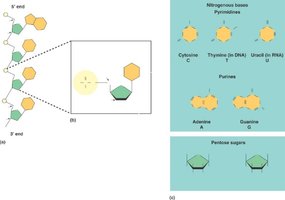
Q24. Label the blank diagram below:
Background
Topic: Nucleic Acid Structure
This question tests your ability to identify parts of a nucleic acid molecule.
Key Terms:
Nucleotide: Monomer of nucleic acids.
Pentose sugar: Five-carbon sugar.
Phosphate group: Part of nucleotide.
Nitrogenous base: A, T, C, G, U.
Step-by-Step Guidance
Examine the diagram and identify the nucleotide components.
Label the pentose sugar, phosphate group, and nitrogenous base.
Relate the structure to the function of nucleic acids.
Try solving on your own before revealing the answer!
Final Answer:
Pentose sugar: Five-carbon sugar (bottom).
Phosphate group: Circle (left).
Nitrogenous base: Hexagon (right).
Q25. What is meant by the term that DNA is antiparallel?
Background
Topic: DNA Structure
This question tests your understanding of the arrangement of DNA strands.
Key Terms:
Antiparallel: Strands run in opposite directions.
5' and 3' ends: Directionality of DNA strands.
Step-by-Step Guidance
Describe the directionality of DNA strands (5' to 3' and 3' to 5').
Explain how the two strands are oriented relative to each other.
Relate this to DNA replication and function.
Try solving on your own before revealing the answer!
Final Answer:
DNA is antiparallel because the two strands run in opposite directions: one from 5' to 3', the other from 3' to 5'. This arrangement is essential for DNA replication and function.
