 Back
Biodiversity and Conservation: Key Concepts and Measures
Study Guide - Smart Notes
 Tailored notes based on your materials, expanded with key definitions, examples, and context.
Biodiversity and Conservation
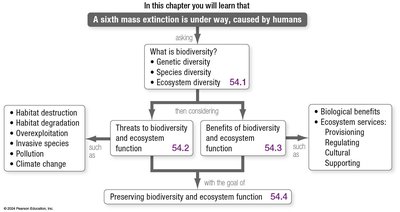
Introduction to Biodiversity
Biodiversity refers to the variety of life forms within a given ecosystem, biome, or the entire planet. It encompasses genetic diversity, species diversity, and ecosystem diversity, all of which are crucial for maintaining ecological balance and supporting human life.
Genetic diversity: Variation in genes within a species.
Species diversity: The number and relative abundance of species in a community.
Ecosystem diversity: The variety of ecosystems in a region.
Measures of Species Diversity
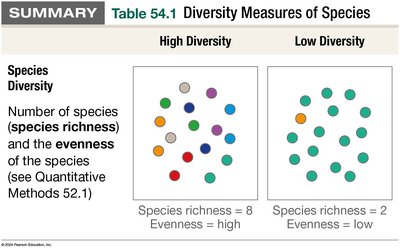
Understanding biodiversity requires quantifying it through several measures:
Species richness: The total number of different species present in a community.
Species evenness: How evenly individuals are distributed among the species.
Species abundance: The number of individuals per species.
Relative abundance: The proportion of individuals belonging to a particular species compared to the total number of individuals.
Phylogenetic Diversity
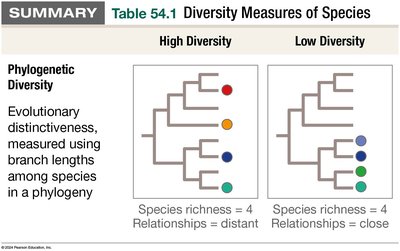
Phylogenetic diversity measures the evolutionary history represented by species in a community. It considers how closely or distantly related species are on a phylogenetic tree.
High phylogenetic diversity: Species are distantly related, representing a broad evolutionary history.
Low phylogenetic diversity: Species are closely related, representing a narrow evolutionary history.
Functional Diversity
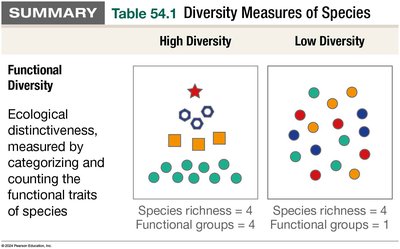
Functional diversity considers the variety of roles, traits, and ecological functions performed by species in a community.
High functional diversity: Many functional groups, each performing different ecological roles.
Low functional diversity: Few functional groups, with similar ecological roles.
Global Patterns of Species Richness
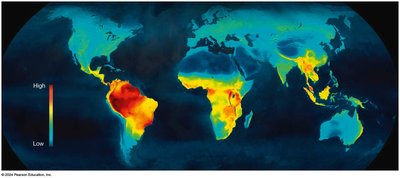
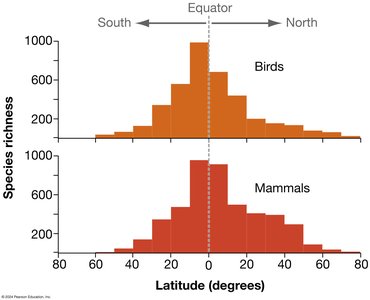
Species richness is not evenly distributed globally. It often shows a strong latitudinal gradient, with the highest diversity near the equator.
Factors contributing to high diversity: Warmer temperatures, longer growing seasons, greater solar energy, more available food and habitats, and stable climates.
Biodiversity Hotspots
Biodiversity hotspots are regions with many endemic species that have lost much of their original habitat and face a high risk of extinction. Protecting these areas can conserve many unique species in a relatively small area. 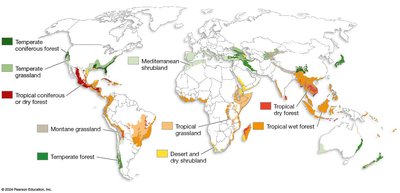
Endangered Species
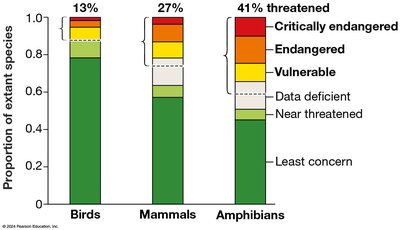
Endangered species are those whose populations have become so small or are declining so rapidly that they are at high risk of extinction.
Categories: Critically endangered, endangered, vulnerable, near threatened, least concern.
Major Threats to Biodiversity
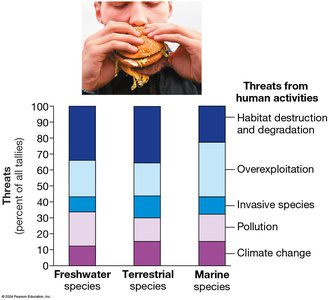
Biodiversity is threatened by several human activities:
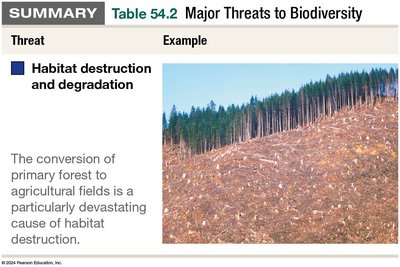
Habitat destruction and degradation: Conversion of natural habitats to agriculture or urban areas.
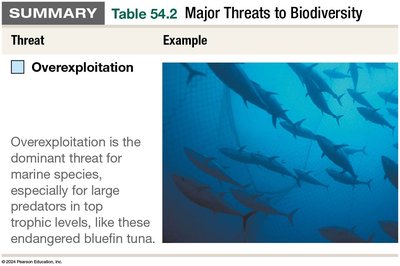
Overexploitation: Harvesting organisms faster than they can reproduce.
Invasive species: Non-native species that disrupt local ecosystems.
Pollution: Contaminants that harm organisms and ecosystems.
Climate change: Alteration of environmental conditions affecting species survival.
Ecosystem Services
Ecosystem services are the benefits that humans derive from ecosystems. Biodiversity is essential for maintaining these services, which include:
Provisioning services: Food, water, medicine, and raw materials.
Regulating services: Climate regulation, disease control, water purification.
Cultural services: Recreation, spiritual value, education.
Supporting services: Nutrient cycling, soil formation, pollination.
Biodiversity and Food Webs
Biodiversity reveals how species are connected and how energy and nutrients move through an ecosystem. Food webs illustrate these connections and dependencies, showing that greater biodiversity creates more resilient and complex food webs.
Conservation Priorities
Preserving biodiversity and ecosystem function is a primary goal of conservation biology. This involves understanding threats, benefits, and prioritizing actions to protect species and habitats. 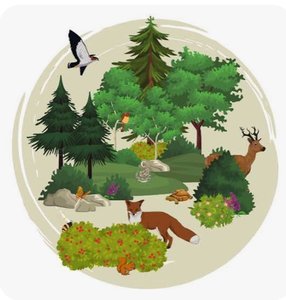
Summary Table: Diversity Measures of Species
Measure | High Diversity | Low Diversity |
|---|---|---|
Species Diversity | Species richness = 8, Evenness = high | Species richness = 2, Evenness = low |
Phylogenetic Diversity | Species richness = 4, Relationships = distant | Species richness = 4, Relationships = close |
Functional Diversity | Species richness = 4, Functional groups = 4 | Species richness = 4, Functional groups = 1 |
Key Equations
Species Evenness (Pielou's Evenness Index): where is the Shannon diversity index and is the total number of species.
Shannon Diversity Index: where is the proportion of individuals in the th species.
Conclusion
Biodiversity is vital for ecosystem stability, resilience, and the provision of essential services to humans. Conservation efforts must address the major threats to biodiversity and prioritize regions and species at greatest risk. Understanding and preserving biodiversity is fundamental to sustaining life on Earth.
