 Back
Biodiversity, Classification, and Phylogeny: Foundations of General Biology
Study Guide - Smart Notes
 Tailored notes based on your materials, expanded with key definitions, examples, and context.
Biodiversity and Classification
Introduction to Biology
Biology is the scientific study of life, encompassing the vast diversity of living organisms and their interactions. The discipline is unified by five major themes: Organization, Information, Energy and Matter, Interactions, and Evolution. These themes provide a framework for understanding the complexity and unity of life.
Levels of Biological Organization
Life can be studied at multiple levels, from molecules to the biosphere. Each level exhibits emergent properties—new characteristics that arise from the arrangement and interaction of parts.
Reductionism: Simplifies complex systems into manageable components for study.
Emergent Properties: For example, cardiac muscle cells form a functioning heart, an organ with properties not found in individual cells.
Structure and Function
Biological structures provide clues to their functions, and understanding function can reveal evolutionary relationships among organisms.
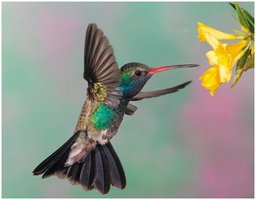
The Cell: Basic Unit of Life
Cell Theory and Types
The cell is the smallest unit capable of all life activities. Cell theory states that all living organisms are composed of cells, which are enclosed by membranes regulating material exchange.
Prokaryotic cells: Found in Bacteria and Archaea; lack a nucleus and membrane-bound organelles.
Eukaryotic cells: Found in Eukarya; possess a nucleus and organelles.
Genetic Information and Gene Expression
DNA and Chromosomes
Chromosomes contain DNA, the hereditary material organized into genes. DNA's double helix structure enables information storage and transmission.
DNA is composed of four nucleotides: A, G, C, T.
Gene expression: The process by which genetic information is used to synthesize proteins.
Genome: The complete set of genetic instructions in an organism.
Energy, Matter, and Interactions
Energy Flow and Matter Cycling
Life depends on the transfer and transformation of energy and matter. Energy enters ecosystems as sunlight, is converted by producers, and passed to consumers. Matter cycles within ecosystems.
Energy is lost as heat during biological work.
Producers (e.g., plants) generate chemical energy; consumers feed on other organisms.
Feedback Regulation
Biological systems self-regulate through feedback mechanisms.
Negative feedback: Reduces the initial stimulus.
Positive feedback: Amplifies the response.
Evolution: Unity and Diversity of Life
Evolutionary Theory
Evolution explains both the unity and diversity of life. All organisms are modified descendants of common ancestors, and natural selection drives adaptation.
Charles Darwin's theory: Descent with modification and natural selection.
Individuals with advantageous traits survive and reproduce, leading to adaptation.
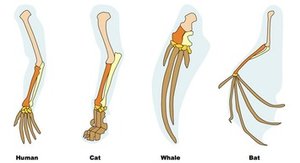
Adaptation Example
Bat wings are an adaptation for flight, illustrating how natural selection shapes traits suited to environments.
Classification and Taxonomy
Binomial Nomenclature
Each species is assigned a two-part scientific name: genus and species (e.g., Homo sapiens). Classification is hierarchical, from domain to species.
Domains: Bacteria, Archaea, Eukarya
Kingdoms in Eukarya: Plantae, Fungi, Animalia, Protists
Hierarchical Classification Table
Domain | Kingdom | Phylum | Class | Order | Family | Genus | Species |
|---|---|---|---|---|---|---|---|
Eukaryotes | Animals | Chordates | Mammals | Primates | Hominids | Homo | sapiens |
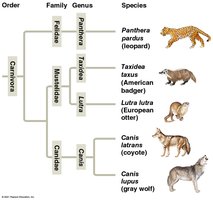
Phylogeny and Evolutionary Relationships
Phylogenetic Trees
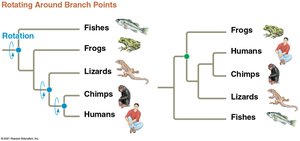
A phylogenetic tree is a branching diagram representing evolutionary relationships. Each branch point indicates divergence from a common ancestor.
Sister taxa share a recent common ancestor.
Tree rotation does not affect relationships.
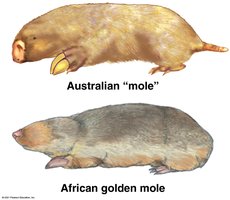
Homology vs. Analogy
Homologies are similarities due to shared ancestry; analogies arise from convergent evolution. Distinguishing these is crucial for accurate phylogeny.
Cladistics and Group Types
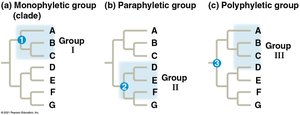
Cladistics groups organisms by common ancestry. Types of groups:
Monophyletic: Ancestor and all descendants (true clade).
Paraphyletic: Ancestor and some descendants.
Polyphyletic: Distantly related species, not their most recent common ancestor.
Scientific Inquiry in Biology
Scientific Method
Science involves observation, hypothesis formation, and experimentation. Hypotheses must be testable and falsifiable.
Qualitative data: Descriptions
Quantitative data: Measurements
Theories: Broad, evidence-supported explanations (e.g., Cell Theory, Theory of Gravity)
Case Study: Mouse Coloration
Researchers tested the hypothesis that mouse coloration is an adaptation for camouflage. Models matching their environment were preyed upon less, supporting the hypothesis.
From Two Kingdoms to Three Domains
Modern Classification
Biologists now use a three-domain system: Bacteria, Archaea, and Eukarya. Eukarya includes Plantae, Fungi, and Animalia; Protista is no longer a kingdom due to diverse relationships.
Key Terms and Concepts
Biodiversity: Variety of life forms
Taxonomy: Logical organization of life
Phylogeny: Evolutionary history of species
Emergent properties: New characteristics at each level of organization
Homology: Similarity due to shared ancestry
Analogy: Similarity due to convergent evolution
Examples of Biodiversity
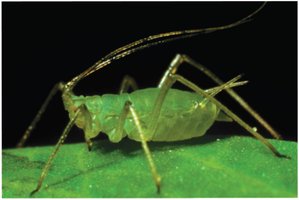
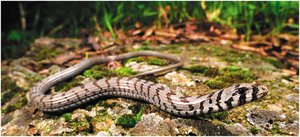
The following images illustrate the diversity of life forms:

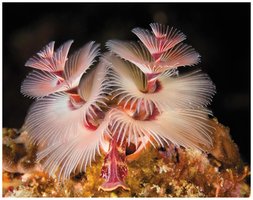
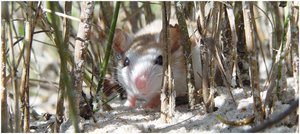
Conclusion
Biology is the study of life, its emergent properties, and its organization. Scientific inquiry and taxonomy provide frameworks for understanding the diversity and unity of living organisms, their evolutionary relationships, and their classification.
