 Back
Biodiversity, Classification, and the Foundations of Biology
Study Guide - Smart Notes
 Tailored notes based on your materials, expanded with key definitions, examples, and context.
Biodiversity and the Themes of Biology
Introduction to Biology
Biology is the scientific study of life, encompassing the vast diversity of living organisms and the processes that sustain them. Life is recognized by a set of characteristics and activities that distinguish living things from nonliving matter.
Diversity of Life: There is an enormous variety of living organisms, each adapted to its environment.
Unifying Themes: Five central themes organize biological study: Organization, Information, Energy and Matter, Interactions, and Evolution.
Levels of Biological Organization
Life can be studied at multiple levels, from molecules to the entire biosphere. Each level exhibits emergent properties—new characteristics that arise from the arrangement and interaction of parts.
Reductionism: A method that simplifies complex systems into manageable components for study.
Emergent Properties: For example, cardiac muscle cells form a functioning heart, an organ with properties not found in individual cells.
Structure and Function
There is a close relationship between the structure of biological components and their function. Understanding one provides insight into the other, as well as evolutionary relationships among species.
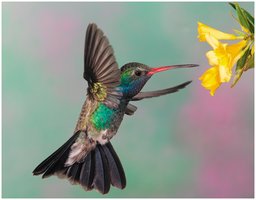
The Cell: The Basic Unit of Life
The cell is the smallest unit capable of performing all activities required for life. According to the cell theory, all living organisms are composed of cells, which are bounded by membranes that regulate material exchange.
Prokaryotic Cells: Simpler, smaller, lack a nucleus and membrane-bound organelles (e.g., Bacteria, Archaea).
Eukaryotic Cells: Larger, contain a nucleus and organelles (e.g., plants, animals, fungi, protists).
Genetic Information and Gene Expression
Genetic information is stored in DNA, which is organized into chromosomes. Genes are units of inheritance that encode instructions for building cellular molecules.
DNA Structure: Double helix composed of four nucleotides (A, G, C, T).
Gene Expression: The process by which information from a gene is used to synthesize proteins.
Genome: The complete set of genetic instructions in an organism.
Energy and Matter in Biological Systems
Life depends on the transfer and transformation of energy and matter. Energy flows through ecosystems, while matter cycles within them.
Producers: Organisms (e.g., plants) that convert solar energy into chemical energy via photosynthesis.
Consumers: Organisms that obtain energy by feeding on other organisms.
Energy Flow: Energy enters as light, is transformed, and exits as heat.
Matter Cycling: Chemical elements are recycled within ecosystems.
Interactions and Regulation
Biological systems are characterized by interactions among their components and with the environment. Many processes are regulated by feedback mechanisms.
Negative Feedback: The response reduces the initial stimulus (e.g., regulation of blood glucose).
Positive Feedback: The end product speeds up its own production (e.g., blood clotting).
Evolution: The Core Theme of Biology
Unity and Diversity of Life
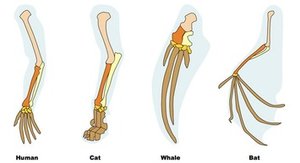
Evolution explains both the unity and diversity of life. All organisms share a common genetic language (DNA) and many structural similarities, reflecting descent from common ancestors.
Classification of Life
Biologists classify organisms to organize and understand the diversity of life. Each species is given a two-part scientific name (binomial nomenclature): genus and species (e.g., Homo sapiens).
Three Domains of Life: Bacteria, Archaea, and Eukarya.
Domain Eukarya: Includes kingdoms Plantae, Fungi, Animalia, and a diverse group called protists.
Charles Darwin and Natural Selection
Charles Darwin proposed that species evolve through descent with modification and that natural selection is the mechanism driving this process.
Individuals vary in heritable traits.
More offspring are produced than survive, leading to competition.
Individuals best suited to their environment are more likely to survive and reproduce.
Over generations, beneficial traits become more common in the population.
Adaptation and Evidence for Evolution
Natural selection results in adaptations—traits that enhance survival and reproduction in specific environments. Evidence for evolution includes anatomical similarities, fossil records, and molecular data.
Scientific Inquiry and the Process of Science
The Scientific Method
Science is a systematic approach to understanding the natural world through observation, hypothesis formation, experimentation, and analysis.
Data: Recorded observations, which can be qualitative (descriptive) or quantitative (numerical).
Hypothesis: A testable explanation for observations.
Experiment: A controlled test to evaluate hypotheses.
Variables and Controls
Experiments involve manipulating an independent variable and measuring the effect on a dependent variable. Control groups are used for comparison.
Theories in Science
A scientific theory is a broad, well-supported explanation for a range of phenomena (e.g., cell theory, theory of gravity). Theories generate testable hypotheses and are supported by extensive evidence.
Classification and Phylogeny
Phylogeny and Cladistics
Phylogeny is the evolutionary history of a species or group. Cladistics groups organisms by common ancestry into clades, which can be nested within larger clades.
Hierarchical Classification
Linnaeus developed a hierarchical system for classifying organisms:
Domain
Kingdom
Phylum
Class
Order
Family
Genus
Species
Example of Hierarchical Classification
Level | Example |
|---|---|
Domain | Eukaryotes |
Kingdom | Animals |
Phylum | Chordates |
Class | Mammals |
Order | Primates |
Family | Hominids |
Genus | Homo |
Species | sapiens |
Phylogenetic Trees
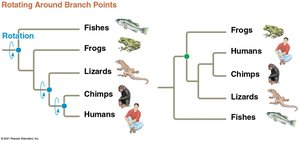
Phylogenetic trees are branching diagrams that represent hypotheses about evolutionary relationships. Each branch point indicates a divergence from a common ancestor.
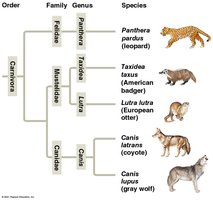
Sister Taxa: Groups that share an immediate common ancestor.
Basal Taxon: A lineage that diverges early in the history of a group.
Homology vs. Analogy
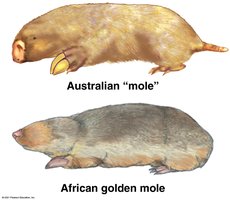
Homologies are similarities due to shared ancestry, while analogies arise from convergent evolution (independent adaptation to similar environments).
Cladistics: Monophyletic, Paraphyletic, and Polyphyletic Groups
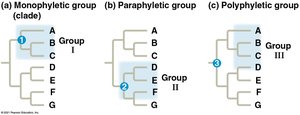
Cladistics distinguishes between different types of groups:
Monophyletic: Includes ancestor and all descendants (a true clade).
Paraphyletic: Includes ancestor and some, but not all, descendants.
Polyphyletic: Includes distantly related species but not their most recent common ancestor.
Modern Classification: The Three-Domain System
Modern taxonomy recognizes three domains: Bacteria, Archaea, and Eukarya. This system reflects major differences in cellular organization and genetic makeup.
Bacteria: Most known prokaryotes.
Archaea: Diverse prokaryotes in various environments.
Eukarya: Organisms with true nuclei, including plants, fungi, and animals.
Key Terms and Concepts
Biology: The study of life and living organisms.
Taxonomy: The science of classifying organisms.
Phylogeny: Evolutionary history of a species or group.
Clade: A group consisting of an ancestor and all its descendants.
Homology: Similarity due to shared ancestry.
Analogy: Similarity due to convergent evolution.
Conclusion: Biology is unified by the study of life’s diversity, the mechanisms of evolution, and the scientific process. Classification systems and phylogenetic analysis help organize our understanding of the relationships among living organisms.
