 Back
Biodiversity, Speciation, and Phylogenetic Classification
Study Guide - Smart Notes
 Tailored notes based on your materials, expanded with key definitions, examples, and context.
Biodiversity and Speciation
Introduction to Biodiversity
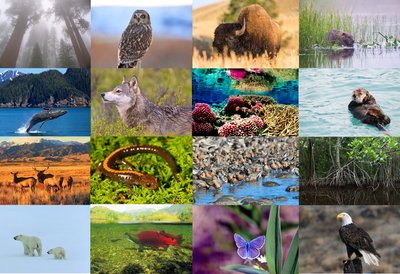
Biodiversity refers to the variety of all life forms on Earth, encompassing the diversity within species, between species, and of ecosystems. Understanding biodiversity is essential for studying the evolutionary processes that generate and maintain the variety of life.
Biodiversity includes genetic, species, and ecosystem diversity.
It is the result of evolutionary processes such as mutation, natural selection, genetic drift, and speciation.
Documenting biodiversity helps scientists understand evolutionary relationships and the history of life.
Speciation: The Formation of New Species
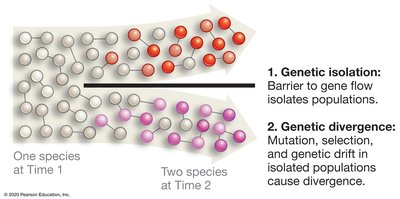
Speciation is the evolutionary process by which populations evolve to become distinct species. It is a two-step process involving genetic isolation and genetic divergence.
Genetic Isolation: A barrier to gene flow isolates populations, preventing interbreeding.
Genetic Divergence: Mutation, selection, and genetic drift in isolated populations cause divergence, leading to the formation of new species.
Speciation can occur through mechanisms such as allopatric (geographic separation) or sympatric (within the same area) processes.
Hybrid Zones
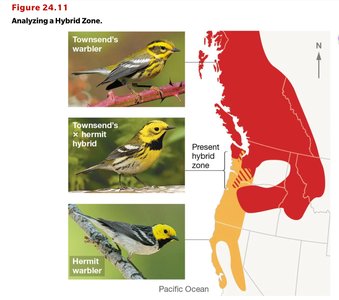
A hybrid zone is a geographic area where interbreeding occurs between two diverged populations, resulting in hybrid offspring. These zones provide insight into the process of speciation and reproductive isolation.
Hybrid offspring may be viable and fertile but are not necessarily considered a new species.
Studying hybrid zones helps biologists understand the dynamics of gene flow and the maintenance of species boundaries.
Mutations and Genetic Variation
Mutation is the ultimate source of genetic variation, creating new alleles. While crossing over and independent assortment shuffle existing alleles, only mutation introduces new genetic material into a population.
Mutations are random with respect to fitness and can be beneficial, neutral, or harmful.
Without mutation, evolution would eventually stop due to the loss of genetic variation.
Mutation alone rarely changes allele frequencies significantly, but in combination with other evolutionary forces, it is crucial for evolution.
Large-Scale Patterns in Life’s History
Adaptive Radiations
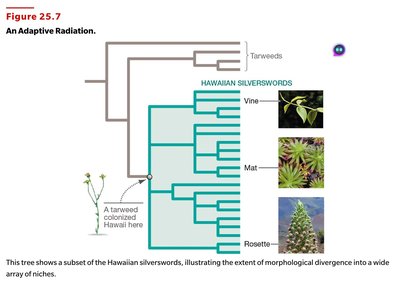
Adaptive radiation is a process in which organisms diversify rapidly into a multitude of new forms, particularly when new habitats or resources become available, or after mass extinctions.
Often triggered by extrinsic factors (e.g., new environments) or intrinsic factors (e.g., evolutionary innovations).
Results in the occupation of a wide array of ecological niches.
Mass Extinctions
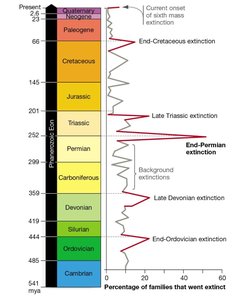
Mass extinctions are events in which a significant proportion of the world’s biodiversity is lost in a relatively short period. Earth has experienced five major mass extinctions, with a possible sixth currently underway due to human activities.
Causes include habitat loss, climate change, invasive species, and overexploitation.
Mass extinctions create opportunities for adaptive radiations by vacating ecological niches.
Phylogenies and Phylogenetic Trees
Understanding Phylogenetic Trees
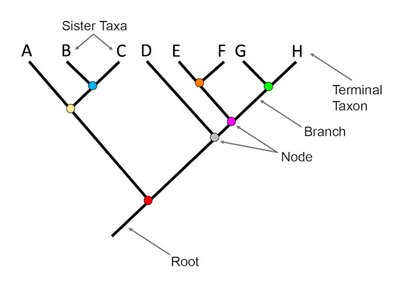
A phylogenetic tree is a diagram that represents the evolutionary relationships among various biological species based on similarities and differences in their physical or genetic characteristics.
Taxon (plural: taxa): A named group of organisms.
Node: Represents a common ancestor.
Branch: Represents the evolutionary lineage.
Tip (Terminal Taxon): Represents the current species or group.
Polytomy: A node from which more than two groups emerge, indicating unresolved relationships.
Synapomorphy: A shared derived trait inherited from a common ancestor.
The Tree of Life
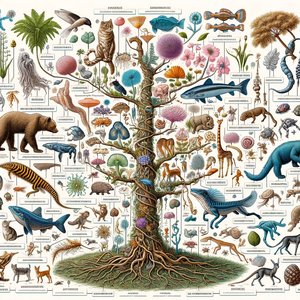
The Tree of Life is a model that hypothesizes the evolutionary relationships among all living organisms. It is constructed using evidence from fossils, morphology, behavior, and genetics.
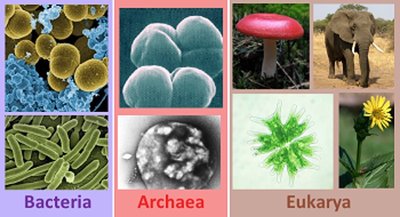
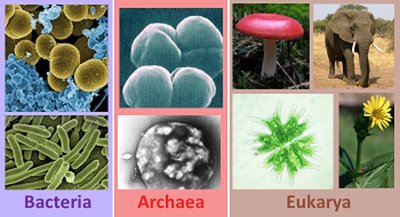
All living things are grouped into three domains: Bacteria, Archaea, and Eukarya.
Taxonomy is the science of naming, describing, and classifying organisms.
Taxonomy and Classification
Taxonomic Levels
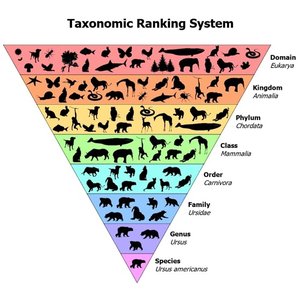
Taxonomy organizes living organisms into hierarchical categories based on shared characteristics. The main taxonomic ranks are:
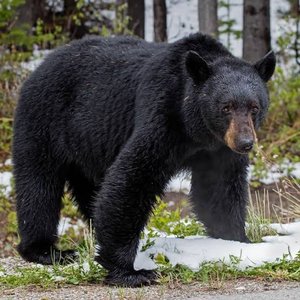
Rank | Example (American Black Bear) |
|---|---|
Domain | Eukarya |
Kingdom | Animalia |
Phylum | Chordata |
Class | Mammalia |
Order | Carnivora |
Family | Ursidae |
Genus | Ursus |
Species | Ursus americanus |
The Three Domains of Life
All life is classified into three domains based on genetic and cellular differences:
Bacteria: Prokaryotic, unicellular organisms with peptidoglycan in their cell walls.
Archaea: Prokaryotic, unicellular organisms with unique membrane lipids and no peptidoglycan.
Eukarya: Organisms with eukaryotic cells, including protists, fungi, plants, and animals.
Kingdoms within Domains
Within each domain, organisms are further classified into kingdoms. For example, the domain Eukarya includes four major kingdoms: Protists, Fungi, Plantae, and Animalia.
Each kingdom is divided into phyla, classes, orders, families, genera, and species.
Classification is based on genetic, morphological, and ecological characteristics.
Binomial Nomenclature
Each species is given a unique scientific name using binomial nomenclature, consisting of the genus and species names (e.g., Ursus americanus for the American Black Bear).
The genus name is capitalized and italicized; the species name is lowercase and italicized.
This system provides a universal language for scientists worldwide.
Practice: Classifying the American Black Bear
The American Black Bear (Ursus americanus) can be classified as follows:
Domain: Eukarya
Kingdom: Animalia
Phylum: Chordata
Class: Mammalia
Order: Carnivora
Family: Ursidae
Genus: Ursus
Species: Ursus americanus
Summary Table: Taxonomic Hierarchy
Level | Description |
|---|---|
Domain | Largest grouping; based on cell type and genetics |
Kingdom | Major groups within domains |
Phylum | Groups of related classes |
Class | Groups of related orders |
Order | Groups of related families |
Family | Groups of related genera |
Genus | Groups of related species |
Species | Basic unit of classification; a group of interbreeding organisms |
Key Terms and Concepts
Speciation: The process by which new species arise.
Biodiversity: The variety of life in all its forms and levels.
Phylogeny: The evolutionary history of a species or group.
Taxonomy: The science of classifying organisms.
Domain, Kingdom, Phylum, Class, Order, Family, Genus, Species: The main taxonomic ranks.
Binomial Nomenclature: The two-part scientific naming system for species.
