 Back
Bioenergetics: Energy, Metabolism, and Cellular Respiration
Study Guide - Smart Notes
 Tailored notes based on your materials, expanded with key definitions, examples, and context.
Bioenergetics and Metabolism
Introduction to Metabolism
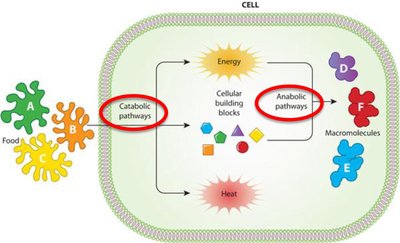
Metabolism encompasses all biochemical reactions occurring within an organism. These reactions are organized into metabolic pathways, which are either catabolic (breaking down molecules to release energy) or anabolic (building complex molecules using energy). The interplay between these pathways is essential for maintaining cellular function and life.
Catabolic pathways: Break down complex molecules into simpler ones, releasing energy.
Anabolic pathways: Use energy to construct complex molecules from simpler ones.
Energy flow: Energy from catabolic reactions is used to drive anabolic reactions.
Energy Transformations in Biology
Energy exists in various forms and is essential for biological processes. The first law of thermodynamics states that energy cannot be created or destroyed, only transformed. The second law states that energy transformations increase the entropy (disorder) of the universe, with some energy lost as heat.
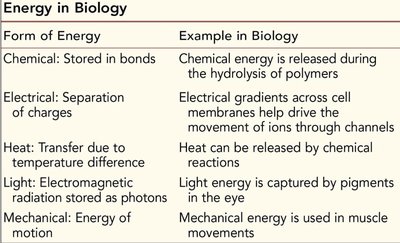
Chemical energy: Stored in chemical bonds and released during reactions.
Electrical energy: Separation of charges, important in nerve impulses and membrane potentials.
Heat energy: Transfer due to temperature differences, often a byproduct of metabolic reactions.
Light energy: Captured by pigments, crucial for photosynthesis.
Mechanical energy: Energy of motion, such as muscle contraction.
Potential Energy in Chemical Bonds
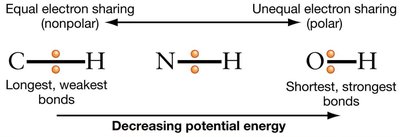
The potential energy of a molecule depends on the types of bonds it contains. Nonpolar bonds (equal electron sharing) have higher potential energy, while polar bonds (unequal sharing) have lower potential energy. Breaking strong bonds releases less energy than breaking weak bonds.
Exergonic and Endergonic Reactions
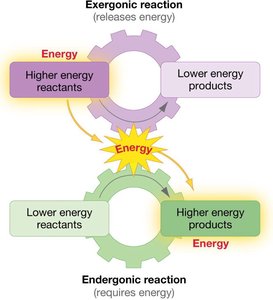
Biochemical reactions are classified based on their energy changes:
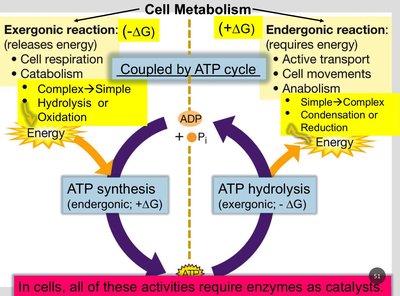
Exergonic reactions: Release energy; products have less free energy than reactants ().
Endergonic reactions: Require energy input; products have more free energy than reactants ().
ATP: The Energy Currency of the Cell
Structure and Function of ATP
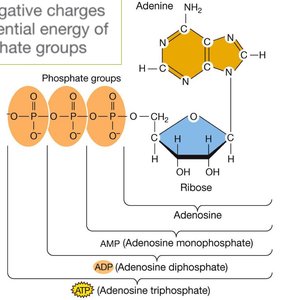
Adenosine triphosphate (ATP) is the primary energy carrier in cells. It consists of adenine, ribose, and three phosphate groups. The high-energy bonds between phosphate groups store potential energy due to repulsion between negative charges.
ATP Hydrolysis and Energy Release
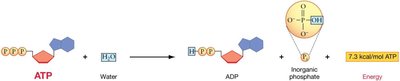
ATP hydrolysis is an exergonic reaction that releases energy by breaking the bond between the second and third phosphate groups, forming ADP and inorganic phosphate ():
The energy released (~7.3 kcal/mol) is used to power cellular processes.
The ATP Cycle
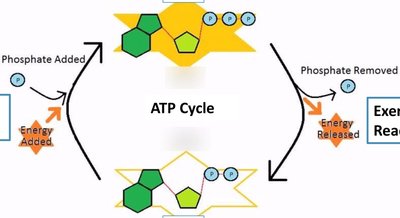
ATP is continuously regenerated from ADP and through cellular respiration and catabolic pathways. This cycle couples exergonic and endergonic reactions, ensuring a constant supply of usable energy for the cell.
Enzymes and Regulation of Metabolism
Role of Enzymes
Enzymes are biological catalysts that speed up chemical reactions by lowering activation energy. They are highly specific for their substrates and can be regulated to control metabolic pathways.
Active site: Region where substrate binds and reaction occurs.
Maximum rate: Achieved when all enzyme molecules are bound to substrate.
Enzyme Regulation
Enzyme activity is regulated by several mechanisms:
Competitive inhibition: Inhibitor resembles substrate and binds to active site, blocking substrate binding.
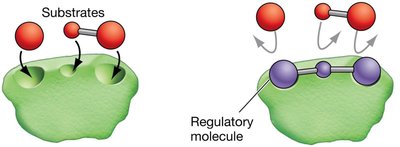
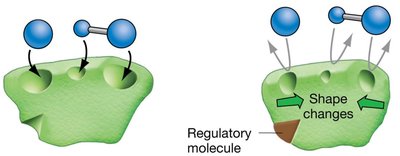
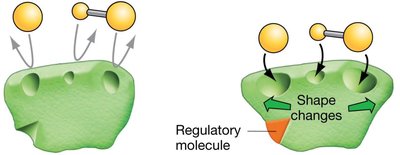
Allosteric regulation: Regulatory molecules bind to sites other than the active site, causing conformational changes that increase or decrease enzyme activity.
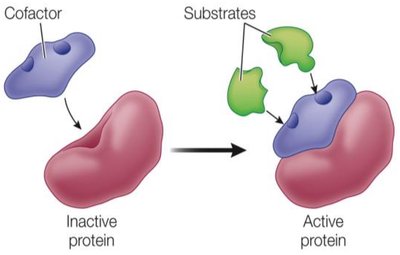
Cofactors: Nonprotein molecules (often metal ions or coenzymes) required for enzyme function.
Coupling of Metabolic Reactions
ATP Coupling
Cells couple exergonic and endergonic reactions through ATP. Exergonic reactions (like ATP hydrolysis) provide the energy needed for endergonic processes (such as active transport and biosynthesis).
Cellular Respiration
Overview of Cellular Respiration
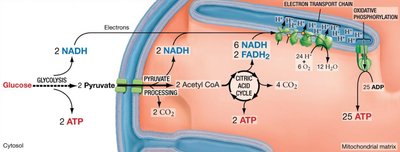
Cellular respiration is a series of metabolic pathways that convert glucose into ATP, releasing energy for cellular work. It consists of glycolysis, pyruvate oxidation, the citric acid cycle, and oxidative phosphorylation.
Glycolysis: Occurs in the cytosol; breaks down glucose into pyruvate, producing ATP and NADH.
Pyruvate oxidation: Converts pyruvate to acetyl-CoA, generating NADH and CO2.
Citric acid cycle (Krebs cycle): Completes the oxidation of glucose, producing NADH, FADH2, ATP, and CO2.
Electron transport chain (ETC) and oxidative phosphorylation: Uses NADH and FADH2 to generate a proton gradient that drives ATP synthesis.
Glycolysis
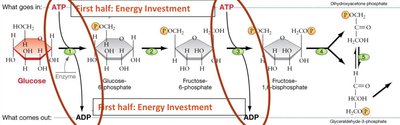
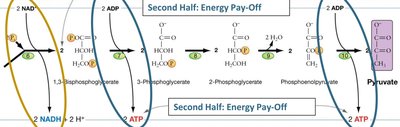
Glycolysis is the first step in glucose catabolism, occurring in the cytosol. It consists of two phases:
Energy investment phase: 2 ATP are used to phosphorylate glucose and its intermediates.
Energy payoff phase: 4 ATP and 2 NADH are produced, with a net gain of 2 ATP per glucose molecule.
Citric Acid Cycle (Krebs Cycle)
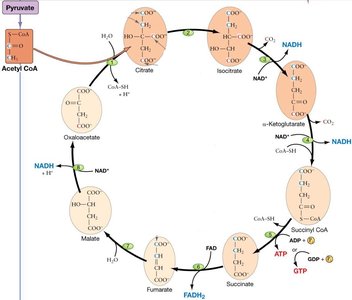
The citric acid cycle occurs in the mitochondrial matrix. Acetyl-CoA enters the cycle, and through a series of enzyme-catalyzed reactions, it is oxidized to CO2. The cycle generates NADH, FADH2, and ATP (or GTP).
Regulation of the Citric Acid Cycle
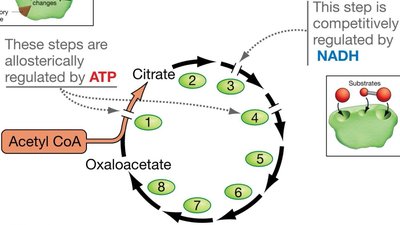
The citric acid cycle is tightly regulated by allosteric and competitive inhibition, primarily by ATP and NADH, to ensure energy production matches cellular demand.
Electron Transport Chain and Oxidative Phosphorylation
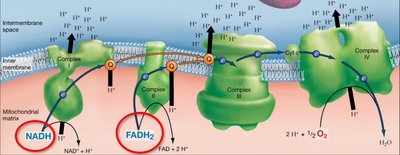
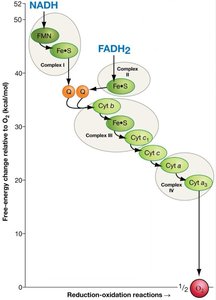
The electron transport chain (ETC) is a series of protein complexes in the inner mitochondrial membrane. Electrons from NADH and FADH2 are transferred through the chain, releasing energy used to pump protons (H+) into the intermembrane space, creating a proton gradient. Oxygen is the final electron acceptor, forming water.
ATP Synthase and Chemiosmosis
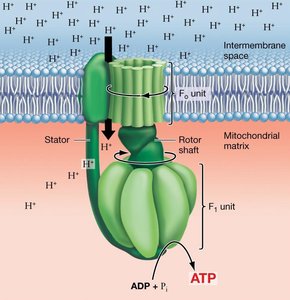
ATP synthase is an enzyme that synthesizes ATP from ADP and inorganic phosphate, powered by the flow of protons down their gradient (chemiosmosis). This process is called oxidative phosphorylation and produces the majority of ATP during cellular respiration.
Photosynthesis and Cellular Respiration: Energy Flow in Ecosystems
Photosynthesis and Respiration Cycle
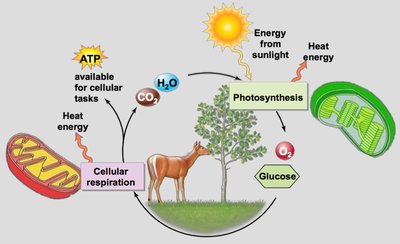
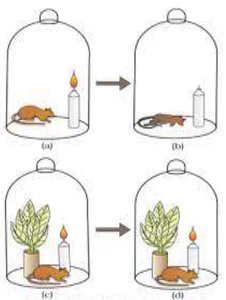
Photosynthesis and cellular respiration are interconnected processes that cycle energy and matter through ecosystems. Photosynthesis converts solar energy into chemical energy (glucose), while respiration releases energy from glucose for cellular work.
Summary Table: Forms of Energy in Biology
Form of Energy | Example in Biology |
|---|---|
Chemical | Chemical energy is released during the hydrolysis of polymers |
Electrical | Electrical gradients across cell membranes help drive the movement of ions through channels |
Heat | Heat can be released by chemical reactions |
Light | Light energy is captured by pigments in the eye |
Mechanical | Mechanical energy is used in muscle movements |
