 Back
BackLec 21
Study Guide - Smart Notes
 Tailored notes based on your materials, expanded with key definitions, examples, and context.
Biogeography: The Study of Species Distribution
Introduction to Biogeography
Biogeography is the scientific study of the distribution of organisms, both living and extinct, across geographic space and through geological time. It seeks to understand the factors that influence where species are found and why certain regions are more diverse than others.
Endemism: The restriction of a species' range to a specific geographic area.
Disjunctions: The division of a species' range into separate, non-contiguous areas.
Species Richness: The number of different species present in a region; varies greatly across the globe.
Biogeographic Regions: Large areas with distinct assemblages of organisms, often shaped by historical and environmental factors.
Historical Biogeography and the Importance of History
Lost Continents, Vicariance, and Biotic Interchange
Historical events such as continental drift, the formation and closure of seaways, and the rise of mountain ranges have profoundly influenced the distribution of species. Vicariance (the splitting of populations by barriers) and biotic interchange (the mixing of faunas between regions) are key processes in shaping biogeographic patterns.
Determinants of Species Richness
Latitudinal Gradients and Environmental Factors
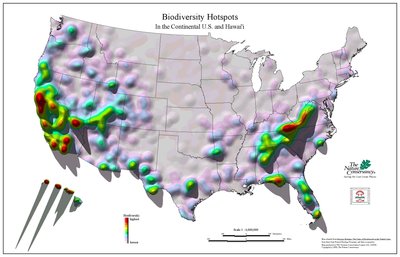
Species richness is not evenly distributed across the globe. Several hypotheses explain why the tropics are more diverse than temperate regions:
Species-Energy Hypothesis: Greater energy input (sunlight) in the tropics leads to higher primary productivity, more ecological niches, and thus more species.
Climatic Harshness: Tropical climates are less stressful, allowing more species to persist.
Climatic Stability: Stable climates over time promote long-term persistence and diversification of species.
Species richness is also influenced by latitude, with higher richness near the equator and lower richness toward the poles.
Resource Partitioning and Elevational Gradients
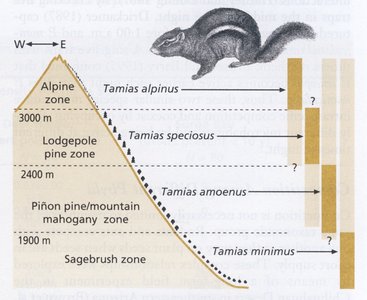
Within regions, species may partition resources along environmental gradients, such as elevation, to reduce competition and promote coexistence.
Patterns of Endemism and Disjunction
Case Studies: Cacti and Marsupials
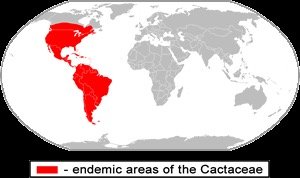
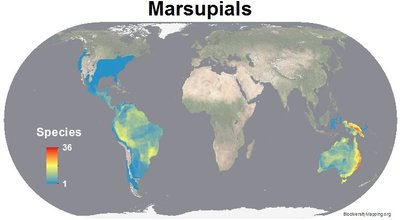
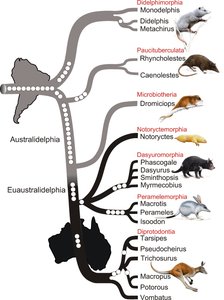
Some groups, such as cacti, are endemic to the New World, while similar-looking succulents are found in the Old World due to convergent evolution. Marsupials are primarily found in the southern hemisphere, with distinct lineages in South America and Australia.
Endemic Areas of Cactaceae: Cacti are native only to the Americas.
Marsupial Distribution: Marsupials are most diverse in Australia and South America, with few species in North America.
Phylogeny of Marsupials
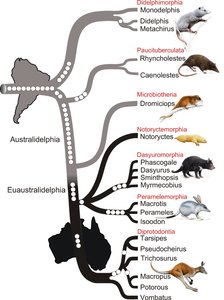
Phylogenetic studies reveal that marsupials in Australia and South America share a common ancestry, reflecting ancient connections between these continents.
Biogeographic Regions and Barriers
Wallace's Line and Biogeographic Provinces
Biogeographic regions are separated by barriers such as oceans, mountains, and deserts. Wallace's Line is a famous boundary separating Asian and Australian faunas in the Malay Archipelago.
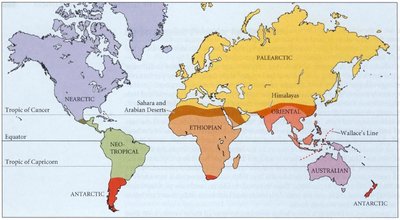
Species on either side of major barriers tend to be more different from each other than those separated by smaller barriers.
Species are often more closely related to others in the same region than to those in distant regions with similar habitats.
Biogeographic Processes
Vicariance, Dispersal, Extinction, and Range Expansion
Several processes shape the geographic ranges of species:
Vicariance: The separation of populations by geological barriers, leading to divergence.
Dispersal: Movement of individuals to colonize new regions.
Local Extinction and Recolonization: Loss and subsequent return of populations to regions.
Range Expansion: Continuous movement across favorable habitats.
Quantifying Diversification and Biogeographic Events
Phylogenies and Diversification Rates
Phylogenetic trees can be used to estimate diversification rates within clades. A constant rate of diversification predicts a linear increase in the number of lineages over time, while deviations indicate bursts of speciation or extinction events.
Lineage-Through-Time Plots: Graphs showing the accumulation of lineages over time; non-linear plots suggest changes in diversification rates.
Case Study: Marine and Terrestrial Biotic Interchange
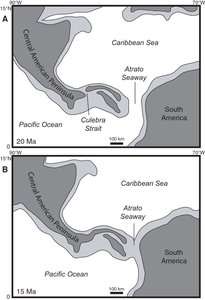
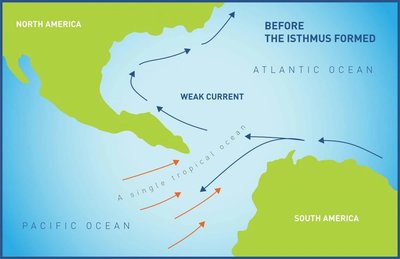
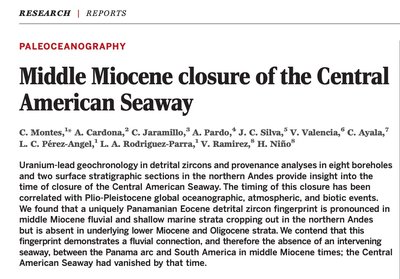
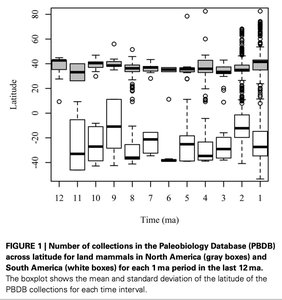
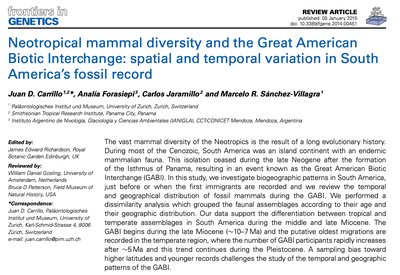
The closure of the Central American Seaway during the Miocene had profound effects on marine and terrestrial biotas, leading to the Great American Biotic Interchange (GABI), where species migrated between North and South America.
Summary Table: Key Biogeographic Processes
Process | Definition | Example |
|---|---|---|
Vicariance | Separation of populations by geological barriers | Formation of the Isthmus of Panama dividing marine species |
Dispersal | Movement of individuals to new regions | Colonization of islands by birds |
Local Extinction | Loss of populations from a region | Extinction of large mammals in North America |
Range Expansion | Continuous movement across suitable habitats | Spread of invasive species |
Conclusion
Biogeography integrates ecological, evolutionary, and geological perspectives to explain the distribution of life on Earth. Understanding these patterns and processes is essential for interpreting biodiversity, speciation, and the effects of historical events on present-day ecosystems.
