 Back
BIOL 1107 Principles of Biology 1: Comprehensive Study Guide and Learning Objectives
Study Guide - Smart Notes
 Tailored notes based on your materials, expanded with key definitions, examples, and context.
Overview of Course Structure and Study Strategies
Study Cycle and Focused Study Sessions
The Study Cycle is a structured approach to mastering course material, emphasizing active engagement and regular review. It consists of several steps: Preview, Attend, Review, Study, and Check. Each step is designed to reinforce learning and ensure thorough understanding of biological concepts.
Preview: Skim materials, identify key concepts, and set learning goals.
Attend: Participate in lectures, ask questions, and take detailed notes.
Review: Revisit notes, summarize information, and clarify doubts.
Study: Complete assignments, practice recall, and deepen understanding.
Check: Test your knowledge through quizzes and self-assessment.
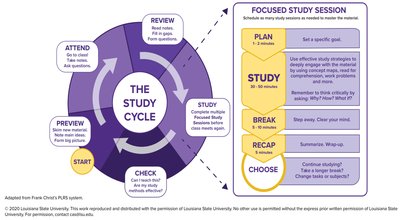
Focused study sessions are recommended, involving planning, active study, breaks, recapping, and choosing next steps. This method helps maximize retention and application of biological concepts.
The DEAL Method for Learning Objectives
For every new term or concept, use the DEAL method to ensure comprehensive understanding:
Define it: Recall the definition from memory and identify characteristics or examples.
Explain it: Describe the concept in your own words, compare it to related ideas, and categorize it.
Apply it: Use the concept in new scenarios, solve problems, and draw conclusions from evidence.
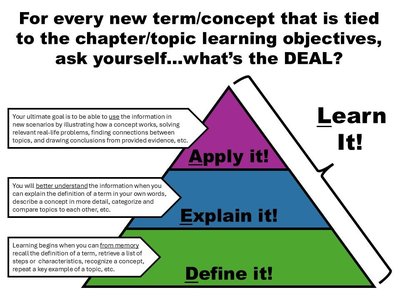
This approach helps students move from basic recall to higher-order thinking and application, which is essential for mastering biology.
Core Topics and Learning Objectives
Scientific Process
The scientific process is fundamental to biology, enabling systematic exploration of living organisms.
Biology: The study of living organisms and their interactions with the environment.
Scientific Method: Steps include observation, hypothesis formation, experimentation, data analysis, and conclusion.
Scientific Questions: Must be testable, measurable, and relevant.
Data Interpretation: Analyze tables and figures to identify variables, controls, sample size, and summarize findings.
Properties of Life
Living organisms share distinct characteristics that define life.
Characteristics of Life: Organization, metabolism, responsiveness, growth, development, reproduction, and homeostasis.
Cells: The basic unit of life; all living things are composed of cells.
Living vs. Non-living: Use observations to determine if an object (e.g., vesicle) meets criteria for life.
Cell Structure
Cells are classified as prokaryotic or eukaryotic, each with unique structural and functional features.
Prokaryotic Cells: Lack membrane-bound organelles; include bacteria and archaea.
Eukaryotic Cells: Contain organelles such as nucleus, mitochondria, and endoplasmic reticulum.
Organelle: Specialized subunit within a cell with a specific function.
Cell Structure and Function: Organization varies based on cellular function; dysfunction in organelles affects cell health.
Membrane Structure
The plasma membrane is a dynamic barrier that regulates interactions between the cell and its environment.
Fluid Mosaic Model: Describes the membrane as a flexible layer with embedded proteins and lipids.
Components: Includes phospholipids, proteins, cholesterol, and carbohydrates.
Membrane Formation: Driven by hydrophobic and hydrophilic interactions among lipids.
Lipids and Biochemistry
Lipids are essential biomolecules with diverse roles in cell structure and function.
Types of Lipids: Phospholipids, steroids, triglycerides/fats.
Chemical Elements: Hydrogen (H), Carbon (C), Nitrogen (N), Oxygen (O) are primary elements in biomolecules.
Structural Formulas: Distinguish hydrocarbon skeletons from functional groups.
Intramolecular Bonds: Nonpolar covalent, polar covalent, and ionic bonds based on electronegativity.
Molecular Interactions and Membrane Formation
Intermolecular interactions are critical for membrane structure and function.
Types of Interactions: Ionic bonds, hydrogen bonds/dipoles, Van der Waals forces.
Hydrophilic vs. Hydrophobic: Classification based on molecular interactions.
Water Properties: Unique characteristics arise from hydrogen bonding.
Membrane Bilayer Formation: Involves both intramolecular and intermolecular interactions.
Membrane Transport
Cells utilize various mechanisms to transport substances across membranes.
Transport Structures: Channels, carriers, pumps.
Concentration Gradients: Drive diffusion and net movement of molecules.
Transport Mechanisms: Passive (simple, facilitated diffusion) vs. active transport; bulk transport.
Environmental Effects: Predict direction and rate of transport based on conditions.
Proteins
Proteins are versatile biomolecules with structural, functional, and regulatory roles.
Types of Proteins: Transport, receptor, enzymes, cell identification.
Monomers and Polymers: Amino acids (monomers) form polypeptides/proteins (polymers).
Protein Structure: Primary, secondary, tertiary, quaternary levels determined by covalent and non-covalent interactions.
Protein Function: Changes in production or structure affect activity.
Gene Expression
Gene expression involves the flow of genetic information from DNA to protein.
Relationships: Genes, amino acids, polypeptides, and proteins are structurally and functionally linked.
Expression Pathway: Transcription (DNA to RNA), translation (RNA to protein), protein folding/modification.
Alleles and Mutations: New alleles arise from mutations; variations affect protein structure/function.
Dominance: Complete, codominance, incomplete, and multifactorial inheritance.
Genetic Material
Nucleic acids (DNA and RNA) store and transmit genetic information.
Nucleic Acids: DNA and RNA; composed of nucleotides.
Structural Formulas: Sugar-phosphate backbone and nitrogenous bases.
Monomers and Polymers: Nucleotides (monomers) form DNA/RNA (polymers).
Gene Definition: Segment of DNA encoding a functional product.
Mutations: Base substitutions and frame shifts affect protein structure/function.
Genetics
Genetics explores the inheritance and variation of traits.
Symbols: Represent genes, alleles, and genotypes.
Homozygous vs. Heterozygous: True-breeding vs. hybrid/carrier individuals.
Punnett Squares: Visualize genetic transmission; apply probability rules.
Chromosome Structure: Genome, chromosome, gene locus, gene, allele.
Replication and Cell Division
Replication and cell division are essential for inheritance and genetic diversity.
Genes and Alleles: Organization and transfer of genetic information.
Chromosome Types: Homologous chromosomes, sister chromatids, haploid, diploid cells.
Ploidy: Predict chromosome number during cell cycle stages.
DNA Replication: Process and outcome.
Cell Division
Mitosis and meiosis are processes that generate new cells and genetic diversity.
Replication and Division: Role in trait inheritance.
Mitosis vs. Meiosis: Compare processes and resulting cells.
Errors: Effects and timing of division errors.
Diversity: Mechanisms in sexual and asexual reproduction.
Enzymes
Enzymes catalyze biochemical reactions and are regulated by various mechanisms.
Structure and Function: Enzymes lower activation energy for reactions.
Regulation: Substrate/enzyme concentration, inhibition, co-factors, environmental factors.
Metabolism and Energy Kinetics
Metabolism encompasses energy transformations and matter modifications in cells.
Energy: Kinetic and potential; free energy change (), enthalpy (), entropy ().
Endergonic vs. Exergonic: Processes in cellular respiration and photosynthesis.
Matter: Anabolism (building) and catabolism (breaking down).
Energy Coupling: ATP structure and phosphorylation/dephosphorylation.
Cellular Respiration and Photosynthesis
Energy and matter flow through ecosystems via photosynthesis and cellular respiration.
Photosynthesis: Formation of food; energy source for cells.
Cellular Respiration: Catabolic steps, electron transport, chemiosmosis, energy coupling.
Aerobic vs. Anaerobic: Compare respiration types and fuel sources.
Carbohydrates
Carbohydrates are vital for energy storage and structural functions.
Types: Monosaccharides, disaccharides, polysaccharides.
Structural Formulas: Hydrocarbon skeletons and functional groups.
Photosynthesis
Photosynthesis consists of two main parts, each with distinct functions and locations in plant cells.
Energy, Electrons, Matter: Movement through light-dependent and light-independent reactions.
Course Outcomes
Upon successful completion, students should be able to:
Describe and apply the scientific process to biological problems.
Use biological vocabulary to explain cellular and molecular concepts.
Distinguish biomolecule structures and relate them to biological functions.
Summarize cellular metabolism and information flow through gene expression and inheritance.
Core Curriculum Impact
This course fulfills STEM core requirements by teaching scientific methods, laboratory procedures, and data analysis to solve biological problems and explain natural phenomena.
