 Back
BackBIOL 208 Final Exam Study Guidance: Key Concepts and Step-by-Step Support
Study Guide - Smart Notes
 Tailored notes based on your materials, expanded with key definitions, examples, and context.
Q1. Which of the following statements correctly describes how an atom of potassium (K) would bond with an atom of chlorine (Cl)?
Background
Topic: Chemical Bonding
This question tests your understanding of the types of chemical bonds formed between atoms, specifically between a metal (potassium) and a non-metal (chlorine).
Key Terms and Formulas
Ionic bond: Formed when one atom donates an electron to another, resulting in oppositely charged ions.
Covalent bond: Formed when atoms share electrons.
Polar covalent bond: Unequal sharing of electrons.
Non-polar covalent bond: Equal sharing of electrons.
Step-by-Step Guidance
Consider the position of potassium and chlorine in the periodic table. Potassium is a Group 1 metal, chlorine is a Group 17 non-metal.
Recall that metals tend to lose electrons and non-metals tend to gain electrons.
Think about the electronegativity difference between potassium and chlorine. A large difference usually leads to electron transfer.
Review the definition of ionic bonds and how they form between metals and non-metals.
Try solving on your own before revealing the answer!
Final Answer: A) An ionic bond would form
Potassium donates an electron to chlorine, forming K+ and Cl- ions, which are held together by electrostatic attraction.
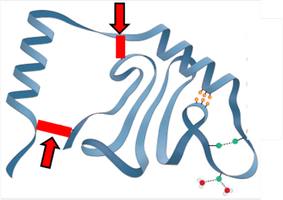
Q2. What types of bonds could the red lines represent?
Background
Topic: Types of Chemical Bonds in Biological Molecules
This question asks you to identify the types of bonds that could be represented in a protein structure diagram.
Key Terms and Formulas
Ionic bonds: Attraction between oppositely charged ions.
Hydrogen bonds: Weak bonds between a hydrogen atom and an electronegative atom.
Covalent bonds: Sharing of electrons between atoms.
Hydrophobic interactions: Nonpolar molecules clustering to avoid water.
Step-by-Step Guidance
Examine the diagram and note the red lines connecting parts of the protein.
Recall the types of interactions that stabilize protein structure: covalent bonds (like peptide bonds), hydrogen bonds (in secondary structure), ionic bonds (between charged side chains), and hydrophobic interactions (between nonpolar side chains).
Consider which bonds are most likely to be represented by lines in a protein diagram.
Try solving on your own before revealing the answer!
Final Answer: B) Hydrogen bonds and C) Covalent bonds
The red lines could represent hydrogen bonds (common in secondary structure) or covalent bonds (such as peptide bonds or disulfide bridges).
Q3. Which organelle produces most cellular ATP?
Background
Topic: Cell Structure and Function
This question tests your knowledge of organelles and their roles in energy production.
Key Terms and Formulas
ATP (adenosine triphosphate): The main energy currency of the cell.
Mitochondrion: Organelle responsible for cellular respiration and ATP production.
Step-by-Step Guidance
Recall which organelle is known as the "powerhouse" of the cell.
Think about the process of cellular respiration and where it occurs.
Review the functions of the nucleus, Golgi apparatus, lysosome, and mitochondrion.
Try solving on your own before revealing the answer!
Final Answer: (D) Mitochondrion
The mitochondrion is responsible for producing most of the cell's ATP through cellular respiration.
Q4. Assume a molecule can pass freely through the cell membrane. For this molecule to reach equilibrium with respect to its concentration on either side of the membrane, it would have to:
Background
Topic: Membrane Transport and Diffusion
This question tests your understanding of passive transport and equilibrium across membranes.
Key Terms and Formulas
Passive transport: Movement of molecules without energy input.
Diffusion: Movement from high to low concentration.
Equilibrium: Equal concentration on both sides.
Step-by-Step Guidance
Recall the definition of equilibrium in the context of membrane transport.
Think about the direction molecules move during diffusion.
Consider what happens when equilibrium is reached—do molecules stop moving?
Try solving on your own before revealing the answer!
Final Answer: B) Move from an area of higher concentration to an area of lower concentration
To reach equilibrium, molecules diffuse from high to low concentration until both sides are equal.
Q5. In a DNA double helix, hydrogen bonds would likely be present between:
Background
Topic: DNA Structure
This question tests your knowledge of the types of bonds present in DNA, specifically between nitrogenous bases.
Key Terms and Formulas
Hydrogen bond: Weak bond between a hydrogen atom and an electronegative atom.
Nitrogenous base: Adenine, thymine, cytosine, guanine.
DNA double helix: Two strands held together by hydrogen bonds between bases.
Step-by-Step Guidance
Recall the structure of DNA and the role of hydrogen bonds in base pairing.
Identify which atoms in the bases participate in hydrogen bonding.
Review the options and determine which describes hydrogen bonding between bases.
Try solving on your own before revealing the answer!
Final Answer: B) An H atom in one nitrogenous base and an O atom in another base
Hydrogen bonds form between nitrogenous bases, such as between adenine and thymine or cytosine and guanine.
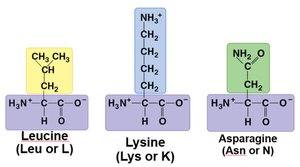
Q6. Which of the following amino acids is most likely to be found on the outside of a folded protein?
Background
Topic: Protein Structure and Amino Acid Properties
This question tests your understanding of amino acid side chains and their placement in protein structure.
Key Terms and Formulas
Polar side chain: Attracts water, likely found on protein exterior.
Non-polar side chain: Repels water, likely found in protein interior.
Charged side chain: Interacts with water, often on protein surface.
Step-by-Step Guidance
Review the properties of leucine, asparagine, and lysine side chains.
Recall that polar and charged amino acids are usually on the outside of proteins, interacting with water.
Examine the chemical structures to identify which amino acid is charged.
Try solving on your own before revealing the answer!
Final Answer: D) Lysine, because its charged side chain
Lysine has a positively charged side chain, making it likely to be found on the protein's exterior.
