 Back
BIOL189A Exam 3 Study Guide: Cell Cycle, Molecular Basis of Inheritance, Gene Expression, and Viruses
Study Guide - Smart Notes
 Tailored notes based on your materials, expanded with key definitions, examples, and context.
Cell Cycle and Mitosis
Genetic Identity in Mitosis
Mitosis is the process by which a eukaryotic cell divides to produce two genetically identical daughter cells. This is achieved through the precise duplication and segregation of chromosomes.
Chromosome: A structure composed of DNA and proteins that carries genetic information.
Chromatid: Each of the two identical halves of a duplicated chromosome.
Chromatin: The complex of DNA and proteins found in the nucleus, which condenses to form chromosomes during cell division.
Example: During mitosis, each daughter cell receives an identical set of chromosomes, ensuring genetic continuity.
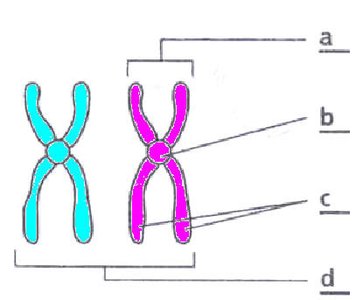
Phases of the Cell Cycle
The cell cycle consists of interphase (G1, S, G2) and the M phase (mitosis and cytokinesis).
Interphase: The cell grows (G1), replicates its DNA (S), and prepares for division (G2).
M Phase: Includes mitosis (division of the nucleus) and cytokinesis (division of the cytoplasm).
Checkpoints: G1, G2, and M checkpoints regulate progression and ensure fidelity.
Cell Cycle Regulation
Checkpoints are controlled by cyclins and cyclin-dependent kinases (CDKs), which ensure proper cell cycle progression.
G1 Checkpoint: Checks for cell size, nutrients, and DNA integrity.
G2 Checkpoint: Ensures DNA replication is complete and checks for DNA damage.
M Checkpoint: Ensures chromosomes are properly attached to the spindle before division.
Molecular Basis of Inheritance
DNA as Genetic Material
DNA is the hereditary material in cells, as demonstrated by experiments such as those by Hershey-Chase and Chargaff.
Structure: Double helix composed of nucleotides (adenine, thymine, cytosine, guanine).
Base-pairing rules: A pairs with T, C pairs with G.
DNA Replication
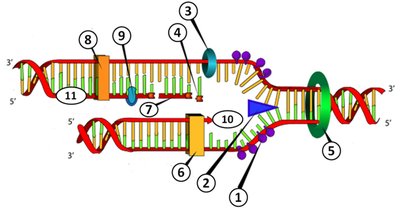
DNA replication is a semi-conservative process, as shown by the Meselson-Stahl experiment. Each new DNA molecule consists of one old and one new strand.
Key Enzymes: Helicase, DNA polymerase, primase, ligase, topoisomerase.
Leading and Lagging Strands: DNA is synthesized continuously on the leading strand and discontinuously (Okazaki fragments) on the lagging strand.
Chromatin Packing
Chromatin is organized at multiple levels, from nucleosomes to higher-order structures, allowing for efficient DNA packaging and regulation.
Euchromatin: Loosely packed, transcriptionally active.
Heterochromatin: Densely packed, transcriptionally inactive.
Gene Expression: From Genes to Proteins
Overview of Gene Expression
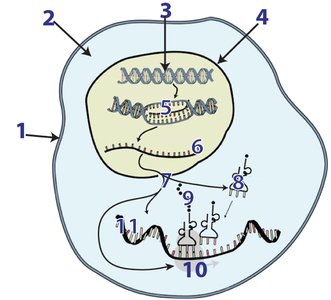
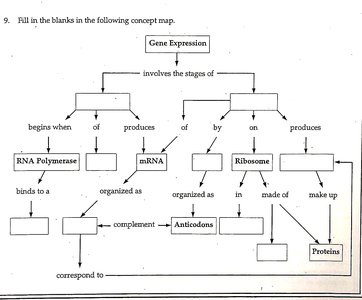
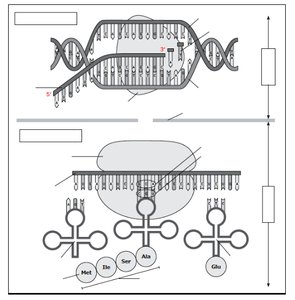
Gene expression involves transcription (DNA to RNA) and translation (RNA to protein), following the central dogma of biology.
Transcription: RNA polymerase synthesizes mRNA from a DNA template.
Translation: Ribosomes synthesize proteins using mRNA as a guide.
Transcription
Transcription is the process by which RNA is synthesized from a DNA template.
Key Molecules: RNA polymerase, promoter, terminator, transcription factors.
Steps: Initiation, elongation, termination.
RNA Processing in Eukaryotes
Pre-mRNA undergoes modifications before becoming mature mRNA.
5' Capping: Addition of a modified guanine nucleotide.
Poly-A Tail: Addition of adenine nucleotides at the 3' end.
Splicing: Removal of introns and joining of exons.
Translation
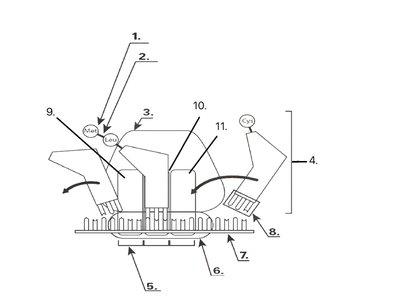
Translation is the process by which ribosomes synthesize proteins from mRNA.
Key Components: Ribosome, mRNA, tRNA, amino acids.
Steps: Initiation, elongation, termination.
Anticodon: Sequence on tRNA that pairs with mRNA codon.
Mutations and Their Effects
Mutations are changes in DNA sequence that can affect protein structure and function.
Point Mutation: Change in a single nucleotide.
Missense Mutation: Alters amino acid sequence.
Nonsense Mutation: Introduces a premature stop codon.
Frameshift Mutation: Insertion or deletion shifts reading frame.
Silent Mutation: No effect on protein sequence.
Viruses
Structure of Viruses
Viruses are composed of genetic material (DNA or RNA) surrounded by a protein coat (capsid), and sometimes a lipid envelope.
Bacteriophage: Virus that infects bacteria.
Prion: Infectious protein.
Viral Replication and Evolution
Viruses replicate by infecting host cells and using their machinery. They evolve rapidly due to high mutation rates.
Lytic Cycle: Virus replicates and lyses host cell.
Lysogenic Cycle: Viral DNA integrates into host genome.
Effects of Viruses on Hosts
Viruses can cause diseases in animals and plants, affecting health and agricultural productivity.
Example: Influenza virus in humans, tobacco mosaic virus in plants.
Key Vocabulary
Review the suggested vocabulary list for definitions and applications relevant to the exam topics.
Central Dogma of Biology: Information flows from DNA to RNA to protein.
DNA Polymerase: Enzyme that synthesizes DNA.
mRNA: Messenger RNA, carries genetic information from DNA to ribosome.
tRNA: Transfer RNA, brings amino acids to ribosome.
Ribosome: Site of protein synthesis.
Important Diagrams to Practice Labeling
Sister chromatids vs. Homologous chromosomes
DNA & RNA structure
DNA replication
Gene expression overview
Transcription
Translation
Equations and Formulas
Base Pairing: ,
Central Dogma:
Semiconservative Replication:
Additional info: Academic context was added to expand brief points and clarify diagrams for exam preparation.
