Back
BackBIOL211 Chapter 7 – Membrane Transport and Osmosis Study Guidance
Study Guide - Smart Notes
 Tailored notes based on your materials, expanded with key definitions, examples, and context.
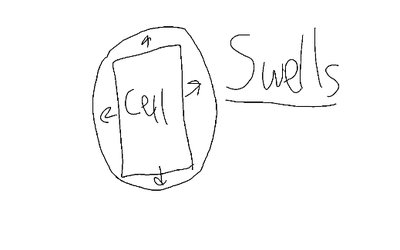
Q1. In a given animal blood cell, the solute concentration within the cell is higher than the solute concentration outside the cell. Which of the following images best represents what would happen to the cell? ARROWS REPRESENT THE MOVEMENT
Background
Topic: Osmosis and Cell Membrane Transport
This question tests your understanding of how water moves across cell membranes in response to solute concentration differences (osmotic gradients). It specifically focuses on animal cells and the effects of different external environments.
Key Terms and Concepts:
Osmosis: The movement of water across a semipermeable membrane from an area of lower solute concentration to higher solute concentration.
Hypertonic: Higher solute concentration outside the cell; water moves out, cell shrinks.
Hypotonic: Lower solute concentration outside the cell; water moves in, cell swells.
Isotonic: Equal solute concentration; no net movement of water.
Step-by-Step Guidance
First, identify the relative solute concentrations: the cell has a higher solute concentration than its surroundings.
Recall that water moves toward areas of higher solute concentration (osmosis).
Determine the direction of water movement: since the cell is hypertonic relative to its environment, water will move into the cell.
Predict the effect on the cell: as water enters, the cell will swell and may eventually burst if too much water enters.
Try solving on your own before revealing the answer!
Final Answer: Image A
Image A shows arrows pointing inward, representing water moving into the cell, causing it to swell. This matches the expected outcome for an animal cell in a hypotonic environment.
Q2. In a plant cell, a lower solute concentration is present in the solution that surrounds the cell than within the plant cell. What term best describes this cell state in plant cells, and what would you expect to happen?
Background
Topic: Osmosis in Plant Cells
This question tests your understanding of osmotic states in plant cells and the terminology used to describe them, as well as the physiological consequences.
Key Terms:
Turgid: The preferred state for plant cells, where water enters the cell and the cell becomes swollen, but the cell wall prevents bursting.
Hypotonic Solution: The external solution has a lower solute concentration than the cell interior.
Cell Wall: Provides structural support and prevents bursting.
Step-by-Step Guidance
Identify the solute concentration: lower outside, higher inside the plant cell.
Recall that water moves into the cell in this scenario (osmosis).
Understand that plant cells become turgid (swollen) when water enters, but the cell wall prevents bursting.
Match the terminology: "turgid" is the term for this state in plant cells.
Try solving on your own before revealing the answer!
Final Answer: C) Turgid; you would expect the cell to expand
Plant cells in a hypotonic environment become turgid, which is their preferred state. The cell wall prevents them from bursting.
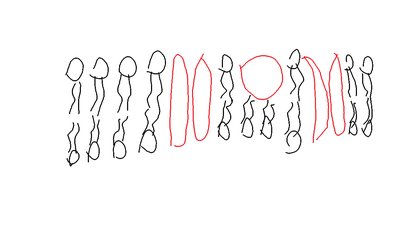
Q4. Which of the following images properly labels the “fluid” and “mosaic” in the fluid-mosaic model? RED SHAPES ARE PROTEINS. YELLOW=FLUID; LAVENDAR/GRAY=MOSAIC
Background
Topic: Fluid-Mosaic Model of the Plasma Membrane
This question tests your understanding of the structural organization of the plasma membrane, specifically the arrangement of proteins and lipids.
Key Terms:
Fluid-Mosaic Model: Describes the plasma membrane as a flexible layer made of lipids (fluid) and proteins (mosaic).
Proteins: Embedded or associated with the membrane, shown as red shapes.
Lipids: The yellow background represents the fluid lipid bilayer.
Step-by-Step Guidance
Identify the components: red shapes are proteins, yellow is fluid, lavender/gray is mosaic.
Recall that the fluid-mosaic model consists of a lipid bilayer (fluid) with proteins scattered throughout (mosaic).
Look for the image that shows proteins embedded in a fluid background, with mosaic labeling.
Match the image to the description: the correct image will have red proteins distributed within the yellow fluid, with lavender/gray indicating the mosaic aspect.
Try solving on your own before revealing the answer!
Final Answer: Image C
Image C correctly shows the fluid (yellow) and mosaic (lavender/gray) components, with proteins (red) embedded in the membrane.
Q20. What are the inputs and outputs of the Na-K pump?
Background
Topic: Sodium-Potassium Pump (Na-K Pump)
This question tests your understanding of active transport mechanisms in animal cells, specifically the Na-K pump, which maintains cellular ion gradients.
Key Terms and Formula:
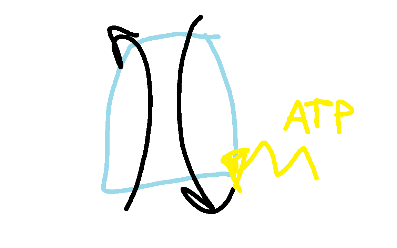
Na-K Pump: An active transport protein that moves sodium (Na+) and potassium (K+) ions across the plasma membrane using ATP.
Active Transport: Requires energy (ATP) to move ions against their concentration gradients.
Inputs/Outputs: The pump typically moves 3 Na+ out of the cell and 2 K+ into the cell per cycle.
Step-by-Step Guidance
Recall the function of the Na-K pump: it maintains high K+ inside and high Na+ outside the cell.
Remember that the pump uses ATP to move ions against their gradients.
Identify the typical movement: 3 Na+ ions are transported out of the cell, while 2 K+ ions are transported into the cell.
Match the answer choices to this movement pattern.
Try solving on your own before revealing the answer!
Final Answer: B) 3 Na+ out, 2 K+ in
The Na-K pump moves 3 sodium ions out of the cell and 2 potassium ions into the cell, using ATP for energy.