 Back
Biological Macromolecules Identification and Properties Study Guide
Study Guide - Smart Notes
 Tailored notes based on your materials, expanded with key definitions, examples, and context.
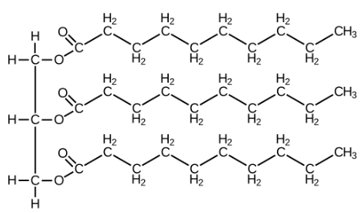
Q1. Structural Formula #1: Identify the macromolecule and answer related questions.
Background
Topic: Lipids (Triglycerides)
This question tests your ability to recognize the structure of a lipid, specifically a triglyceride, and understand its monomers, function, and the type of bonds formed during synthesis.
Key Terms and Formulas:
Triglyceride: A lipid formed from one glycerol and three fatty acids.
Dehydration reaction: A chemical reaction that joins monomers by removing water.
Ester bond: The bond formed between glycerol and fatty acids in triglycerides.
Functional groups: Carboxyl (-COOH) in fatty acids.
Step-by-Step Guidance
Examine the structure: Notice the three long hydrocarbon chains attached to a glycerol backbone.
Identify the repeating monomer: Look for the fatty acid chains and the glycerol molecule.
Consider the primary function: Think about the role of triglycerides in energy storage and insulation.
Identify the bond formed: Recall the dehydration reaction between glycerol and fatty acids, forming ester bonds.
Circle or highlight the carboxyl groups present in the fatty acid chains.
Try solving on your own before revealing the answer!
Final Answer:
This is a lipid (triglyceride). The repeating monomers are fatty acids and glycerol. The primary function is energy storage. The bonds formed by dehydration are ester bonds.
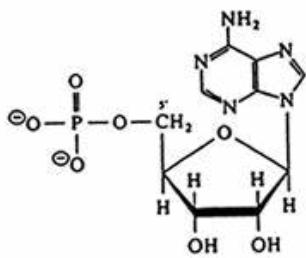
Q2. Structural Formula #2: Identify the macromolecule and answer related questions.
Background
Topic: Nucleic Acids (Nucleotide structure)
This question tests your ability to recognize a nucleotide, the monomer of nucleic acids, and understand its function and the bonds formed during polymerization.
Key Terms and Formulas:
Nucleotide: Composed of a phosphate group, a pentose sugar, and a nitrogenous base.
Phosphodiester bond: The bond formed between nucleotides in nucleic acids.
Functional groups: Phosphate (-PO₄), amino (-NH₂), hydroxyl (-OH).
Step-by-Step Guidance
Examine the structure: Identify the phosphate group, pentose sugar, and nitrogenous base.
Determine the repeating monomer: Recognize that nucleotides are the building blocks of nucleic acids.
Consider the primary function: Think about the role of nucleic acids in genetic information storage and transmission.
Identify the bond formed: Recall the dehydration reaction forming phosphodiester bonds between nucleotides.
Circle or highlight the phosphate, amino, and hydroxyl groups present.
Try solving on your own before revealing the answer!
Final Answer:
This is a nucleic acid (nucleotide). The repeating monomer is the nucleotide. The primary function is storage and transmission of genetic information. The bonds formed by dehydration are phosphodiester bonds.
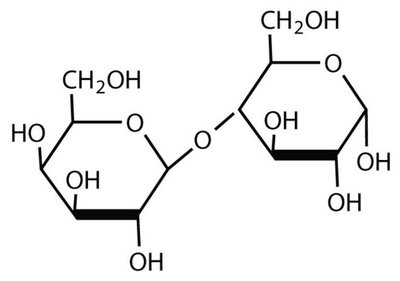
Q3. Structural Formula #3: Identify the macromolecule and answer related questions.
Background
Topic: Carbohydrates (Disaccharide structure)
This question tests your ability to recognize a carbohydrate, specifically a disaccharide, and understand its monomers, function, and the type of bonds formed during synthesis.
Key Terms and Formulas:
Monosaccharide: The monomer of carbohydrates (e.g., glucose).
Glycosidic bond: The bond formed between monosaccharides in disaccharides and polysaccharides.
Functional groups: Hydroxyl (-OH).
Step-by-Step Guidance
Examine the structure: Notice the two ring structures connected by an oxygen atom.
Identify the repeating monomer: Look for monosaccharide units (such as glucose).
Consider the primary function: Think about the role of carbohydrates in energy storage and structural support.
Identify the bond formed: Recall the dehydration reaction forming glycosidic bonds between monosaccharides.
Circle or highlight the hydroxyl groups present.
Try solving on your own before revealing the answer!
Final Answer:
This is a carbohydrate (disaccharide). The repeating monomer is the monosaccharide. The primary function is energy storage. The bonds formed by dehydration are glycosidic bonds.
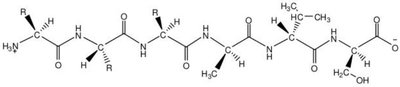
Q4. Structural Formula #4: Identify the macromolecule and answer related questions.
Background
Topic: Proteins (Polypeptide structure)
This question tests your ability to recognize a protein, specifically a polypeptide, and understand its monomers, function, and the type of bonds formed during synthesis.
Key Terms and Formulas:
Amino acid: The monomer of proteins.
Peptide bond: The bond formed between amino acids in proteins.
Functional groups: Amino (-NH₂), carboxyl (-COOH), R-group.
Step-by-Step Guidance
Examine the structure: Notice the repeating units with amino, carboxyl, and R-groups.
Identify the repeating monomer: Look for amino acid units.
Consider the primary function: Think about the role of proteins in catalysis, structure, and regulation.
Identify the bond formed: Recall the dehydration reaction forming peptide bonds between amino acids.
Circle or highlight the amino, carboxyl, and R-groups present.
Try solving on your own before revealing the answer!
Final Answer:
This is a protein (polypeptide). The repeating monomer is the amino acid. The primary function is catalysis, structure, and regulation. The bonds formed by dehydration are peptide bonds.
Q5. Match the functional group to its correct macromolecule.
Background
Topic: Functional Groups in Biological Macromolecules
This question tests your understanding of which functional groups are characteristic of each macromolecule type.
Key Terms:
Carboxyl (-COOH): Found in amino acids and fatty acids.
Amino (-NH₂): Found in amino acids.
Phosphate (-PO₄): Found in nucleic acids and phospholipids.
Hydroxyl (-OH): Found in carbohydrates.
Step-by-Step Guidance
Recall which macromolecule each functional group is commonly associated with.
Match carboxyl to amino acids and fatty acids, amino to amino acids, phosphate to nucleic acids and phospholipids, hydroxyl to carbohydrates.
Write the correct macromolecule next to each functional group.
Try solving on your own before revealing the answer!
Final Answer:
1. Carboxyl (-COOH) → Protein/Lipid 2. Amino (-NH₂) → Protein 3. Phosphate (-PO₄) → Nucleic Acid 4. Hydroxyl (-OH) → Carbohydrate
Q6. Why are lipids hydrophobic while carbohydrates are hydrophilic?
Background
Topic: Properties of Macromolecules
This question tests your understanding of the chemical properties that make lipids insoluble in water and carbohydrates soluble.
Key Terms:
Hydrophobic: Repels water; nonpolar.
Hydrophilic: Attracts water; polar.
Functional groups: Hydrocarbon chains (lipids), hydroxyl groups (carbohydrates).
Step-by-Step Guidance
Consider the structure of lipids: Long nonpolar hydrocarbon chains.
Consider the structure of carbohydrates: Multiple polar hydroxyl groups.
Think about how polarity affects solubility in water.
Explain why nonpolar molecules are hydrophobic and polar molecules are hydrophilic.
Try solving on your own before revealing the answer!
Final Answer:
Lipids are hydrophobic because their long hydrocarbon chains are nonpolar and do not interact with water. Carbohydrates are hydrophilic because their polar hydroxyl groups form hydrogen bonds with water, making them soluble.
Q7. What is the difference between a saturated and unsaturated fatty acid?
Background
Topic: Lipid Structure
This question tests your understanding of the structural differences between saturated and unsaturated fatty acids and their impact on physical properties.
Key Terms:
Saturated fatty acid: No double bonds; straight chain.
Unsaturated fatty acid: One or more double bonds; bent chain.
Step-by-Step Guidance
Recall the definition of saturated and unsaturated fatty acids.
Identify the presence or absence of double bonds in the hydrocarbon chain.
Consider how double bonds affect the shape and packing of fatty acids.
Think about the physical properties (solid vs. liquid at room temperature).
Try solving on your own before revealing the answer!
Final Answer:
Saturated fatty acids have no double bonds and are straight, allowing tight packing and making them solid at room temperature. Unsaturated fatty acids have one or more double bonds, causing bends that prevent tight packing, making them liquid at room temperature.
Q8. How does the sequence of amino acids in a protein determine its function?
Background
Topic: Protein Structure and Function
This question tests your understanding of how the primary structure of a protein affects its three-dimensional shape and function.
Key Terms:
Primary structure: Sequence of amino acids.
Secondary, tertiary, quaternary structure: Higher levels of protein folding.
Function: Enzyme activity, structural support, signaling.
Step-by-Step Guidance
Recall that the sequence of amino acids is the primary structure of a protein.
Understand how this sequence determines the way the protein folds.
Consider how folding creates the active site or functional regions of the protein.
Think about how changes in sequence can alter protein function.
Try solving on your own before revealing the answer!
Final Answer:
The sequence of amino acids determines how the protein folds into its three-dimensional shape, which is critical for its function. Changes in the sequence can alter the protein's structure and therefore its activity.
Q9. What roles do DNA and RNA play in the storage and transmission of genetic information?
Background
Topic: Nucleic Acids
This question tests your understanding of the distinct functions of DNA and RNA in cells.
Key Terms:
DNA: Deoxyribonucleic acid; stores genetic information.
RNA: Ribonucleic acid; transmits genetic information for protein synthesis.
Step-by-Step Guidance
Recall the structure and function of DNA in storing genetic information.
Recall the role of RNA in transmitting information from DNA to ribosomes.
Consider the processes of transcription and translation.
Think about how these molecules interact in the central dogma of molecular biology.
Try solving on your own before revealing the answer!
Final Answer:
DNA stores genetic information in the cell, while RNA transmits this information to the ribosome for protein synthesis. DNA is the blueprint; RNA is the messenger and translator.
Q10. A scientist isolates a molecule containing C, H, and O in a 1:2:1 ratio. What type of macromolecule is this likely to be?
Background
Topic: Carbohydrate Identification
This question tests your ability to recognize the characteristic elemental ratio of carbohydrates.
Key Terms:
Carbohydrate: Contains carbon, hydrogen, and oxygen in a 1:2:1 ratio.
Step-by-Step Guidance
Recall the general formula for carbohydrates: .
Compare the elemental ratio to other macromolecules.
Identify the macromolecule based on the ratio.
Try solving on your own before revealing the answer!
Final Answer:
The molecule is most likely a carbohydrate, as it contains C, H, and O in a 1:2:1 ratio.
Q11. A student tests an unknown sample and finds it contains nitrogen and an amino group (-NH₂). What macromolecule is most likely present?
Background
Topic: Protein Identification
This question tests your ability to identify proteins based on the presence of nitrogen and amino groups.
Key Terms:
Amino group (-NH₂): Characteristic of amino acids and proteins.
Nitrogen: Found in proteins and nucleic acids.
Step-by-Step Guidance
Recall which macromolecules contain nitrogen and amino groups.
Consider the structure of amino acids and proteins.
Compare to nucleic acids, which also contain nitrogen but not amino groups in the same way.
Try solving on your own before revealing the answer!
Final Answer:
The macromolecule is most likely a protein, as it contains nitrogen and an amino group (-NH₂).
Q12. A cell membrane contains molecules with long hydrocarbon chains and a phosphate group. What type of macromolecule is it composed of?
Background
Topic: Lipid Identification (Phospholipids)
This question tests your ability to recognize phospholipids based on their structural features.
Key Terms:
Phospholipid: Contains long hydrocarbon chains and a phosphate group.
Cell membrane: Composed primarily of phospholipids.
Step-by-Step Guidance
Recall the structure of phospholipids: two fatty acid tails and a phosphate-containing head.
Consider the role of phospholipids in forming the cell membrane.
Compare to other macromolecules that do not have both hydrocarbon chains and phosphate groups.
Try solving on your own before revealing the answer!
Final Answer:
The cell membrane is composed of phospholipids, which have long hydrocarbon chains and a phosphate group.
Q13. Drawing Practice: Draw a simple structural formula for a monosaccharide (simple sugar).
Background
Topic: Carbohydrate Structure
This question tests your ability to draw and label the basic structure of a monosaccharide.
Key Terms:
Monosaccharide: Simple sugar, e.g., glucose.
Functional groups: Hydroxyl (-OH).
Step-by-Step Guidance
Recall the ring structure of glucose or another monosaccharide.
Draw the ring and label the hydroxyl groups.
Label the carbon atoms and any other relevant features.
Try solving on your own before revealing the answer!
Final Answer:
A monosaccharide like glucose has a ring structure with hydroxyl groups attached to each carbon. (See textbook for example diagram.)
Q14. Drawing Practice: Draw a simple structural formula for a fatty acid (showing a saturated or unsaturated bond).
Background
Topic: Lipid Structure
This question tests your ability to draw and label the basic structure of a fatty acid, including the carboxyl group and hydrocarbon chain.
Key Terms:
Fatty acid: Long hydrocarbon chain with a carboxyl group.
Saturated: No double bonds.
Unsaturated: One or more double bonds.
Step-by-Step Guidance
Draw a long hydrocarbon chain with a carboxyl group at one end.
For unsaturated, add a double bond in the chain.
Label the carboxyl group and any double bonds.
Try solving on your own before revealing the answer!
Final Answer:
A fatty acid has a carboxyl group at one end and a hydrocarbon chain. Unsaturated fatty acids have at least one double bond in the chain. (See textbook for example diagram.)
Q15. Drawing Practice: Draw a simple structural formula for an amino acid, labeling the amino group (-NH₂), carboxyl group (-COOH), and R-group.
Background
Topic: Protein Structure
This question tests your ability to draw and label the basic structure of an amino acid.
Key Terms:
Amino acid: Contains amino group, carboxyl group, and R-group.
Step-by-Step Guidance
Draw a central carbon atom.
Attach an amino group (-NH₂), a carboxyl group (-COOH), a hydrogen atom, and an R-group to the central carbon.
Label each group clearly.
Try solving on your own before revealing the answer!
Final Answer:
An amino acid has a central carbon with an amino group, carboxyl group, hydrogen, and R-group attached. (See textbook for example diagram.)
Q16. Drawing Practice: Draw a simple structural formula for a nucleotide, labeling the phosphate, sugar, and nitrogenous base.
Background
Topic: Nucleic Acid Structure
This question tests your ability to draw and label the basic structure of a nucleotide.
Key Terms:
Nucleotide: Contains phosphate group, pentose sugar, and nitrogenous base.
Step-by-Step Guidance
Draw a pentose sugar (ring structure).
Attach a phosphate group to one carbon of the sugar.
Attach a nitrogenous base to another carbon of the sugar.
Label each component clearly.
Try solving on your own before revealing the answer!
Final Answer:
A nucleotide has a phosphate group, pentose sugar, and nitrogenous base. (See textbook for example diagram.)
