 Back
Biological Macromolecules III: Proteins – Structure and Function
Study Guide - Smart Notes
 Tailored notes based on your materials, expanded with key definitions, examples, and context.
Biological Macromolecules: Proteins
Overview of Biological Macromolecules
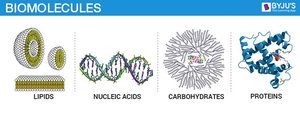
Living organisms are composed of four major classes of biological macromolecules: lipids, nucleic acids, carbohydrates, and proteins. Each class plays a unique and essential role in cellular structure and function. Proteins, in particular, are the most functionally diverse macromolecules, responsible for a wide range of cellular activities.
Proteins: The Workhorses of the Cell
General Functions of Proteins
Proteins are the primary worker molecules in cells, carrying out most of the essential biological functions. Their diversity in shape and structure enables them to perform a vast array of tasks, including catalysis, transport, defense, signaling, movement, and structural support.
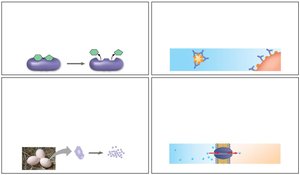
Enzymatic proteins: Catalyze (speed up) specific chemical reactions. Example: Digestive enzymes hydrolyze food molecules.
Storage proteins: Store amino acids for later use. Example: Ovalbumin in egg white provides amino acids for embryos.
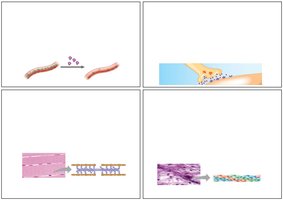
Defensive proteins: Protect against pathogens. Example: Antibodies neutralize viruses and bacteria.
Transport proteins: Move substances within or between cells. Example: Hemoglobin transports oxygen in blood.
Hormonal proteins: Coordinate cellular activities. Example: Insulin regulates blood glucose levels.
Receptor proteins: Detect chemical signals and trigger cellular responses. Example: Nerve cell receptors detect neurotransmitters.
Contractile and motor proteins: Enable movement. Example: Actin and myosin facilitate muscle contraction.
Structural proteins: Provide support and strength. Example: Collagen in connective tissue, keratin in hair and skin.
Proteins Determine Cell Structure and Function
Protein Diversity in Cells
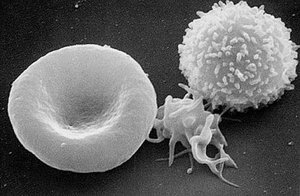
The specific proteins produced by a cell largely determine its structure (shape) and function (role). Different cell types express different sets of genes, resulting in the production of distinct proteins. For example, red blood cells and white blood cells have different forms and functions because they synthesize different proteins.
Protein Structure: From Amino Acids to Functional Molecules
Proteins as Polymers of Amino Acids
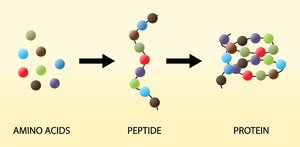
All proteins are polymers constructed from the same set of 20 amino acid monomers. These amino acids are linked by covalent peptide bonds to form unbranched chains called polypeptides. A functional protein consists of one or more polypeptides folded into a specific three-dimensional shape.
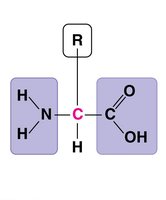
Structure of an Amino Acid
Each amino acid has a central (α) carbon atom bonded to four groups: an amino group, a carboxyl group, a hydrogen atom, and a variable side chain (R group). The R group determines the unique properties of each amino acid.
Classification of Amino Acids by R Groups
Amino acids differ in their R groups, which can be nonpolar (hydrophobic), polar (hydrophilic), or charged (acidic or basic, hydrophilic). These chemical properties influence protein folding and function.
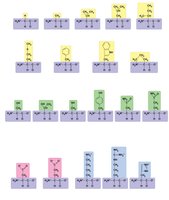
Key Point: You do not need to memorize individual amino acids, but you should recognize that R groups confer different chemical properties.
Formation of Peptide Bonds
Amino acids are joined by dehydration reactions, forming peptide bonds between the carboxyl group of one amino acid and the amino group of another. This process releases water. Polypeptides have a specific sequence, with an amino (N-) terminus and a carboxyl (C-) terminus.
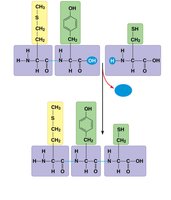
Levels of Protein Structure
Primary Structure
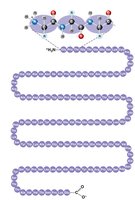
The primary structure of a protein is its unique sequence of amino acids. This sequence is determined by the genetic code in DNA. Even a single change (mutation) in the sequence can alter protein structure and function.
Secondary Structure
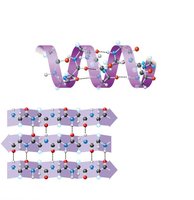
The secondary structure refers to local folding patterns in the polypeptide backbone, stabilized by hydrogen bonds. The two most common types are the α helix (a spiral) and the β pleated sheet (a folded sheet).
Tertiary Structure
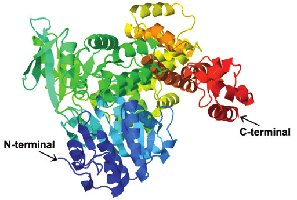
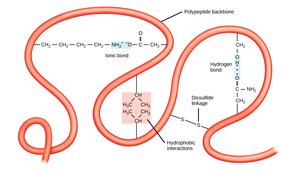
The tertiary structure is the overall three-dimensional shape of a polypeptide, determined by interactions among R groups, including hydrogen bonds, ionic bonds, hydrophobic interactions, van der Waals forces, and sometimes covalent disulfide bonds. The folding of the polypeptide creates a unique shape essential for function.
Quaternary Structure
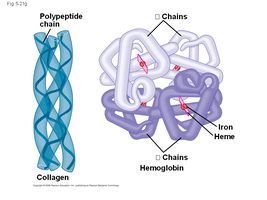
Some proteins consist of multiple polypeptide chains (subunits) that assemble into a functional complex. The quaternary structure describes the arrangement and interactions of these subunits. Examples include collagen (three polypeptides in a rope-like structure) and hemoglobin (four subunits: two alpha and two beta chains).
Protein Denaturation
Effects of Physical and Chemical Conditions
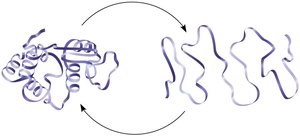
Protein structure is sensitive to environmental conditions. Changes in temperature, pH, or chemical exposure can disrupt the interactions that maintain a protein's shape, leading to denaturation. Denatured proteins lose their functional three-dimensional structure, but the primary sequence often remains unchanged. Sometimes, normal conditions can restore function if the protein refolds correctly.
Summary Table: Levels of Protein Structure
Level | Description | Stabilizing Interactions |
|---|---|---|
Primary | Sequence of amino acids | Peptide bonds (covalent) |
Secondary | Local folding (α helix, β sheet) | Hydrogen bonds (backbone) |
Tertiary | Overall 3D shape of polypeptide | R group interactions (hydrogen bonds, ionic bonds, hydrophobic interactions, van der Waals, disulfide bonds) |
Quaternary | Assembly of multiple polypeptides | Non-covalent interactions (hydrogen bonds, ionic, hydrophobic, van der Waals) |
Key Concepts and Applications
Proteins are polymers of amino acids with diverse functions determined by their structure.
R groups give amino acids their unique properties, influencing protein folding and function.
Protein structure is organized into four levels, each contributing to the final shape and function.
Denaturation disrupts protein structure and function but may be reversible if the primary sequence is intact.
