 Back
Biological Macromolecules III: Proteins – Structure, Function, and Diversity
Study Guide - Smart Notes
 Tailored notes based on your materials, expanded with key definitions, examples, and context.
Proteins: The Worker Molecules of Life
Overview of Biological Macromolecules
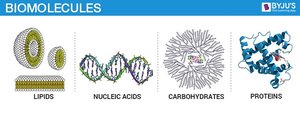
Living organisms are composed of four major classes of biological macromolecules: lipids, nucleic acids, carbohydrates, and proteins. Each class plays a distinct role in cellular structure and function, with proteins being the most versatile and functionally diverse.
Protein Functions in Cells
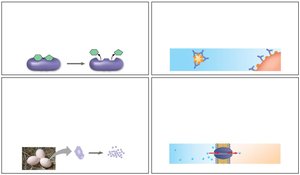
Proteins carry out most tasks in a cell, acting as the primary worker molecules. Their diverse shapes and structures allow them to perform a wide range of essential functions:
Enzymatic proteins: Catalyze specific chemical reactions, such as digestive enzymes breaking down food molecules.
Storage proteins: Store amino acids for later use (e.g., ovalbumin in egg white).
Defensive proteins: Protect against pathogens (e.g., antibodies neutralizing viruses and bacteria).
Transport proteins: Move substances within or between cells (e.g., hemoglobin transports oxygen).
Hormonal proteins: Coordinate activities of cells and tissues (e.g., insulin regulates blood glucose).
Receptor proteins: Detect chemical signals and trigger cellular responses.
Contractile and motor proteins: Produce or control movement (e.g., actin and myosin in muscle contraction).
Structural proteins: Provide support and strength (e.g., keratin in hair, collagen in connective tissue).
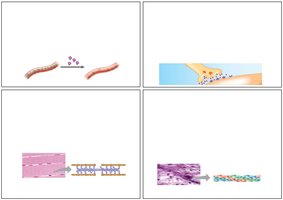
Proteins Determine Cell Structure and Function
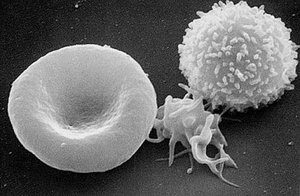
The specific proteins produced by a cell largely determine its structure (shape) and function (activity). Different cell types express different genes, resulting in the production of distinct proteins.
Protein Structure: From Amino Acids to Functional Molecules
Proteins as Polymers of Amino Acids
All proteins are constructed from the same set of monomer units called amino acids. These monomers are linked by covalent bonds to form unbranched polymers known as polypeptides. A protein is a biologically functional molecule consisting of one or more polypeptides folded into a specific three-dimensional shape.
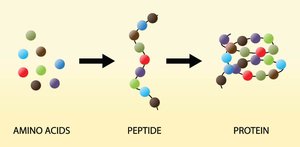
Structure of Amino Acid Monomers
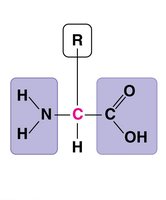
Amino acids are organic molecules with a central (α) carbon atom bonded to an amino group, a carboxyl group, a hydrogen atom, and a side chain (R group). The R group varies among amino acids, giving each its unique chemical properties. There are 20 common amino acids used to construct proteins.
Classification of Amino Acids by R Groups
The chemical properties of the R groups determine the characteristics of each amino acid:
Nonpolar R groups: Hydrophobic (e.g., glycine, alanine, valine)
Polar R groups: Hydrophilic and can form hydrogen bonds (e.g., serine, threonine)
Charged R groups: Hydrophilic; can be acidic (negatively charged) or basic (positively charged)
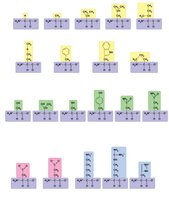
Additional info: Students should recognize the diversity of R groups and their impact on protein structure and function, but memorization of individual amino acids is not required.
Formation of Peptide Bonds
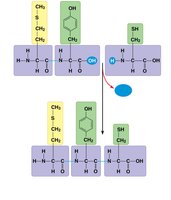
Amino acids are joined by peptide bonds through dehydration reactions between the carboxyl group of one amino acid and the amino group of another. This process forms a polypeptide with a specific linear sequence, featuring an amino end (N-terminus) and a carboxyl end (C-terminus).
Levels of Protein Structure
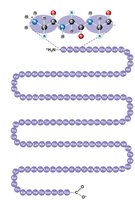
Primary Structure
The primary structure of a protein is its unique sequence of amino acids, determined by the order of nucleotides in a gene. Changes (mutations) in the gene sequence can alter protein structure and function.
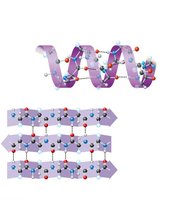
Secondary Structure
Secondary structure refers to local folding patterns in the polypeptide backbone, stabilized by hydrogen bonds. The two most common types are:
α helix: The backbone coils into a spiral.
β pleated sheet: The backbone folds into a sheet.
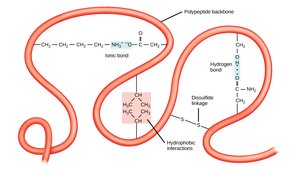
Tertiary Structure
Tertiary structure is the overall three-dimensional shape of a polypeptide, determined by interactions among R groups, including hydrogen bonds, ionic attractions, hydrophobic interactions, van der Waals forces, and disulfide bonds. The folding is influenced by the chemical properties of the R groups and their interactions with water.
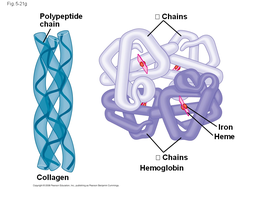
Quaternary Structure
Quaternary structure arises when a protein consists of multiple polypeptide chains (subunits) assembled into a single functional unit. Subunits are held together by non-covalent interactions. Not all proteins have quaternary structure; it is only present in proteins with more than one polypeptide chain.
Protein Denaturation and Function
Denaturation of Proteins
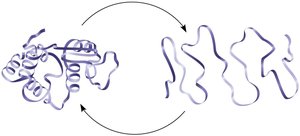
Physical and chemical conditions such as temperature, pH, and salt concentration can disrupt the molecular interactions that maintain a protein's functional shape. Denaturation is the loss of normal structure and function, typically affecting secondary, tertiary, and quaternary structure but not the primary sequence. Denaturation may be reversible if conditions return to normal.
Summary Table: Levels of Protein Structure
Level | Description | Key Interactions |
|---|---|---|
Primary | Sequence of amino acids | Peptide bonds |
Secondary | Local folding (α helix, β sheet) | Hydrogen bonds (backbone) |
Tertiary | 3-D shape of polypeptide | R group interactions: hydrogen bonds, ionic, hydrophobic, van der Waals, disulfide bonds |
Quaternary | Assembly of multiple polypeptides | Non-covalent interactions |
Key Concepts and Questions for Review
What feature of amino acids gives them their different chemical properties? (Answer: The R group)
What accounts for the diversity of protein functions? (Answer: The variety of amino acid sequences and resulting structures)
Describe the four levels of protein structure and the molecular interactions involved.
What happens to a protein exposed to high temperature? Does its primary structure change?
Additional info: Understanding protein structure is fundamental to grasping how proteins function in biological systems and how changes in structure can lead to disease or altered cellular activity.
