 Back
Biological Macromolecules: Properties, Structures, and Functions
Study Guide - Smart Notes
 Tailored notes based on your materials, expanded with key definitions, examples, and context.
Biological Macromolecules
Introduction to Macromolecules
Biological macromolecules are large, complex molecules essential for life. They are primarily composed of carbon, hydrogen, oxygen, nitrogen, phosphorus, and sulfur. The four major classes of macromolecules are carbohydrates, proteins, nucleic acids, and lipids. Each class has unique structures and functions that are critical for cellular processes.
Carbohydrates: Energy storage and structural support
Proteins: Catalysis, structure, transport, signaling, and defense
Nucleic Acids: Storage and transmission of genetic information
Lipids: Energy storage, membrane structure, and signaling
Note: Nitrogen is essential for proteins and nucleic acids; phosphorus is important for nucleic acids and some lipids.
Formation and Breakdown of Macromolecules
Polymers and Monomers
Most macromolecules (except lipids) are polymers, which are long chains of repeating units called monomers. The diversity of biological molecules arises from the variety of monomers and the ways they are assembled.
Polymer: A large molecule made of covalently bonded monomers.
Monomer: The basic repeating unit that forms polymers.
Dehydration Synthesis and Hydrolysis
Macromolecules are assembled and disassembled by two key reactions:
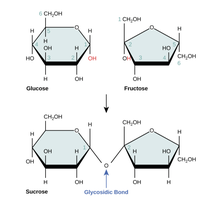
Dehydration Reaction (Synthesis): Joins two monomers by removing a water molecule. Example: Formation of sucrose from glucose and fructose.
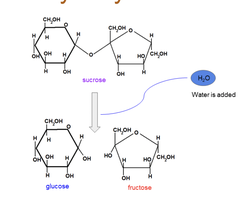
Hydrolysis: Breaks a polymer into monomers by adding water. Example: Breakdown of sucrose into glucose and fructose.
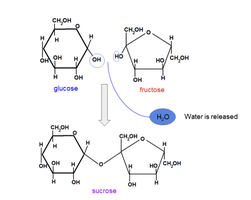
Equation for Dehydration:
Equation for Hydrolysis:
Example: To completely hydrolyze a polymer of 300 glucose monomers (amylose starch), 299 water molecules are required.
Carbohydrates
Monosaccharides
Monosaccharides are the simplest carbohydrates, serving as energy sources and building blocks for more complex sugars. They have the general formula .
Glucose is the most common monosaccharide.
Contain a carbonyl group and multiple hydroxyl groups.
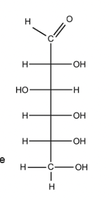
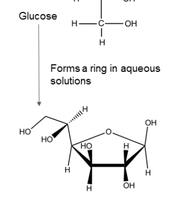
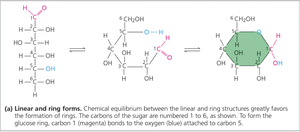
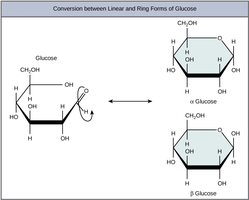
Example: A monosaccharide with 4 carbons is threose ().
Disaccharides
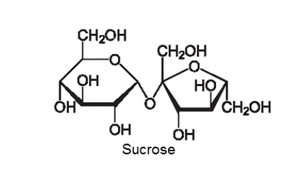
Disaccharides are formed by joining two monosaccharides via a dehydration reaction, creating a covalent glycosidic bond. The most common disaccharide is sucrose (glucose + fructose).
Polysaccharides
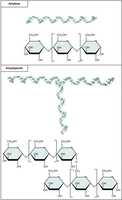
Polysaccharides are long chains of monosaccharides linked by glycosidic bonds. They serve as storage or structural molecules.
Storage Polysaccharides:
Starch: Storage form in plants (amylose and amylopectin).
Glycogen: Storage form in animals (liver and muscle cells).
Structural Polysaccharides:
Cellulose: Main component of plant cell walls.
Chitin: Forms exoskeletons of arthropods.
Lipids
Overview of Lipids
Lipids are hydrophobic molecules that do not form true polymers. They are diverse in structure and function, including fats, phospholipids, and steroids.
Composed mainly of C, H, and O (P in phospholipids).
Functions: energy storage, membrane structure, signaling.
Fats (Triglycerides)
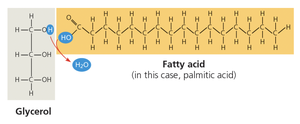
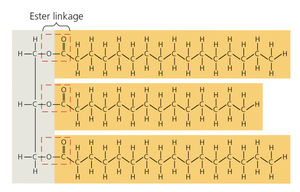
Fats are composed of one glycerol and three fatty acids, joined by ester linkages through dehydration reactions.
Glycerol: A three-carbon alcohol with hydroxyl groups.
Fatty acids: Long hydrocarbon chains with a carboxyl group.
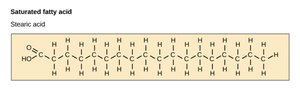
Saturated vs. Unsaturated Fatty Acids
Saturated fatty acids: No double bonds; straight chains; solid at room temperature.
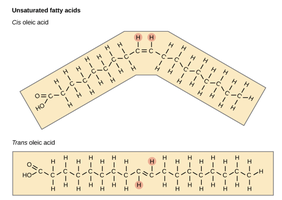
Unsaturated fatty acids: One or more double bonds; bent chains; liquid at room temperature.
Cis fats: Hydrogens on the same side of the double bond (bent).
Trans fats: Hydrogens on opposite sides (straighter).
Phospholipids
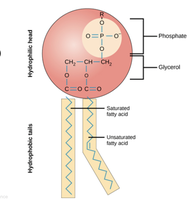
Phospholipids are major components of cell membranes. They consist of two fatty acids, a glycerol, and a phosphate group. In water, they form bilayers with hydrophobic tails and hydrophilic heads.
Steroids
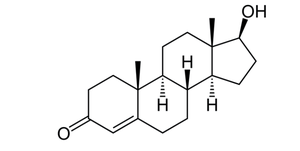
Steroids are lipids with four fused carbon rings. Different functional groups attached to the rings determine the type of steroid (e.g., cholesterol, testosterone).
Proteins
Structure and Function
Proteins are polymers of amino acids, folded into specific three-dimensional shapes that determine their function. They are involved in nearly every cellular process.
Monomer: Amino acid
Polymer: Polypeptide
Elements: C, H, O, N (sometimes S)


Amino Acids
Amino acids have a central carbon, an amino group, a carboxyl group, a hydrogen atom, and a variable side chain (R group). There are 20 different amino acids, classified by the properties of their side chains (nonpolar, polar, charged).
Side chains determine the chemical nature and function of the protein.
Peptide Bonds and Polypeptides
Peptide bonds form between the carboxyl group of one amino acid and the amino group of another via dehydration synthesis. Polypeptides have directionality: an N-terminus (amino end) and a C-terminus (carboxyl end).
The sequence of amino acids (primary structure) is determined by genes and dictates the protein's final shape and function.
Levels of Protein Structure
Primary structure: Linear sequence of amino acids.
Secondary structure: Coils and folds (α-helix, β-pleated sheet) due to hydrogen bonding.
Tertiary structure: 3D folding due to side chain interactions (hydrophobic interactions, disulfide bridges).
Quaternary structure: Association of multiple polypeptides (only in some proteins).
All levels contribute to the protein's function.
Functions of Proteins
Antibodies: Immune defense
Enzymes: Catalyze biochemical reactions
Messengers: Hormones and signaling molecules
Structural: Support and shape (e.g., collagen)
Transport/Storage: Move and store molecules (e.g., hemoglobin)
Nucleic Acids
Structure and Function
Nucleic acids store, transmit, and express hereditary information. The two main types are DNA (deoxyribonucleic acid) and RNA (ribonucleic acid).
Monomer: Nucleotide
Polymer: Polynucleotide (DNA or RNA)
Nucleotide Structure
Each nucleotide consists of three components:
Nitrogenous base: Purines (adenine, guanine) or pyrimidines (cytosine, thymine, uracil)
Five-carbon sugar: Deoxyribose (DNA) or ribose (RNA)
Phosphate group
Polynucleotide Formation
Nucleotides are joined by phosphodiester linkages between the 5' phosphate and 3' hydroxyl of adjacent sugars, giving directionality (5' to 3'). The sequence of bases encodes genetic information.
DNA Structure
DNA consists of two antiparallel polynucleotide strands forming a double helix, held together by hydrogen bonds between complementary bases (A-T, C-G).
RNA Structure
RNA is usually single-stranded and can fold into various shapes due to internal base pairing. In RNA, uracil replaces thymine.
Summary Table: Macromolecules
Macromolecule | Elements Involved | Monomer | Polymer |
|---|---|---|---|
Carbohydrates | Carbon, hydrogen, oxygen | Monosaccharide | Polysaccharide |
Proteins | Carbon, hydrogen, oxygen, nitrogen, sulfur | Amino acid | Polypeptide |
Lipids | Carbon, hydrogen, oxygen (phosphorus for phospholipids) | Glycerol and fatty acids | Does not contain true polymers |
Nucleic Acids | Carbon, hydrogen, oxygen, nitrogen, phosphorus | Nucleotide | DNA, RNA |
Additional info: This guide covers the core concepts of biological macromolecules, including their structures, functions, and the chemical reactions involved in their synthesis and breakdown. Understanding these molecules is foundational for topics such as cell structure, metabolism, genetics, and physiology.
