 Back
Biological Macromolecules: Structure, Function, and Properties
Study Guide - Smart Notes
 Tailored notes based on your materials, expanded with key definitions, examples, and context.
Biological Macromolecules
Overview of Biomolecules
Biological macromolecules are large, complex molecules essential for life. They include carbohydrates, lipids, proteins, and nucleic acids. Each class of macromolecule is built from smaller units called monomers, which join to form polymers through specific chemical reactions.
Carbohydrates: Provide energy and structural support.
Lipids: Store energy, form cell membranes, and act as signaling molecules.
Proteins: Perform a wide range of functions including catalysis, structure, transport, and signaling.
Nucleic Acids: Store and transmit genetic information.
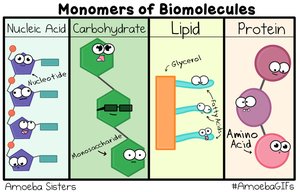
Monomers and Polymers
Monomer-Polymer Relationships
Monomers are the basic building blocks of macromolecules. When monomers join together, they form polymers through dehydration synthesis (removal of water). The reverse process, hydrolysis, breaks polymers into monomers by adding water.
Carbohydrate monomer: Monosaccharide (e.g., glucose)
Lipid monomer: Glycerol and fatty acids
Protein monomer: Amino acid
Nucleic acid monomer: Nucleotide
Carbohydrates
Structure and Types
Carbohydrates are organic molecules composed of carbon, hydrogen, and oxygen, typically in a 1:2:1 ratio. They serve as energy sources and structural components in cells.
Monosaccharides: Simple sugars (e.g., glucose, fructose, ribose)
Disaccharides: Two monosaccharides joined together (e.g., sucrose = glucose + fructose, lactose = glucose + galactose)
Polysaccharides: Long chains of monosaccharides (e.g., starch, glycogen, cellulose, chitin)
Pentose sugars: Five-carbon sugars (e.g., ribose in RNA, deoxyribose in DNA)
Polysaccharide | Function | Source |
|---|---|---|
Starch | Energy storage | Plants |
Glycogen | Energy storage | Animals (liver, muscle) |
Cellulose | Structural support | Plant cell walls |
Chitin | Structural support | Fungal cell walls, arthropod exoskeletons |
Lipids
Types and Functions
Lipids are hydrophobic molecules that include fats, oils, waxes, phospholipids, and steroids. They are important for energy storage, membrane structure, and signaling.
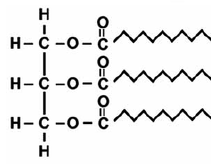
Fats and oils: Triglycerides composed of glycerol and three fatty acids
Waxes: Protective coatings in plants and animals
Phospholipids: Major component of cell membranes
Steroids: Four fused rings; includes cholesterol and hormones
Cholesterol: Maintains membrane fluidity and serves as a precursor for steroid hormones
Saturated fats: No double bonds; solid at room temperature
Unsaturated fats: One or more double bonds; liquid at room temperature
Proteins
Structure and Function
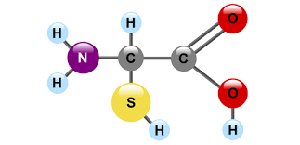
Proteins are polymers of amino acids linked by peptide bonds. They have diverse functions, including catalysis (enzymes), structural support, transport, signaling, and immune defense.
Amino acids: 20 different types, each with a unique R group
Polypeptides: Chains of amino acids that fold into functional proteins
Protein functions: Enzymes, structural support, receptors, signaling, growth, transport
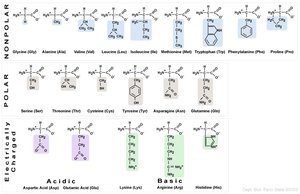
Classification of Amino Acids
Amino acids are classified based on the properties of their side chains (R groups):
Nonpolar: R group contains mostly carbon and hydrogen
Polar: R group contains oxygen, nitrogen, or sulfur bound to hydrogen
Acidic: R group contains a carboxyl group (COOH/COO-)
Basic: R group contains nitrogen-containing groups (N/NH+, NH/NH2+ or NH2/NH3+), not attached to a carbonyl
Nucleic Acids
Structure and Function
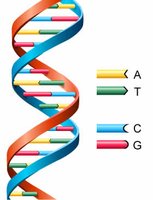
Nucleic acids, including DNA and RNA, are polymers of nucleotides. They store and transmit genetic information and direct protein synthesis.
Nucleotide components: Phosphate group, five-carbon sugar (deoxyribose or ribose), nitrogenous base
DNA: Double helix structure, bases A-T and C-G
RNA: Single-stranded, bases A-U and C-G
Summary Table: Biomolecules
Biomolecule | Monomer | Examples | Function | Structure | Sources |
|---|---|---|---|---|---|
Carbohydrate | Monosaccharide | Glucose, fructose | Energy, structure | C6H12O6 | Fruits, grains, plant stems, animal liver |
Lipid | Glycerol + fatty acids | Triglyceride, cholesterol, phospholipid | Energy storage, membranes | Chains of fatty acids and glycerol | Animal fats, oils, cell membranes |
Protein | Amino acid | Enzymes, receptors | Catalysis, structure, signaling | Amine and carboxyl groups | Meat, beans, cultured cells |
Nucleic Acid | Nucleotide | DNA, RNA | Genetic information | Phosphate, sugar, base | All cells, raw foods |
Key Chemical Reactions
Dehydration Synthesis and Hydrolysis
Macromolecules are assembled and disassembled by two key reactions:
Dehydration synthesis: Joins monomers by removing water.
Hydrolysis: Breaks polymers into monomers by adding water.
Additional info:
Element found in all organic compounds: Carbon
Isomer: Molecules with the same formula but different structures (e.g., glucose and fructose)
Enzymes: Proteins that catalyze biochemical reactions
