 Back
BackBiological Molecules: Structure, Function, and Diversity
Study Guide - Smart Notes
 Tailored notes based on your materials, expanded with key definitions, examples, and context.
Ch. 3: Biological Molecules
Introduction to Biological Molecules
Biological molecules are essential for life, forming the backbone of cellular structure and function. They are primarily carbon-based, with hydrogen, oxygen, nitrogen, phosphorus, and sulfur as common elements.
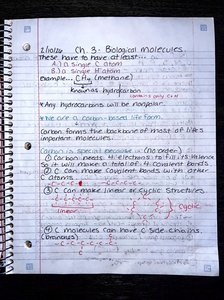
Hydrocarbons: Molecules consisting of only carbon and hydrogen. Example: Methane (CH4).
Carbon's versatility: Carbon can form four covalent bonds, allowing for a vast diversity of molecular structures.
Organic molecules: Defined by the presence of carbon atoms, often arranged in chains or rings.
Carbon Skeletons and Functional Groups
The arrangement of carbon atoms (carbon skeletons) determines the shape and function of organic molecules. Functional groups are specific clusters of atoms that confer unique properties.
Carbon skeletons: Can be linear, branched, or cyclic.
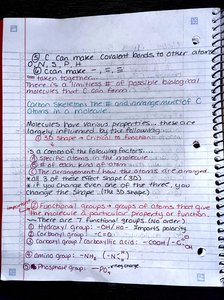
Functional groups: Common groups include hydroxyl (-OH), carboxyl (-COOH), amino (-NH2), phosphate (-PO4), methyl (-CH3), and sulfhydryl (-SH).
Polarity: Functional groups influence molecular polarity and reactivity.
Properties and Roles of Functional Groups
Functional groups are critical for molecular interactions and biological activity.
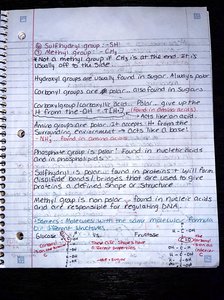
Hydroxyl group: Polar, found in sugars.
Carboxyl group: Acidic, found in amino acids and fatty acids.
Amino group: Basic, found in amino acids.
Phosphate group: Polar, found in nucleotides.
Methyl group: Nonpolar, affects gene expression.
Sulfhydryl group: Found in proteins, forms disulfide bonds.
Macromolecules and Polymers
Monomers and Polymers
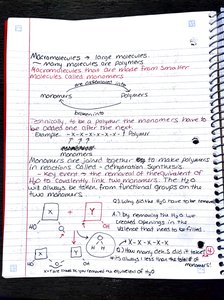
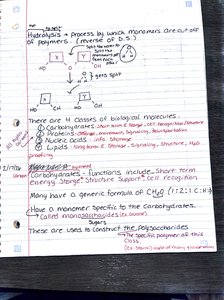
Macromolecules are large molecules composed of repeating subunits called monomers. Polymers are formed by linking monomers through dehydration synthesis (removal of water).
Dehydration synthesis: Joins monomers, releasing water.
Hydrolysis: Breaks polymers into monomers by adding water.
Examples: Polysaccharides (carbohydrates), proteins, nucleic acids.
Classes of Biological Molecules
There are four main classes of biological macromolecules:
Carbohydrates: Energy storage, structure, cell recognition.
Lipids: Energy storage, membranes, signaling.
Proteins: Catalysis, structure, transport, defense.
Nucleic acids: Information storage and transfer.
Carbohydrates
Monosaccharides and Polysaccharides
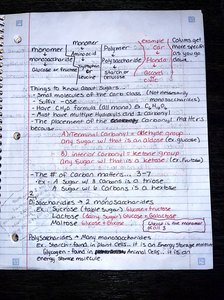
Carbohydrates are composed of monosaccharides (simple sugars) and polysaccharides (complex carbohydrates).
Monosaccharides: Glucose, fructose, galactose. Generic formula: .
Polysaccharides: Starch, glycogen, cellulose. Formed by linking monosaccharides.
Functions: Energy storage (starch, glycogen), structural support (cellulose).
Proteins
Structure and Function of Proteins
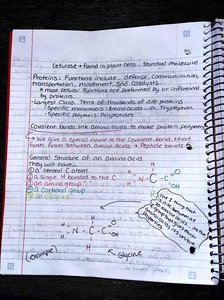
Proteins are polymers of amino acids, performing diverse functions such as catalysis, defense, and structure.
Amino acid structure: Central carbon, amino group, carboxyl group, R group (side chain).
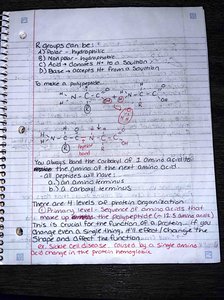
Peptide bonds: Link amino acids to form polypeptides.
Levels of protein structure: Primary (sequence), secondary (alpha helix, beta sheet), tertiary (3D folding), quaternary (multiple polypeptides).
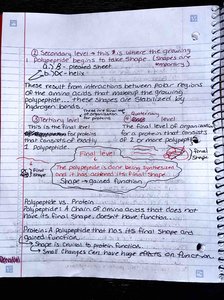
Denaturation
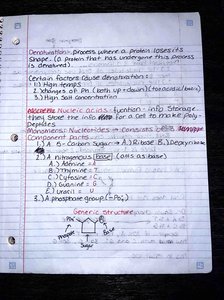
Denaturation is the process by which a protein loses its shape and function due to environmental changes.
Causes: High temperature, pH changes, high salt concentration.
Effect: Loss of biological activity.
Nucleic Acids
Structure and Function of Nucleic Acids
Nucleic acids (DNA and RNA) store and transmit genetic information.
Monomers: Nucleotides, composed of a sugar, phosphate group, and nitrogenous base.
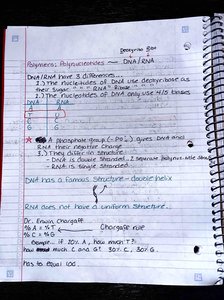
DNA: Double helix, deoxyribose sugar, bases A, T, C, G.
RNA: Single-stranded, ribose sugar, bases A, U, C, G.
Chargaff's Rule
Chargaff's rule states that in DNA, the amount of adenine equals thymine, and the amount of cytosine equals guanine.
Formula:
Application: Used to determine base composition in DNA samples.
----------------------------------------
