 Back
Biological Molecules: Structure, Function, and Diversity
Study Guide - Smart Notes
 Tailored notes based on your materials, expanded with key definitions, examples, and context.
Bond Types and Water’s Properties
Chemical Bonds in Biology
Chemical bonds are essential for the structure and function of biological molecules. The three main types of bonds found in biological systems are:
Covalent Bonds: Atoms share electrons, forming strong, stable bonds. Example: the bonds within a water molecule (H2O).
Ionic Bonds: Electrons are transferred from one atom to another, creating charged ions that attract each other. Example: sodium chloride (NaCl).
Hydrogen Bonds: Weak attractions between a hydrogen atom in one molecule and an electronegative atom (like oxygen or nitrogen) in another. Critical for water’s properties and DNA structure.
Water’s unique properties—such as cohesion, temperature regulation, floating ice, and its role as a solvent—are due to its polarity and hydrogen bonding.
Organic Compounds and Carbon Chemistry
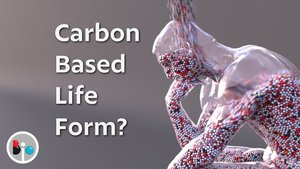
Why Life on Earth is Carbon-Based
All known life is carbon-based because carbon atoms can form four covalent bonds, allowing for a vast diversity of stable, complex molecules. This versatility supports the complexity required for life.
Defining Organic Compounds
Organic compounds are molecules that contain covalently bonded carbon atoms, often with hydrogen, oxygen, nitrogen, sulfur, and other elements. Not all carbon-containing molecules are organic; for example, methane (CH4) is organic, but carbon dioxide (CO2) is not.
Carbon Backbone: Carbon atoms can bond to each other, forming chains or rings of various lengths and branching patterns, creating molecular diversity.
Other Elements: Hydrogen, oxygen, nitrogen, and sulfur are commonly found in organic molecules.
Skeletal Formula Models
Skeletal formulas are shorthand representations of organic molecules. Carbon atoms are represented by the ends and intersections of lines, and hydrogen atoms attached to carbons are usually omitted for simplicity.
Functional Groups
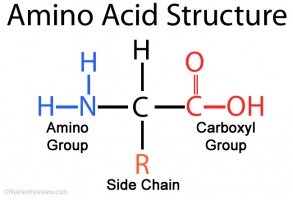
Functional groups are specific groups of atoms within molecules that are responsible for the characteristic chemical reactions of those molecules. They are more reactive than the carbon backbone and determine the properties and functions of organic compounds.
Examples of Functional Groups:
Hydroxyl (-OH): Found in alcohols.
Carboxyl (-COOH): Found in acids like amino acids and fatty acids.
Amino (-NH2): Found in amino acids.
Phosphate (-PO4): Found in nucleic acids and ATP.
Macromolecules: Structure and Function
Monomers and Polymers
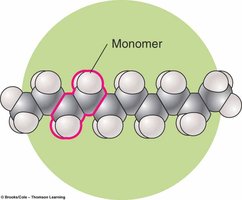
Macromolecules are large, complex molecules essential for life. They are typically polymers, which are long chains made by linking together smaller units called monomers.
Monomer: The basic building block (e.g., amino acid, nucleotide, monosaccharide).
Polymer: A large molecule made of repeating monomers (e.g., protein, DNA, polysaccharide).
Four Major Classes of Macromolecules
Carbohydrates: Sugars and starches, used for energy and structure.
Proteins: Made of amino acids, perform a wide range of functions including catalysis, structure, and transport.
Nucleic Acids: DNA and RNA, store and transmit genetic information.
Lipids: Fats, oils, and steroids, important for energy storage, membranes, and signaling.
Making and Breaking Macromolecules
Cells build and break down macromolecules through chemical reactions:
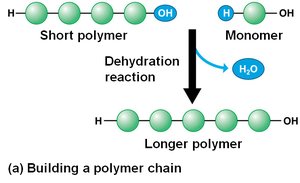
Dehydration Reaction (Synthesis): Joins monomers by removing a molecule of water, forming a covalent bond.
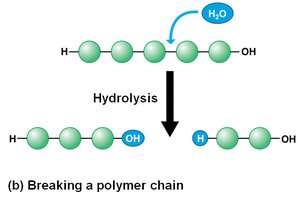
Hydrolysis (Breakdown): Breaks polymers into monomers by adding water, splitting the covalent bond.

Carbohydrates
Structure and Function
Carbohydrates are hydrophilic molecules that serve as energy sources and structural components. They are classified by the number of sugar units:
Monosaccharides: Simple sugars (e.g., glucose, ribose) that cannot be broken down into smaller sugars. Main fuel for cellular work.
Disaccharides: Two monosaccharides joined by a dehydration reaction (e.g., sucrose, lactose, maltose).
Polysaccharides: Long chains of monosaccharides (e.g., starch, glycogen, cellulose) used for energy storage or structural support.
Lipids
Types and Functions
Lipids are hydrophobic molecules, including fats, oils, waxes, phospholipids, and steroids. They are important for energy storage, membrane structure, and signaling.
Fats/Oils/Waxes: Composed of glycerol and fatty acids. Triglycerides are formed by joining one glycerol with three fatty acids via dehydration reactions.
Phospholipids: Major component of cell membranes, with a polar head and non-polar tails.
Steroids: Characterized by four fused carbon rings. Cholesterol is a key steroid, serving as a precursor for hormones like estrogen and testosterone.
Saturated vs. Unsaturated Fats
Saturated fats have fatty acid chains fully saturated with hydrogen atoms (no double bonds), making them solid at room temperature. Unsaturated fats have one or more double bonds, causing kinks in the chain and making them liquid at room temperature.
Summary Table: Major Biological Molecules
Macromolecule | Monomer | Polymer | Function |
|---|---|---|---|
Carbohydrate | Monosaccharide | Polysaccharide | Energy, structure |
Protein | Amino acid | Polypeptide | Catalysis, structure, transport |
Nucleic Acid | Nucleotide | DNA/RNA | Genetic information |
Lipid | Glycerol, fatty acids | Triglyceride, phospholipid, steroid | Energy storage, membranes, signaling |
Key Equations
Dehydration Synthesis:
Hydrolysis:
Additional info: This guide expands on the provided notes with definitions, examples, and a summary table for clarity and completeness.
