Back
Biologically Important Functional Groups: Structure, Properties, and Roles
Study Guide - Smart Notes
 Tailored notes based on your materials, expanded with key definitions, examples, and context.
Biologically Important Functional Groups
Overview
Functional groups are specific groups of atoms within molecules that have characteristic properties and chemical reactivities. They play a crucial role in the structure and function of biological macromolecules, influencing solubility, reactivity, and interactions within cells. Understanding these groups is essential for grasping the chemical context of life and the molecular diversity found in living organisms.
Amino Group (R-NH2)
Structure: Consists of a nitrogen atom bonded to two hydrogen atoms and the carbon skeleton (R-NH2).
Ionized (Charged) Form: Gains a proton (H+) to become R-NH3+.
Properties: Basic (can accept H+), polar, hydrophilic.
Commonly Found In: Amino acids, bases of nucleic acids.
Example: The amino group in glycine, an amino acid, allows it to act as a base in aqueous solutions.
Carboxyl Group (R-COOH)
Structure: A carbon double-bonded to an oxygen and single-bonded to a hydroxyl group (R-COOH).
Ionized (Charged) Form: Loses a proton to become R-COO-.
Properties: Acidic (can donate H+), polar, hydrophilic.
Commonly Found In: Amino acids, fatty acids, other organic acids.
Example: The carboxyl group in acetic acid gives vinegar its acidic properties.
Carbonyl Group (R-CO-R')
Structure: A carbon atom double-bonded to an oxygen atom (C=O), with the carbon also bonded to two other atoms (R and R').
Properties: Polar, hydrophilic.
Commonly Found In: Sugars (as ketones and aldehydes), proteins, bases of nucleic acids.
Example: The carbonyl group in glucose (an aldehyde) and fructose (a ketone) affects their reactivity and solubility.
Hydroxyl Group (R-OH)
Structure: An oxygen atom bonded to a hydrogen atom (R-OH).
Properties: Polar, hydrophilic.
Commonly Found In: Sugars and alcohols.
Example: The hydroxyl group in ethanol makes it soluble in water.
Phosphate Group (R-PO4)
Structure: A phosphorus atom bonded to four oxygen atoms, one of which is bonded to the carbon skeleton (R-PO4).
Ionized (Charged) Form: Typically carries negative charges (e.g., R-PO42-).
Properties: Acidic (can donate H+), polar, hydrophilic.
Commonly Found In: Phospholipids in membranes, DNA backbone, ATP, important in regulation.
Example: The phosphate group in ATP stores and transfers energy in cells.
Methyl Group (R-CH3)
Structure: A carbon atom bonded to three hydrogen atoms (R-CH3).
Properties: Nonpolar, hydrophobic.
Commonly Found In: Fatty acid chains, imprint on DNA for regulation (epigenetic modifications).
Example: Methylation of DNA can regulate gene expression.
Summary Table: Functional Groups in Biology
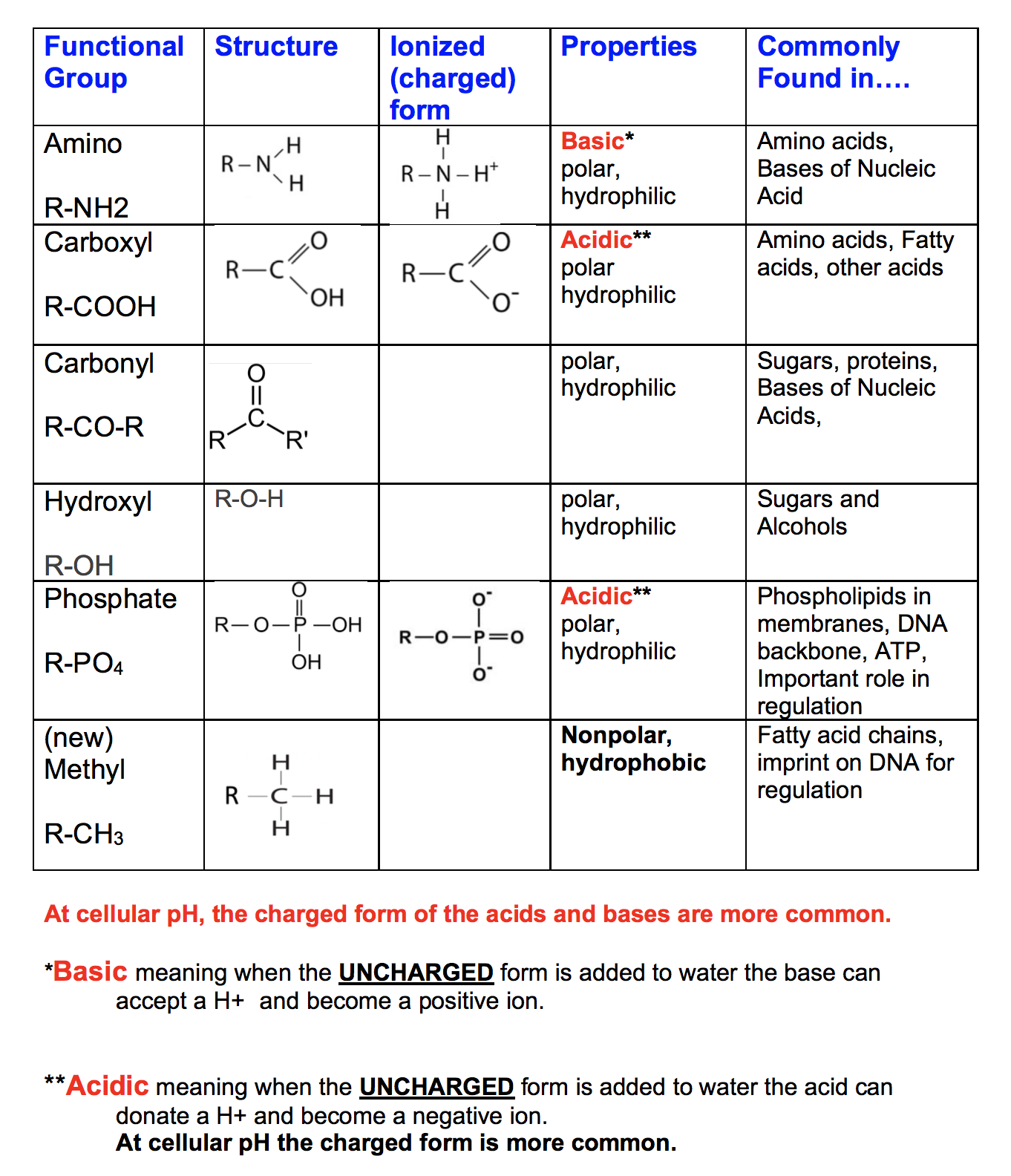
Functional Group | Structure | Ionized (Charged) Form | Properties | Commonly Found in… |
|---|---|---|---|---|
Amino (R-NH2) | R-NH2 | R-NH3+ | Basic, polar, hydrophilic | Amino acids, Bases of Nucleic Acid |
Carboxyl (R-COOH) | R-COOH | R-COO- | Acidic, polar, hydrophilic | Amino acids, Fatty acids, other acids |
Carbonyl (R-CO-R') | R-CO-R' | — | Polar, hydrophilic | Sugars, proteins, Bases of Nucleic Acids |
Hydroxyl (R-OH) | R-OH | — | Polar, hydrophilic | Sugars and Alcohols |
Phosphate (R-PO4) | R-PO4 | R-PO42- | Acidic, polar, hydrophilic | Phospholipids in membranes, DNA backbone, ATP, regulation |
Methyl (R-CH3) | R-CH3 | — | Nonpolar, hydrophobic | Fatty acid chains, DNA regulation |
Key Concepts and Additional Information
At cellular pH, the charged form of acids and bases is more common.
Basic: When the uncharged form is added to water, the base can accept a proton (H+) and become a positive ion.
Acidic: When the uncharged form is added to water, the acid can donate a proton (H+) and become a negative ion.
Functional groups determine the chemical reactivity and interactions of biological molecules, influencing processes such as enzyme activity, DNA regulation, and membrane structure.