 Back
Biology 1 Exam 1 Practice Test Study Guidance
Study Guide - Smart Notes
 Tailored notes based on your materials, expanded with key definitions, examples, and context.
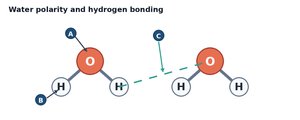
Q36. Water molecules: For A, identify the partial charge at the oxygen atom. For B, identify the partial charge at the hydrogen atom. Name the interaction marked C.
Background
Topic: Water Polarity and Hydrogen Bonding
This question tests your understanding of the polarity of water molecules and the nature of hydrogen bonding between them. It is fundamental to many biological processes, including solubility, cohesion, and temperature regulation.
Key Terms and Concepts:
Polarity: Water is a polar molecule because oxygen is more electronegative than hydrogen, creating partial charges.
Partial Charges: Oxygen has a partial negative charge (), and hydrogen has a partial positive charge ().
Hydrogen Bond: A weak attraction between the partial positive charge of hydrogen in one water molecule and the partial negative charge of oxygen in another.
Key Formula:
There is no mathematical formula for this question, but the notation for partial charges is:
(partial negative) and (partial positive)
Step-by-Step Guidance
Examine the diagram and locate the oxygen atom labeled "A." Consider the electronegativity of oxygen compared to hydrogen.
Recall that oxygen attracts shared electrons more strongly, resulting in a partial negative charge () at the oxygen atom.
Next, look at the hydrogen atom labeled "B." Since hydrogen is less electronegative, it has a partial positive charge ().
Identify the interaction labeled "C" between the two water molecules. This is a bond formed due to the attraction between the partial positive hydrogen and partial negative oxygen.
Think about the name of this interaction and why it is important in biological systems.
Try solving on your own before revealing the answer!
Final Answer:
A: partial negative charge ()
B: partial positive charge ()
C: hydrogen bond
Oxygen is more electronegative, so it attracts the shared electrons more strongly, resulting in a partial negative charge. Hydrogen, being less electronegative, has a partial positive charge. The hydrogen bond forms between the partial positive hydrogen of one molecule and the partial negative oxygen of another, which is crucial for many properties of water.
