 Back
BackBiology 1001: Photosynthesis, Cell Division, Genetics, Evolution, and Ecology – Study Guide
Study Guide - Smart Notes
 Tailored notes based on your materials, expanded with key definitions, examples, and context.
Chapter 7: Photosynthesis
7.1 - 7.2 Energy Roles & Leaf Anatomy
Photosynthesis is the process by which light energy is converted into chemical energy, allowing organisms to synthesize food. This process is essential for life on Earth, as it forms the basis of most food chains.
Autotrophs: Organisms that produce their own food from inorganic substances. They are also called "self-feeders."
Photoautotrophs: Autotrophs that use sunlight to synthesize organic molecules (e.g., plants, algae, some bacteria).
Chemotrophs: Organisms that obtain energy by oxidizing inorganic chemicals (e.g., some bacteria).
Heterotrophs: Organisms that must consume other organisms for energy and nutrients.
Chloroplasts: Organelles in plant cells where photosynthesis occurs.
Mesophyll: The inner tissue of a leaf, rich in chloroplasts, where most photosynthesis takes place.
Stomata: Small pores on the leaf surface that regulate gas exchange (CO2 in, O2 out).
Stroma: The fluid-filled space inside the chloroplast where the Calvin cycle (sugar synthesis) occurs.
Thylakoids & Grana: Thylakoids are membrane-bound sacs containing chlorophyll; stacks of thylakoids are called grana.
7.4 - 7.9 The Chemical Process
Photosynthesis is a redox process involving the transfer of electrons, primarily occurring in two stages: the light reactions and the Calvin cycle.
Redox Reaction: In photosynthesis, water is oxidized and carbon dioxide is reduced.
Light Reactions: These occur in the thylakoid membranes, converting solar energy into chemical energy (ATP and NADPH).
Outputs: ATP, NADPH, and O2 (oxygen is released as a byproduct).
Electron Replacement: Electrons lost from Photosystem II are replaced by splitting water molecules.
ATP Synthase: An enzyme that synthesizes ATP from ADP and inorganic phosphate, powered by a proton gradient.
Pigments: Chlorophyll and other pigments absorb light energy for use in the light reactions.
Electromagnetic Spectrum: The range of all types of electromagnetic radiation, including visible light used in photosynthesis.
Chapter 8: Reproduction & Cell Division
8.1 - 8.3 Types of Reproduction
Organisms reproduce either asexually or sexually, with important consequences for genetic diversity.
Asexual Reproduction: Involves a single parent; offspring are genetically identical to the parent (clones).
Sexual Reproduction: Involves two parents; offspring have unique combinations of genes, increasing genetic diversity.
Cell Types: Eukaryotic cells are larger and more complex than prokaryotic cells, containing a nucleus and more genes.
Sister Chromatids: Identical copies of a chromosome, joined at a region called the centromere.
8.4 - 8.18 The Cell Cycle & Mitosis
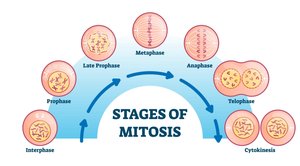
The cell cycle describes the sequence of events in the life of a cell, including growth, DNA replication, and division. Mitosis is the process by which eukaryotic cells divide to produce genetically identical daughter cells.
Interphase: The cell grows, performs normal functions, and duplicates its DNA in preparation for division.
Prophase: Chromosomes condense, and the mitotic spindle begins to form.
Metaphase: Chromosomes align at the cell's equator; spindle fibers attach to centromeres.
Anaphase: Sister chromatids are pulled apart toward opposite poles of the cell.
Telophase: Nuclear envelopes reform around the separated chromosomes, which begin to decondense.
Cytokinesis: Division of the cytoplasm, resulting in two separate daughter cells.
Plant vs. Animal Cell Division: Plant cells form a cell plate due to the presence of a cell wall; animal cells divide by cleavage.
Density-dependent Inhibition: Cells stop dividing when crowded, helping regulate tissue growth.
Homologous Chromosomes: Chromosome pairs with genes for the same traits, one from each parent.
Nondisjunction: Failure of chromosome pairs to separate properly during cell division, leading to abnormal chromosome numbers in daughter cells.
Example: Nondisjunction can result in conditions such as Down syndrome (trisomy 21).
Chapter 9: Patterns of Inheritance
9.2 - 9.10 Genetics & Disorders
Genetics is the study of heredity and variation in organisms. Mendelian genetics explains how traits are inherited through generations.
True Breeding: Organisms that consistently produce offspring with the same traits when self-fertilized.
Alleles: Different versions of a gene found at the same locus on homologous chromosomes.
Mendel’s Law of Independent Assortment: Genes for different traits are inherited independently of each other.
Dihybrid Cross: A cross between individuals heterozygous for two traits yields a 9:3:3:1 phenotypic ratio in the offspring.
Genetic Disorders:
Recessive Disorders: Caused by two copies of a recessive allele (e.g., cystic fibrosis).
Heterozygous (Carrier): An individual with one normal and one mutant allele; does not show symptoms but can pass the disorder to offspring.
Dominant Disorders: Caused by a single dominant allele; less common due to lethality before reproductive age (e.g., Huntington's disease).
PKU Testing: Newborns are screened for phenylketonuria, a metabolic disorder treatable with dietary management.
9.11 - 9.13 Complex Inheritance
Some traits do not follow simple Mendelian inheritance patterns.
Codominance: Both alleles are fully expressed in heterozygotes (e.g., AB blood type).
Pleiotropy: One gene affects multiple traits (e.g., sickle-cell disease affects hemoglobin and other symptoms).
Polygenic Inheritance: Multiple genes contribute to a single trait (e.g., skin color, height).
Chapter 13 & 34: Evolution and Ecology
13.1 - 13.14 Evolution
Evolution is the central concept in biology, explaining the diversity and unity of life through changes in populations over time.
Evolution: The process by which species change over generations through genetic variation and natural selection.
Natural Selection: Individuals with advantageous traits are more likely to survive and reproduce, passing those traits to the next generation.
Mutation: Random changes in DNA that create new alleles and genetic diversity.
Evolutionary Tree: Diagrams that depict relationships among species based on shared characteristics.
Types of Selection:
Directional Selection: Favors one extreme phenotype.
Stabilizing Selection: Favors intermediate phenotypes.
Disruptive Selection: Favors both extreme phenotypes over intermediates.
34.1 - 34.16 Ecology
Ecology is the study of interactions between organisms and their environment, focusing on energy flow and chemical cycling.
Ecosystem: A community of organisms and their physical environment, interacting as a system.
Environmental Zones:
Intertidal Zone: The area between high and low tide, where ocean meets land.
Tropical Rain Forest: Characterized by high rainfall and diverse vegetation.
Arctic Tundra: Marked by permafrost and low biodiversity.
Agricultural Runoff: Excess fertilizer can cause algal blooms, depleting oxygen and harming aquatic life.
