 Back
BackBiology 1406 Lab Exam Review – Step-by-Step Study Guidance
Study Guide - Smart Notes
 Tailored notes based on your materials, expanded with key definitions, examples, and context.
Q1. Which of the structures below are carbohydrates, disaccharide, glucose (monosaccharide), starch, lipid, and polypeptide?
Background
Topic: Biological Macromolecules
This question tests your ability to identify and distinguish between different types of biological macromolecules based on their structural features.
Key Terms:
Carbohydrate: Organic molecule made of sugars (monosaccharides, disaccharides, polysaccharides).
Monosaccharide: Simple sugar, e.g., glucose.
Disaccharide: Two monosaccharides joined together, e.g., sucrose.
Starch: Polysaccharide made of many glucose units.
Lipid: Non-polar molecule, often made of fatty acids and glycerol.
Polypeptide: Chain of amino acids linked by peptide bonds.
Step-by-Step Guidance
Examine each structure for repeating units or characteristic functional groups. For example, carbohydrates often have ring structures or chains of carbon, hydrogen, and oxygen.
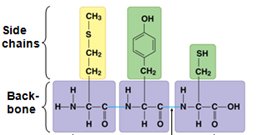
Look for peptide bonds (–CO–NH–) to identify polypeptides. These are typical in protein structures.
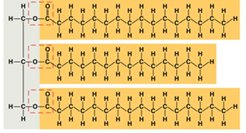
Identify long hydrocarbon chains with a glycerol backbone to spot lipids (triglycerides).
For carbohydrates, check for monosaccharide (single unit), disaccharide (two units), or polysaccharide (many units, like starch).
Compare the side chains and backbone in the polypeptide structure to distinguish it from other macromolecules.
Try solving on your own before revealing the answer!
Final Answer:
Image 1: Lipid (triglyceride) – three fatty acid chains attached to a glycerol backbone.
Image 2: Polypeptide – backbone of amino acids with different side chains.
These images show the structural differences between lipids and polypeptides. Lipids are hydrophobic and non-polar, while polypeptides are made of amino acids linked by peptide bonds.
Q2. Compare and contrast compound light microscope and dissecting microscope.
Background
Topic: Microscopy
This question tests your understanding of the differences between two types of microscopes commonly used in biology labs.
Key Terms:
Compound Microscope: Uses multiple lenses for high magnification, suitable for viewing small/thin specimens.
Dissecting Microscope (Stereomicroscope): Uses two eyepieces for low magnification, suitable for viewing larger specimens.
Magnification: How much larger an object appears.
Resolution: Ability to distinguish two points as separate.
Working Distance: Space between lens and specimen.
Step-by-Step Guidance
Review the features of each microscope: number of lenses, magnification range, and working space.
Compare the light source location: below specimen (compound) vs. above specimen (dissecting).
Consider the types of specimens each microscope is best suited for (small/thin vs. large).
Think about the practical uses in the lab for each microscope.
Try solving on your own before revealing the answer!
Final Answer:
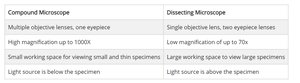
Compound Microscope: Multiple objective lenses, high magnification, small working space, light source below specimen.
Dissecting Microscope: Single objective lens, low magnification, large working space, light source above specimen.
The table summarizes the main differences. Compound microscopes are ideal for cellular details, while dissecting microscopes are used for larger, three-dimensional specimens.
Q3. Complete the table comparing dissecting and compound microscopes (Magnification, Resolution, Size of field of view, Depth of field).
Background
Topic: Microscopy – Comparative Analysis
This question asks you to fill in a table comparing key characteristics of two types of microscopes.
Key Terms:
Magnification: Degree to which the specimen is enlarged.
Resolution: Clarity of the image.
Field of View: Area visible through the microscope.
Depth of Field: Thickness of specimen in focus.
Step-by-Step Guidance
Recall the typical magnification ranges for each microscope type.
Think about which microscope provides higher resolution and why.
Consider which microscope has a larger field of view and greater depth of field.
Use your knowledge from previous questions and lab experience to fill in the table.
Try solving on your own before revealing the answer!
Final Answer:
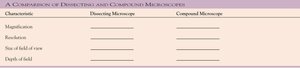
Dissecting Microscope: Low magnification, low resolution, large field of view, high depth of field.
Compound Microscope: High magnification, high resolution, small field of view, low depth of field.
These characteristics help determine which microscope is best for different types of specimens and observations.
