 Back
Biology 1408 Chapter 1 Study Guide: Properties, Domains, Levels, and Themes of Life
Study Guide - Smart Notes
 Tailored notes based on your materials, expanded with key definitions, examples, and context.
Q1. What are the properties of life?
Background
Topic: Properties of Life
This question tests your understanding of the fundamental characteristics that define living organisms. These properties distinguish living things from nonliving matter.
Key Terms:
Order
Reproduction
Growth and development
Energy processing
Response to the environment
Regulation
Evolutionary adaptation
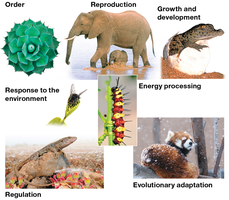
Step-by-Step Guidance
Review each property listed above and think about what it means for an organism to exhibit that property.
Consider examples for each property (e.g., reproduction in elephants, energy processing in caterpillars).
Reflect on how these properties are interconnected and why all are necessary for life.
Try to match each property with a real-world example from the image or your own knowledge.
Try solving on your own before revealing the answer!
Final Answer:
The properties of life are: order, reproduction, growth and development, energy processing, response to the environment, regulation, and evolutionary adaptation. Each property is illustrated in the image, showing how living organisms maintain structure, reproduce, grow, use energy, respond to stimuli, regulate internal conditions, and adapt over generations.
Q2. Compare the three domains of life.
Background
Topic: Domains of Life
This question is about the classification of life into three major domains: Bacteria, Archaea, and Eukarya. Understanding these domains helps you appreciate the diversity and evolutionary relationships among organisms.
Key Terms:
Bacteria: Prokaryotic cells, no nucleus
Archaea: Prokaryotic cells, often found in extreme environments
Eukarya: Eukaryotic cells, have a nucleus and organelles
Step-by-Step Guidance
Identify the cell type for each domain (prokaryotic or eukaryotic).
List example organisms for each domain (e.g., bacteria, archaea, plants, animals, fungi).
Note any interesting facts or unique features about each domain.
Compare the domains based on their cellular structure and typical habitats.
Try solving on your own before revealing the answer!
Final Answer:
The three domains of life are Bacteria (prokaryotic, no nucleus), Archaea (prokaryotic, often extremophiles), and Eukarya (eukaryotic, includes plants, animals, fungi, and protists). Eukarya have cells with nuclei and organelles, while Bacteria and Archaea lack these structures.
Q3. Number the levels of biological organization from smallest to largest.
Background
Topic: Levels of Biological Organization
This question tests your understanding of the hierarchy of biological organization, from molecules to the biosphere.
Key Terms:
Molecule
Organelle
Cell
Tissue
Organ
Organ System
Organism
Population
Community
Ecosystem
Biosphere
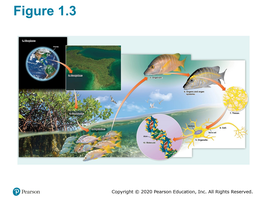
Step-by-Step Guidance
Start by identifying the smallest unit (molecule) and the largest (biosphere).
Arrange the levels in order, considering how each builds upon the previous (e.g., molecules make up organelles, organelles make up cells).
Think about examples for each level, as shown in the image.
Write the sequence, but stop before filling in the final numbers for each level.
Try solving on your own before revealing the answer!
Final Answer:
The correct order from smallest to largest is: Molecule, Organelle, Cell, Tissue, Organ, Organ System, Organism, Population, Community, Ecosystem, Biosphere.
Q4. What is the smallest unit considered alive? Define an emergent property.
Background
Topic: Cells and Emergent Properties
This question focuses on the cell as the basic unit of life and the concept of emergent properties, which arise from the interaction of simpler components.
Key Terms:
Cell: Basic unit of life
Emergent property: A property that arises from the arrangement and interaction of parts within a system
Step-by-Step Guidance
Recall the definition of a cell and why it is considered the smallest living unit.
Think about how emergent properties are observed in biological systems (e.g., a functioning organ vs. individual cells).
Write a definition for emergent property, but stop before giving a specific example.
Try solving on your own before revealing the answer!
Final Answer:
The smallest unit considered alive is the cell. An emergent property is a characteristic that arises from the arrangement and interaction of parts within a system, such as the ability of a heart to pump blood, which individual heart cells cannot do alone.
Q5. Explain how scientists investigate questions and interpret a controlled experiment.
Background
Topic: Scientific Method and Controlled Experiments
This question tests your understanding of how scientists use observation, hypothesis, prediction, and experimentation to answer questions. It also covers the importance of control groups in experiments.
Key Terms:
Observation
Hypothesis
Prediction
Controlled experiment
Independent variable
Dependent variable
Control group
Step-by-Step Guidance
Start with an observation (e.g., flashlight doesn't work).
Formulate a question based on the observation.
Develop hypotheses to explain the observation.
Make predictions based on each hypothesis.
Design experiments to test the predictions, using control groups where appropriate.
Try solving on your own before revealing the answer!
Final Answer:
Scientists investigate questions by making observations, forming hypotheses, making predictions, and testing them through controlled experiments. A controlled experiment changes only one variable at a time, keeping others constant, to determine the effect of the independent variable on the dependent variable. Control groups are necessary to provide a baseline for comparison.
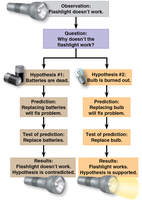
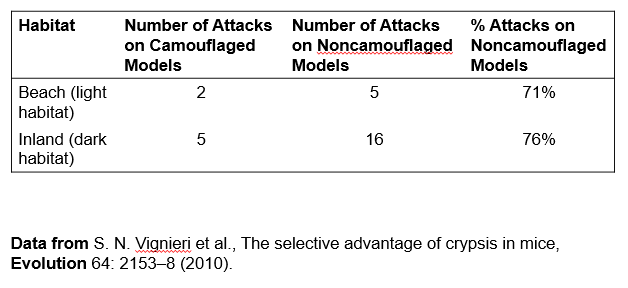
Q6. Review the experiment about the coloration of beach mice versus inland mice.
Background
Topic: Controlled Experiments and Adaptation
This question examines how scientists use controlled experiments to study adaptation, specifically the effect of coloration on predation in mice.
Key Terms:
Independent variable: Mouse coloration
Dependent variable: Number of attacks
Control group: Mice with coloration matching their habitat
Step-by-Step Guidance
Identify the question being tested (e.g., does coloration affect predation?).
Determine the independent and dependent variables.
Explain why a control group is necessary (to compare against experimental groups).
Analyze the data in the table, but stop before drawing the final conclusion.
Try solving on your own before revealing the answer!
Final Answer:
The experiment tested whether mouse coloration affects predation rates. The independent variable was mouse coloration, and the dependent variable was the number of attacks. Control groups were necessary to compare the effect of coloration. The data show that non-camouflaged mice were attacked more frequently, supporting the hypothesis that camouflage provides a selective advantage.
Q7. Scientists tested hypotheses about the evolutionary relationships of red pandas using observational data.
Background
Topic: Evolutionary Relationships and Classification
This question explores how scientists use morphological and genetic data to classify organisms and understand evolutionary relationships.
Key Terms:
Hypothesis
Observational data
DNA sequence analysis
Step-by-Step Guidance
List similarities between red pandas and raccoons (e.g., body shape, fur patterns).
List similarities between red pandas and giant pandas (e.g., diet, habitat).
Consider how DNA sequence analysis can clarify evolutionary relationships.
Stop before stating the final classification result.
Try solving on your own before revealing the answer!
Final Answer:
Red pandas share some physical traits with raccoons and some with giant pandas. DNA sequence analysis revealed that red pandas are more closely related to raccoons than to giant pandas, placing them in their own family within the order Carnivora.
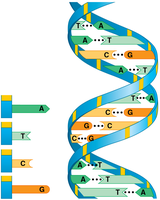
Q8. Complete the flowchart: DNA → ____________ → ____________ → Trait
Background
Topic: Information Flow in Biology
This question tests your understanding of how genetic information is transferred from DNA to traits via intermediate steps.
Key Terms:
DNA
RNA
Protein
Trait
Step-by-Step Guidance
Recall the central dogma of molecular biology: DNA is transcribed to RNA.
RNA is then translated into protein.
Proteins determine traits in organisms.
Fill in the blanks in the flowchart, but stop before writing the final sequence.
Try solving on your own before revealing the answer!
Final Answer:
The flowchart is: DNA → RNA → Protein → Trait. DNA is transcribed into RNA, which is translated into protein, and proteins determine the traits of an organism.
Q9. Explain the relationship between structure and function. Give two examples.
Background
Topic: Structure and Function in Biology
This question asks you to explain how the shape or arrangement of biological structures enables their function, a key theme in biology.
Key Terms:
Structure
Function
Example: Enzyme shape, cell membrane structure
Step-by-Step Guidance
Describe how structure determines function in biological systems.
Think of examples, such as the shape of an enzyme or the structure of a cell membrane.
Explain how each structure helps its function, but stop before giving the full explanation.
Try solving on your own before revealing the answer!
Final Answer:
Structure determines function in biology; for example, the shape of an enzyme allows it to bind specific substrates, and the structure of a cell membrane enables selective transport. These examples show how biological structures are adapted to their functions.
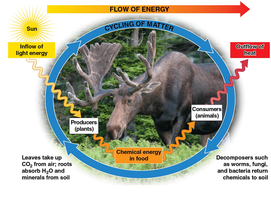
Q10. Which group captures light energy and converts it to chemical energy? What happens to energy as it moves through an ecosystem?
Background
Topic: Energy and Matter in Ecosystems
This question tests your understanding of how energy flows and matter cycles in ecosystems, focusing on producers and consumers.
Key Terms:
Producers (plants)
Consumers (animals)
Decomposers
Energy flow
Cycling of matter
Step-by-Step Guidance
Identify which group in the ecosystem captures light energy (producers).
Describe how energy is converted to chemical energy in food.
Explain what happens to energy as it moves through the ecosystem (e.g., loss as heat).
Stop before stating the final answer.
Try solving on your own before revealing the answer!
Final Answer:
Producers (plants) capture light energy and convert it to chemical energy. As energy moves through an ecosystem, it is transferred from producers to consumers and decomposers, with some energy lost as heat at each step.
