 Back
BackBiology 161 Exam 2 Study Guidance: Cell Structure, Membranes, and Transport
Study Guide - Smart Notes
 Tailored notes based on your materials, expanded with key definitions, examples, and context.
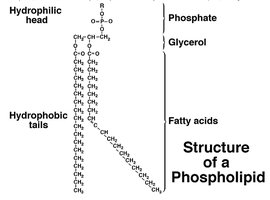
Q21. The molecule depicted at right is a(n) ______.
Background
Topic: Biological Macromolecules – Lipids
This question tests your ability to recognize the structure of a phospholipid, a key component of cell membranes, and distinguish it from other biological molecules such as amino acids, nucleotides, triglycerides, and steroids.
Key Terms and Concepts:
Phospholipid: A lipid molecule with a hydrophilic (water-loving) phosphate head and two hydrophobic (water-fearing) fatty acid tails.
Hydrophilic head: The part of the molecule that interacts with water.
Hydrophobic tails: The part of the molecule that avoids water.
Step-by-Step Guidance
Examine the structure for a phosphate group (PO43-) attached to a glycerol backbone.
Look for two long hydrocarbon chains (fatty acid tails) attached to the glycerol.
Recall that phospholipids have both hydrophilic and hydrophobic regions, which is essential for forming biological membranes.
Compare this structure to those of amino acids (which have an amino group, carboxyl group, and side chain), nucleotides (which have a sugar, phosphate, and nitrogenous base), triglycerides (which have three fatty acids and no phosphate), and steroids (which have a four-ring structure).
Try solving on your own before revealing the answer!
Final Answer: b) phospholipid
The molecule shown has a phosphate group, a glycerol backbone, and two fatty acid tails, which is characteristic of a phospholipid.
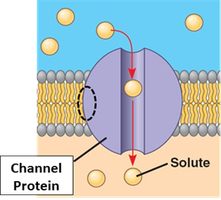
Q23. Which of these would you expect to find at the circled site of the channel protein shown here?
Background
Topic: Membrane Proteins and Amino Acid Properties
This question tests your understanding of the structure of channel proteins and the types of amino acids that are found in different regions of these proteins, especially those lining the channel through which polar or charged molecules pass.
Key Terms and Concepts:
Channel protein: A membrane protein that allows specific molecules or ions to pass through the membrane.
Polar amino acid: An amino acid with a side chain that can form hydrogen bonds with water or other polar molecules.
Non-polar amino acid: An amino acid with a hydrophobic side chain.
Step-by-Step Guidance
Identify the location of the circled site: it is inside the channel, where the solute passes through.
Recall that the interior of a channel protein must interact with the molecules it transports, which are often polar or charged.
Think about which type of amino acid side chain would be compatible with a polar or charged environment (inside the channel).
Contrast this with the exterior of the protein, which interacts with the hydrophobic core of the membrane and would contain non-polar amino acids.
Try solving on your own before revealing the answer!
Final Answer: a) Polar amino acid
The circled site is inside the channel, where polar or charged solutes pass, so polar amino acids are expected here to facilitate their movement.
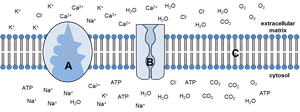
Q32. Illustrated below is the plasma membrane of a living cell, containing (A) a sodium-potassium pump, (B) a calcium channel, and (C) a region lacking transmembrane proteins. Molecules are shown to depict their relative concentrations on each side of the membrane.
Background
Topic: Membrane Transport Mechanisms
This question tests your understanding of how different substances move across the cell membrane via various transport proteins and the importance of electrochemical gradients.
Key Terms and Concepts:
Sodium-potassium pump (Na+/K+ ATPase): Actively transports Na+ out and K+ into the cell using ATP.
Calcium channel: Allows Ca2+ ions to move down their concentration gradient.
Simple diffusion: Movement of small, nonpolar molecules (like O2 and CO2) directly through the lipid bilayer.
Electrochemical gradient: The combined effect of a chemical gradient (difference in concentration) and an electrical gradient (difference in charge) across a membrane.
Step-by-Step Guidance
For Region A (sodium-potassium pump): Recall that this pump moves Na+ out of the cell and K+ into the cell, both against their concentration gradients, using ATP.
For Region B (calcium channel): Calcium ions (Ca2+) move through the channel down their concentration gradient, typically into the cell.
For Region C (no proteins): Only small, nonpolar molecules like O2 and CO2 can diffuse directly through the membrane here.
Consider how the movement of these ions and molecules contributes to the formation of an electrochemical gradient across the membrane.
Try solving on your own before revealing the answer!
Final Answer:
Region A: Na+ out, K+ in (active transport); Region B: Ca2+ in (facilitated diffusion); Region C: O2 in, CO2 out (simple diffusion). An electrochemical gradient exists due to the uneven distribution of ions, which is essential for cell function.
