 Back
Biology 1610 Exam 1 Review: Foundations of General Biology
Study Guide - Smart Notes
 Tailored notes based on your materials, expanded with key definitions, examples, and context.
Introduction to Biology
Scientific Process and Method
The scientific method is a systematic approach used to investigate natural phenomena, develop hypotheses, and test predictions through experimentation. - Observation: Noticing phenomena or patterns in nature. - Question: Formulating a question based on observations. - Hypothesis: Proposing a testable explanation. - Prediction: Making a logical statement about what will happen if the hypothesis is correct. - Experiment: Designing and conducting tests to evaluate the hypothesis. - Test: Collecting and analyzing data. - Repeat: Repeating experiments to confirm results. Example: Observing that students who attend review sessions perform better on exams, then designing an experiment to test this hypothesis.
Chemistry
Atoms and Bonds
Atoms are the basic units of matter, consisting of a nucleus surrounded by electrons in energy levels (shells). The outermost shell is called the valence shell, which determines chemical bonding. - Covalent Bonds: Formed by sharing electrons between atoms. - Valence Shell: First shell holds 2 electrons; subsequent shells hold up to 8. - HONCP: Hydrogen (1), Oxygen (2), Nitrogen (3), Carbon (4), Phosphorus (5) indicate the number of bonds each atom can form. Example: Oxygen has 6 electrons in its valence shell and can form 2 covalent bonds.
Types of Chemical Bonds
Chemical bonds are classified based on electron sharing and charge distribution. - Polar Covalent Bond: Uneven sharing of electrons, resulting in partial charges. - Non-Polar Covalent Bond: Even sharing of electrons, no partial charges. - Hydrogen Bond: Attraction between a hydrogen atom and an electronegative atom (O or N) in polar molecules. - Ionic Bond: Complete transfer of electrons, resulting in full charges and attraction between ions. Example: - CH: Non-polar covalent - NH: Polar covalent - KCl: Ionic 
Water
pH and [H+] Concentration
The pH scale measures the acidity or basicity of a solution, based on the concentration of hydrogen ions ([H+]). - Acidic: pH < 7, high [H+] - Neutral: pH = 7, [H+] = M - Basic: pH > 7, low [H+] Formula: Example: If [H+] = 0.0001 (or ), pH = 4 (acidic). If pH = 9, [H+] = (basic). 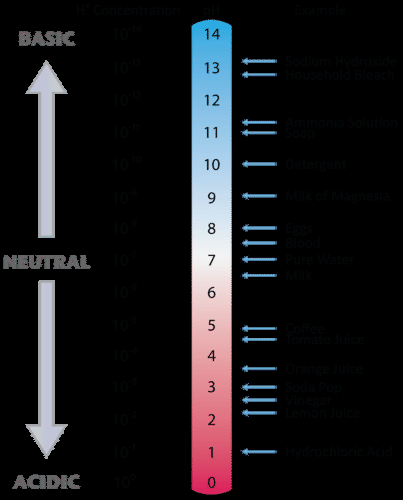
Polarity
Polarity describes the distribution of electrical charge across a molecule. - Polar molecules: Hydrophilic (water-loving), dissolve in water. - Nonpolar molecules: Hydrophobic (water-fearing), do not dissolve in water. Example: Water is polar and hydrophilic; oils are nonpolar and hydrophobic.
Cell Components
Prokaryotic vs. Eukaryotic Cells
Cells are the fundamental units of life, classified as prokaryotic or eukaryotic. - Prokaryotic cells: Simple, lack nucleus and organelles; found in bacteria and archaea. - Eukaryotic cells: Complex, contain nucleus and organelles; found in animals, plants, fungi, and protists. Example: Eukaryotic cells in different tissues (heart, stomach, skin) are genetically identical except for reproductive cells.
Biomolecules
Four Major Biomolecules
Biomolecules are essential for life, each with unique functions and structures. - Carbohydrates: Quick energy, energy storage, structural support. - Monomer: Monosaccharides (e.g., glucose) - Polymer: Polysaccharides (e.g., starch, glycogen, cellulose) - Lipids: Long-term energy storage, cell membranes, insulation. - Monomers: Fatty acids and glycerol (not true polymers) - Polymer-like structures: Triglycerides, phospholipids - Proteins: Enzymes, structure, transport, movement, signaling. - Monomer: Amino acids - Polymer: Polypeptides (proteins) - Nucleic Acids: Store and transmit genetic information. - Monomer: Nucleotides - Polymer: DNA and RNA 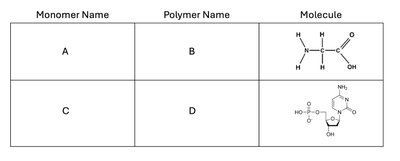
Building and Breaking Polymers
- Dehydration Synthesis: Building polymers by removing water. - Hydrolysis: Breaking polymers by adding water.
Protein Structure
Proteins have four levels of structure, each critical for function. - Primary Structure: Sequence of amino acids held by peptide bonds. - Secondary Structure: Local folding (α-helices, β-sheets) stabilized by hydrogen bonds. - Tertiary Structure: Overall 3D shape of a single polypeptide, stabilized by side chain interactions. - Quaternary Structure: Assembly of multiple polypeptide chains into one protein.
Additional Study Tips
- Know functional group names, structures, and properties. - Identify amino acids, their terminals (N and C), and side chains. - DNA strand matching: A-T and G-C base pairs. - Practice drawing molecules and reviewing their structures.
Example Molecules
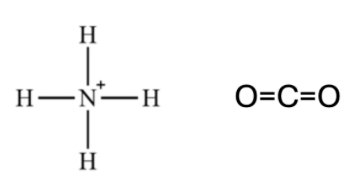 Example: Ammonium ion (NH4+) and carbon dioxide (CO2) illustrate different bonding and polarity. Additional info: Practice identifying bond types and molecular polarity using electronegativity values and structural diagrams. ----------------------------------------
