 Back
BackBiology 180 Final Exam Comprehensive Study Guide
Study Guide - Smart Notes
 Tailored notes based on your materials, expanded with key definitions, examples, and context.
Introduction to Biology
What is Biology?
Biology is the scientific study of life, encompassing the structure, function, growth, origin, evolution, and distribution of living organisms. It includes specialized fields such as Cell Biology (study of cells) and Molecular Biology (study of macromolecules essential for life, with an emphasis on DNA).
Biology: The study of life and living organisms.
Cell Biology: Focuses on the structure, function, and behavior of cells.
Molecular Biology: Examines macromolecules, especially DNA, essential for life.
Levels of Organization of Life
Life is organized hierarchically, from molecules to the biosphere. Each level has unique properties and functions.
Biosphere: Global sum of all ecosystems.
Ecosystem: Includes all living populations and non-living factors.
Community: All populations of species living in the same area (living things only).
Population: Group of individuals of the same species in a given area.
Organism: Individual living entity.
Organs, Organ Systems, Tissues, Cells, Organelles, Molecules: Increasingly smaller units of biological structure and function.
Characteristics of Cells
Cells are the fundamental units of life, containing genetic material (DNA) organized into chromosomes and genes.
DNA: Genetic material of cells.
Chromosomes: Structures containing DNA.
Genes: Units of heredity encoded in DNA.
Prokaryotic vs. Eukaryotic Cells
Cells are classified as prokaryotic or eukaryotic based on their structure and complexity.
Prokaryotic Cells: Lack membrane-bound organelles; include Bacteria and Archaea.
Eukaryotic Cells: Contain membrane-bound organelles; include Eukarya (protists, plants, fungi, animals).
Micrometer: Unit of measurement for cell size.
Classification of Life
Life is classified into three domains: Bacteria, Archaea, and Eukarya.
Bacteria: Prokaryotic, single-celled, diverse.
Archaea: Prokaryotic, single-celled, often live in extreme environments.
Eukarya: Eukaryotic, includes single-celled and multicellular organisms.
Scientific Inquiry
Scientific inquiry involves hypothesis-based science, experimentation, and peer review.
Hypothesis: Testable explanation for an observation.
Experimental Predictions: Measurable outcomes expected if hypothesis is correct.
Variables: Independent (manipulated) and dependent (measured).
Experimental Group: Receives the independent variable.
Control Group: Does not receive the independent variable.
Theories: Explanations supported by evidence from many experiments.
Chemical Context of Life
Matter and Elements
Matter is anything that takes up space and has mass. Elements are substances that cannot be broken down by ordinary chemical reactions.
Atoms: Smallest unit of matter retaining element properties.
Atomic Number: Number of protons.
Mass Number: Number of protons plus neutrons.
Isotopes: Atoms with same protons, different neutrons.
Radioactive Isotopes: Unstable nuclei that release energy.
Chemical Bonding
Chemical bonds determine molecular shape and properties.
Ionic Bonds: Attraction between oppositely charged ions.
Covalent Bonds: Sharing of electrons; strongest bond.
Polar Covalent Bonds: Unequal sharing, partial charges.
Hydrogen Bonds: Weak, additive, important in DNA and water.
Van der Waals: Weak, brief interactions.
Chemical Reactions
Chemical reactions involve the transformation of reactants into products.
Reactant: Starting material.
Product: Resulting material.
Water and Life
Properties of Water
Water is essential for life due to its unique properties.
Solvent: Dissolves polar molecules and ions.
Cohesion: Water molecules bond to each other.
Adhesion: Water bonds to other substances.
Specific Heat: High threshold for temperature change.
Density: Ice is less dense than liquid water.
Acids and Bases
Acids increase hydrogen ion concentration; bases decrease it. pH measures acidity.
Acid: Increases [H+].
Base: Decreases [H+].
pH:
Buffer: Minimizes pH changes.
Carbon and Molecular Diversity of Life
Organic Molecules and Functional Groups
Organic molecules contain carbon and hydrogen. Functional groups determine chemical properties.
Hydroxyl: Polar, hydrophilic, alcohols.
Carbonyl: Polar, hydrophilic, ketones & aldehydes.
Carboxyl: Very polar, ionizes, acts as acid.
Amino: Very polar, ionizes, acts as base.
Sulfhydryl: Polar, forms covalent bonds.
Phosphate: Very polar, ionizes, acts as acid.
Methyl: Nonpolar, hydrophobic.
Isomers
Isomers have the same molecular formula but different atom arrangements, affecting properties.
Structural Isomers: Differ in covalent arrangement.
Cis-Trans Isomers: Same covalent arrangement, different spatial arrangement around double bonds.
Enantiomers: Mirror images, differ by spatial arrangement around chiral carbon.
Large Biological Molecules
Macromolecules
Macromolecules are large, complex organic molecules essential for life.
Proteins: Polymers of amino acids, diverse functions.
Carbohydrates: Sugars and polymers, energy and structure.
Lipids: Hydrophobic, energy storage, membranes.
Nucleic Acids: DNA and RNA, genetic information.
Protein Structure
Proteins have four levels of structure: primary, secondary, tertiary, and quaternary.
Primary: Linear sequence of amino acids.
Secondary: Coiling/folding due to hydrogen bonds (α-helix, β-sheet).
Tertiary: 3D folding due to R-group interactions.
Quaternary: Multiple polypeptides assembled.
Carbohydrates
Carbohydrates are major nutrients and structural materials.
Monosaccharides: Simple sugars.
Disaccharides: Double sugars.
Polysaccharides: Complex carbohydrates (starch, glycogen, cellulose).
Lipids
Lipids include triglycerides, phospholipids, and steroids.
Triglycerides: Energy storage.
Phospholipids: Membrane structure.
Steroids: Hormones, membrane components.
Nucleic Acids
Nucleic acids store and transmit genetic information.
DNA: Double-stranded, genetic code.
RNA: Single-stranded, gene expression.
Nucleotide: Monomer unit.
Tour of the Cell
Microscopy
Microscopes magnify and resolve cellular structures. Light microscopes view cells and organelles; electron microscopes view smaller structures.
Resolution: Minimum distance two objects are seen as distinct.
Magnification: Enlargement of image.
Prokaryotic Cell Structure
Prokaryotic cells lack membrane-bound organelles and have a simple structure.
Cytoplasm: Contains cytosol, nucleoid, ribosomes.
Fimbriae: Hair-like strands for attachment.
Plasma Membrane: Boundary of cell.
Cell Wall: Structural support.
Flagella: Movement.
Eukaryotic Cell Structure
Eukaryotic cells contain membrane-bound organelles and have a higher surface area to volume ratio.
Organelles: Specialized structures for cellular functions.
Surface Area to Volume Ratio: Limits cell size and efficiency.
Nucleus
The nucleus contains the cell's genetic material and is surrounded by a double membrane.
Chromatin: DNA and protein complex.
Nuclear Envelope: Double membrane with pores.
Nucleolus: Site of ribosome production.
Endomembrane System
The endomembrane system regulates protein trafficking and includes the ER, Golgi apparatus, lysosomes, and vesicles.
Smooth ER: Lipid synthesis, detoxification.
Rough ER: Protein synthesis.
Golgi Apparatus: Modifies, sorts, ships proteins.
Lysosome: Digestion and recycling.
Vacuole: Storage and water regulation.
Mitochondria and Chloroplasts
Mitochondria generate ATP via cellular respiration; chloroplasts conduct photosynthesis.
Endosymbiont Theory: Origin of mitochondria and chloroplasts from engulfed bacteria.
Cytoskeleton
The cytoskeleton provides structural support and facilitates movement.
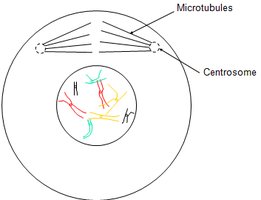
Microtubules: Thick rods, cell shape, movement, chromosome movement.
Microfilaments: Actin, cell shape, movement.
Intermediate Filaments: Structural support.
Example: The diagram below illustrates the role of microtubules and centrosomes in organizing the cytoskeleton during cell division.
Membrane Structure and Function
Membrane Structure
Biological membranes are composed of a phospholipid bilayer with embedded proteins, providing selective permeability.
Phospholipids: Amphipathic molecules forming bilayers.
Proteins: Integral, peripheral, transport, receptor.
Fluidity and Permeability
Membrane fluidity is influenced by fatty acid saturation, cholesterol, and temperature. Membranes are selectively permeable, allowing diffusion and active transport.
Diffusion: Movement of molecules from high to low concentration.
Osmosis: Diffusion of water.
Active Transport: Requires energy (ATP).
Introduction to Metabolism
Metabolic Pathways
Metabolism includes catabolic (breakdown) and anabolic (synthesis) pathways.
Catabolic Pathways: Release energy.
Anabolic Pathways: Consume energy.
Energy and Thermodynamics
Energy transformations follow the laws of thermodynamics.
First Law: Energy cannot be created or destroyed.
Second Law: Entropy increases.
Free Energy:
Cellular Respiration and Fermentation
Redox Reactions
Cellular respiration involves oxidation-reduction reactions, transferring electrons to generate ATP.
NAD+/NADH: Electron carriers.
ATP: Energy currency.
Glycolysis, Citric Acid Cycle, Oxidative Phosphorylation
These pathways break down glucose to produce ATP.
Glycolysis: Occurs in cytosol.
Citric Acid Cycle: Occurs in mitochondria.
Oxidative Phosphorylation: Electron transport chain, ATP synthesis.
Fermentation
Fermentation regenerates NAD+ in the absence of oxygen.
Alcohol Fermentation: Produces ethanol.
Lactic Acid Fermentation: Produces lactic acid.
Photosynthesis
Overview and Location
Photosynthesis converts solar energy to chemical energy in chloroplasts.
Light Reactions: Generate ATP and NADPH.
Calvin Cycle: Fixes carbon to produce glucose.
Cell Communication
Types of Cell Signaling
Cells communicate via local and long-distance signaling, using receptors and signal transduction pathways.
Local Signaling: Direct contact, paracrine, synaptic.
Endocrine Signaling: Hormones.
Signal Transduction
Signal transduction involves phosphorylation cascades and second messengers.
Phosphorylation: Addition of phosphate group.
Second Messengers: cAMP, Ca2+.
Cell Cycle and Mitosis
Cell Cycle
The cell cycle includes interphase (G1, S, G2) and mitotic phase (mitosis, cytokinesis).
Genome: Complete set of DNA.
Chromosomes: DNA molecules.
Interphase: Cell growth and DNA replication.
Mitosis: Division of nucleus.
Cytokinesis: Division of cytoplasm.
Cell Cycle Checkpoints
Checkpoints regulate cell division and ensure accuracy.
G1, G2, M Checkpoints: Control progression.
Cyclins and CDKs: Regulatory proteins.
Meiosis and Sexual Life Cycles
Asexual vs. Sexual Reproduction
Asexual reproduction involves one parent and produces genetically identical offspring. Sexual reproduction involves two parents and produces genetically diverse offspring.
Asexual Reproduction: One parent, no fertilization, identical offspring.
Sexual Reproduction: Two parents, fertilization required, diverse offspring.
Chromosome Number and Structure
Diploid cells (2n) have pairs of homologous chromosomes; haploid cells (n) have one set.
Diploid: Two sets of chromosomes (2n).
Haploid: One set of chromosomes (n).
Gametes: Haploid reproductive cells.
Homologous Chromosomes: Chromosome pairs with same genes.
Meiosis
Meiosis reduces chromosome number by half, producing haploid gametes. It includes two divisions: Meiosis I (separates homologous chromosomes) and Meiosis II (separates sister chromatids).
Meiosis I: Reductive division.
Meiosis II: Equational division.
Crossing Over: Exchange of genetic material.
Independent Assortment: Random distribution of chromosomes.
Spermatogenesis and Oogenesis
Gametogenesis produces sperm (spermatogenesis) and eggs (oogenesis).
Spermatogenesis: Occurs in testes, produces sperm.
Oogenesis: Occurs in ovaries, produces ovum and polar bodies.
Aneuploidy
Aneuploidy results from nondisjunction, leading to abnormal chromosome numbers (trisomy, monosomy).
Trisomy: Extra chromosome (2n+1).
Monosomy: Missing chromosome (2n-1).
Examples: Down syndrome, Turner syndrome, Klinefelter syndrome.
Genetics
Mendelian Genetics
Mendel's principles explain inheritance patterns: law of segregation and law of independent assortment.
Genes: Units of heredity.
Alleles: Variants of a gene.
Genotype: Genetic makeup.
Phenotype: Observable traits.
Dominant/Recessive: Dominant alleles mask recessive ones.
Genetic Crosses
Monohybrid and dihybrid crosses predict offspring genotypes and phenotypes using Punnett squares.
Monohybrid Cross: One gene.
Dihybrid Cross: Two genes.
Punnett Square: Diagram for predicting genetic outcomes.
Pedigree Analysis
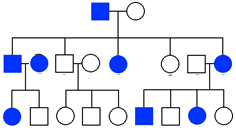
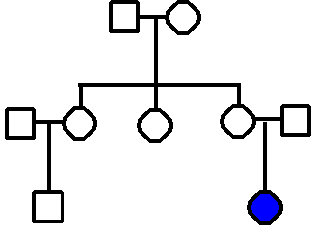
Pedigrees trace inheritance patterns in families. Dominant and recessive traits can be identified by analyzing affected and unaffected individuals.
Dominant Pedigree: Trait appears in every generation.
Recessive Pedigree: Trait may skip generations.
Example: The pedigree below illustrates a dominant inheritance pattern, with affected individuals shaded in blue.
Example: The pedigree below illustrates a recessive inheritance pattern, with affected individuals shaded in blue.
Molecular Basis of Inheritance
DNA Structure and Replication
DNA is composed of a deoxyribose sugar, phosphate backbone, and nitrogenous bases. Replication is semiconservative, involving enzymes such as helicase, DNA polymerase, and ligase.
Antiparallel Strands: 5' to 3' and 3' to 5'.
Complementary Base Pairing: A-T, G-C.
Replication Fork: Site of DNA synthesis.
DNA Repair and Chromatin Packing
DNA repair mechanisms correct errors; chromatin is packed into nucleosomes, euchromatin, and heterochromatin.
Gene Expression: From Gene to Protein
Transcription and Translation
Transcription produces RNA from DNA; translation synthesizes proteins from mRNA.
Transcription: RNA polymerase, promoter, template strand.
Translation: Ribosomes, tRNA, codons, anticodons.
Mutations
Mutations alter DNA sequence, leading to missense, nonsense, silent, or frameshift changes.
Regulation of Gene Expression
Bacterial and Eukaryotic Regulation
Gene expression is regulated at transcriptional, post-transcriptional, and epigenetic levels.
Operons: Bacterial gene clusters.
Epigenetics: DNA methylation, histone modification.
Noncoding RNAs: miRNA, siRNA, RNAi.
Additional info: This study guide covers all major concepts and vocabulary from Biology 180, including cell structure, molecular biology, genetics, and gene regulation. The included images are directly relevant to the explanation of cell division (microtubules and centrosome) and pedigree analysis (dominant and recessive inheritance patterns).
