 Back
Biology 1A: Molecules, Genes, and Cells – Step-by-Step Study Guidance
Study Guide - Smart Notes
 Tailored notes based on your materials, expanded with key definitions, examples, and context.
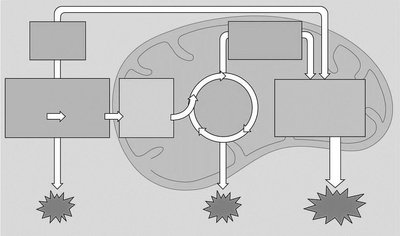
Q6a. Complete this simplified diagram of aerobic respiration by writing the appropriate term(s) for each numbered shape (1 to 8).
Background
Topic: Cellular Respiration
This question tests your understanding of the main steps and components of aerobic respiration, including glycolysis, the citric acid cycle, and oxidative phosphorylation, as well as the production of ATP.
Key Terms and Concepts:
Glycolysis
Pyruvate
Citric Acid Cycle (Krebs Cycle)
Electron Transport Chain
ATP (adenosine triphosphate)
NADH and FADH2 (electron carriers)
Step-by-Step Guidance
Examine the diagram and identify the mitochondrion, which is the site of aerobic respiration in eukaryotic cells.
Start with the first numbered shape, which typically represents glycolysis occurring in the cytoplasm. Glycolysis converts glucose into pyruvate and produces ATP and NADH.
The next shape likely represents the conversion of pyruvate to acetyl-CoA, which enters the citric acid cycle.
The circular pathway in the diagram is the citric acid cycle, where acetyl-CoA is oxidized, producing NADH, FADH2, and ATP (or GTP).
Electron carriers (NADH and FADH2) transfer electrons to the electron transport chain, which is embedded in the inner mitochondrial membrane.
ATP is produced at multiple steps: some directly in glycolysis and the citric acid cycle, but most via oxidative phosphorylation in the electron transport chain.
Identify the points in the diagram where ATP is shown as being produced, and match these to the correct steps.
Use your knowledge of the sequence of events to fill in the remaining shapes, but stop before writing the final terms for each numbered shape.
Try solving on your own before revealing the answer!
Final Answer:
1. Glycolysis 2. Pyruvate 3. Acetyl-CoA 4. Citric Acid Cycle (Krebs Cycle) 5. NADH/FADH2 (electron carriers) 6. Electron Transport Chain 7. ATP produced by substrate-level phosphorylation 8. ATP produced by oxidative phosphorylation
This diagram summarizes the flow of carbon and energy through aerobic respiration, showing where ATP is generated and how electron carriers feed into the electron transport chain.
Q6b. List the types of energy conversion that take place during oxidative phosphorylation.
Background
Topic: Oxidative Phosphorylation
This question tests your understanding of how energy is transformed during the final stage of cellular respiration, specifically in the mitochondria.
Key Terms and Concepts:
Oxidative phosphorylation
Electron transport chain
ATP synthase
Proton gradient
Chemiosmosis
Step-by-Step Guidance
Recall that oxidative phosphorylation occurs in the inner mitochondrial membrane.
Electrons from NADH and FADH2 are transferred through the electron transport chain, releasing energy.
This energy is used to pump protons (H+) across the membrane, creating a proton gradient.
The proton gradient represents potential energy, which is then used by ATP synthase to convert ADP and inorganic phosphate into ATP.
Identify the types of energy involved: chemical energy in NADH/FADH2, electrical potential energy in the proton gradient, and chemical energy in ATP.
Try solving on your own before revealing the answer!
Final Answer:
The types of energy conversion during oxidative phosphorylation are: 1. Chemical energy (in NADH/FADH2) → Electrical potential energy (proton gradient) 2. Electrical potential energy (proton gradient) → Mechanical energy (rotation of ATP synthase) 3. Mechanical energy → Chemical energy (formation of ATP)
These conversions allow the cell to efficiently produce ATP from the energy stored in electron carriers.
Q6c. In a muscle cell deprived of oxygen, which step(s) of glucose oxidation can no longer take place? Which step(s) can still take place? Briefly explain why.
Background
Topic: Anaerobic vs. Aerobic Respiration
This question tests your understanding of how cells respond to the absence of oxygen and which metabolic pathways are affected.
Key Terms and Concepts:
Glycolysis
Citric Acid Cycle
Electron Transport Chain
Fermentation
Oxygen as the final electron acceptor
Step-by-Step Guidance
Recall that glycolysis does not require oxygen and occurs in the cytoplasm.
The citric acid cycle and electron transport chain require oxygen, as it is the final electron acceptor in the chain.
In the absence of oxygen, the electron transport chain cannot function, and NADH cannot be oxidized to NAD+.
Without NAD+ regeneration, the citric acid cycle also stops.
Glycolysis can continue if NAD+ is regenerated through fermentation (e.g., lactic acid fermentation in muscle cells).
Try solving on your own before revealing the answer!
Final Answer:
Without oxygen, the citric acid cycle and electron transport chain cannot take place because oxygen is required as the final electron acceptor. Glycolysis can still occur, as it does not require oxygen, and NAD+ is regenerated via fermentation.
This is why muscle cells switch to lactic acid fermentation when oxygen is scarce.
