 Back
Biology Exam 3 Study Guide: Immune System, Thermoregulation, Urinary System, and Reproductive System
Study Guide - Smart Notes
 Tailored notes based on your materials, expanded with key definitions, examples, and context.
Immune System
Function and Lines of Defense
The immune system enables animals to avoid or limit infections caused by pathogens. Pathogens include bacteria, viruses, fungi, protozoans, and worms. The immune system distinguishes between self (the body's own cells and molecules) and non-self (foreign substances or pathogens).
First line of defense: Nonspecific barrier defenses (skin, mucus, cilia) prevent pathogen entry.
Second line of defense: Nonspecific internal defenses (inflammation, phagocytic cells) fight pathogens inside the body.
Third line of defense: Specific adaptive immune responses recognize and target particular pathogens.
Barrier Defenses: Skin and Respiratory Tract
Barrier defenses are physical and chemical protections that prevent pathogens from entering the body. Examples include the skin and the linings of the respiratory and digestive tracts.
Skin: Multiple cell layers, acidic secretions (sebum and sweat), lysozyme enzyme, and resident bacteria provide protection.
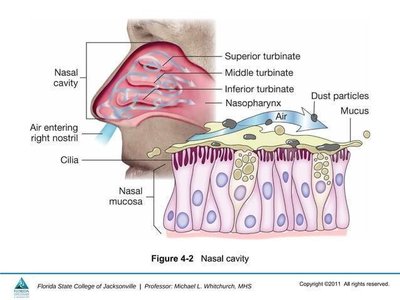
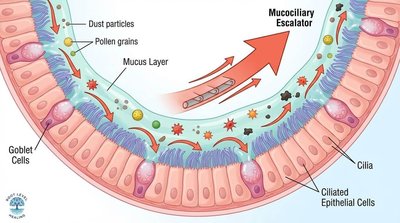
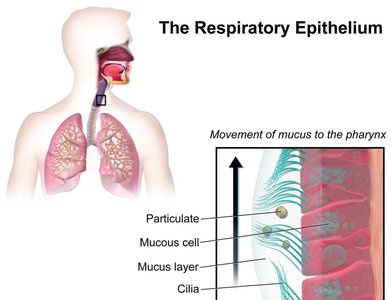
Respiratory tract: Nasal hairs filter particles, mucus traps dust and microbes, and cilia move trapped material toward the throat.
Sequence: Nasal hairs filter → mucus traps → cilia move trapped particles toward the throat.
Adaptive Immunity
B Cells, T Cells, and Immunological Memory
Adaptive immunity is a specific defense found in vertebrates, recognizing particular antigens and responding to them. It includes:
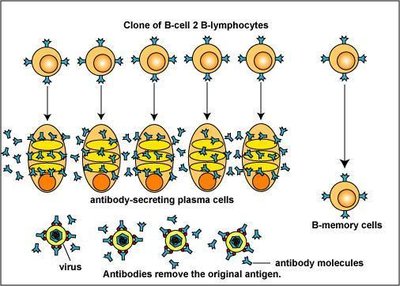
Antibody-mediated (humoral) immunity: B cells develop into plasma cells that produce antibodies, which bind to specific antigens.
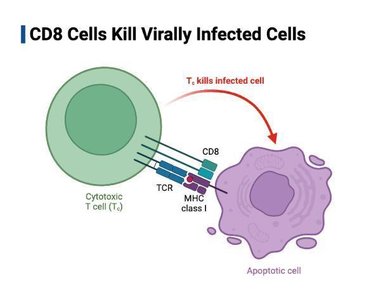
Cell-mediated immunity: T cells (helper and cytotoxic) coordinate responses and attack infected cells.
Antigens, Antigen Receptors, and Antibodies
Antigen: A molecule recognized by the immune system; provides a target for recognition.
Antigen receptor: Protein on lymphocytes that recognizes specific antigens.
Antibody: Protein produced by plasma cells that binds to specific antigens.
Lymphocytes: B Cells vs. T Cells
B cells: Bind intact antigens directly; can become plasma cells (secrete antibodies) or memory B cells.
T cells: Recognize antigen fragments presented on MHC molecules; differentiate into helper, cytotoxic, or memory T cells.
Four Aspects of Adaptive Immunity
Diversity: Recognizes many different antigens.
Self-tolerance: Normally avoids attacking self.
Clonal proliferation: Activated lymphocytes multiply to produce clones.
Immunological memory: Faster, stronger response after repeat exposure.
Activation of B and T Cells
Effector cells: Act immediately (plasma cells, cytotoxic T cells, helper T cells).
Memory cells: Long-lived, respond to future exposures.
Immunological Memory: Primary vs. Secondary Response
Feature | Primary Response | Secondary Response |
|---|---|---|
Exposure | First encounter | Repeat encounter |
Peak timing | 10–17 days | 2–7 days |
Antibody production | Lower | Much higher |
Memory cells | Generated | Drive rapid response |
Antibody-Mediated Immunity
How Antibodies Affect Pathogens
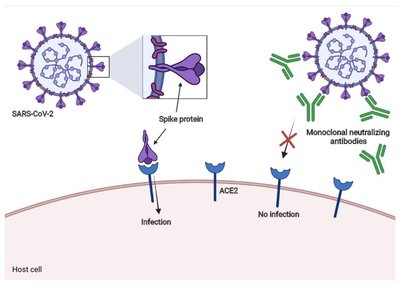
Neutralization: Antibodies block viruses/toxins from attaching to host cells.
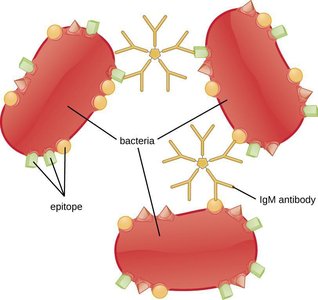
Agglutination: Antibodies cross-link particles/cells, causing clumping.
Opsonization: Antibodies coat pathogens, making them easier for phagocytes to engulf.
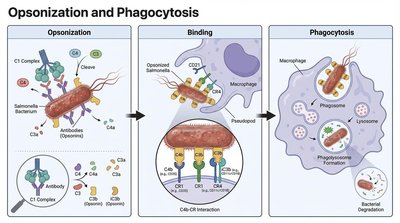
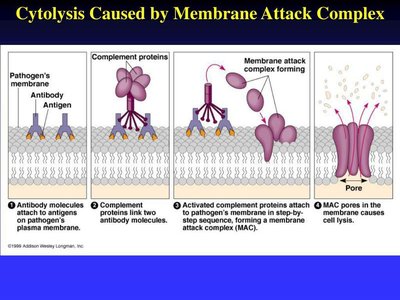
Complement activation: Antibodies activate complement proteins, promoting pathogen clearance and membrane damage.
Cell-Mediated Immunity
T Cell Activation and Function
Helper T cells: Coordinate immune responses, activate B cells and cytotoxic T cells.
Cytotoxic T cells: Kill infected or abnormal body cells.
Memory T cells: Provide faster response after future exposure.
Immune Disorders
Allergies, Autoimmune Disorders, and Immunodeficiency
Allergy: Excessive immune response to harmless antigens (allergens); involves histamine and can cause anaphylaxis.
Autoimmune disorder: Immune system attacks self (e.g., lupus, rheumatoid arthritis, type 1 diabetes).
Immunodeficiency: Defective or weakened immune response (e.g., HIV/AIDS).
Disorder | Main Problem |
|---|---|
Allergy | Excessive response |
Autoimmune | Wrong target (self-attack) |
Immunodeficiency | Insufficient defense |
Thermoregulation
Types and Mechanisms
Endothermy: Internal heat production (birds, mammals).
Ectothermy: Reliance on external heat sources (reptiles, amphibians, most fish).
Heat Exchange
Radiation: Heat transfer via electromagnetic waves.
Evaporation: Heat loss as liquid becomes vapor.
Convection: Heat transfer via moving air/water.
Conduction: Heat transfer via direct contact.
Adaptations
Insulation: Fur, feathers, fat reduce heat loss.
Vasodilation: Blood vessels widen, releasing heat.
Vasoconstriction: Blood vessels narrow, conserving heat.
Countercurrent heat exchanger: Transfers heat between fluids flowing in opposite directions.
Evaporative cooling: Sweating, panting remove heat.
Mammalian Thermoregulation
Hypothalamus: Acts as the body's thermostat.
Negative feedback: Maintains body temperature via vasodilation, sweating, vasoconstriction, shivering.
Fever and Acclimatization
Fever: Increased temperature set point during infection.
Acclimatization: Physiological adjustment to environmental temperature changes.
Torpor, Hibernation, Estivation
Torpor: Temporary reduction in metabolic rate.
Hibernation: Surviving cold and limited food.
Estivation: Surviving heat and limited water.
Urinary System & Osmoregulation
Functions and Structures
Excretion: Removal of metabolic wastes.
Osmoregulation: Balance of water and solutes.
Transport epithelium: Controls movement of substances.
Nitrogenous Waste Types
Waste | Toxicity | Energy Cost | Water Required |
|---|---|---|---|
Ammonia | High | Low | High |
Urea | Moderate | Moderate | Moderate |
Uric acid | Low | High | Very low |
Osmoregulation Strategies
Osmoconformers: Internal solute concentration matches environment (e.g., sharks).
Osmoregulators: Maintain specific internal solute concentration (e.g., marine/freshwater fish, land animals).
Nephron Structure and Urine Formation
Kidney: Filters blood, produces urine.
Nephron: Functional unit; includes glomerulus, Bowman's capsule, PCT, Loop of Henle, DCT, collecting duct.
Filtration: Blood filtered in glomerulus.
Reabsorption: Useful substances returned to blood.
Secretion: Additional substances added to filtrate.
Excretion: Urine eliminated from body.
Hormonal Regulation
ADH: Increases water reabsorption, produces concentrated urine.
RAAS: Responds to low blood volume/pressure, increases sodium and water retention.
ANP: Responds to high blood volume/pressure, increases sodium and water excretion.
System | Main Stimulus | Sensor | Hormone | Main Action |
|---|---|---|---|---|
ADH | Increased osmolarity | Hypothalamus | ADH | Reabsorbs water |
RAAS | Decreased blood volume/pressure | JGA | Renin → angiotensin II → aldosterone | Reabsorbs Na+ and water |
ANP | Increased blood volume/pressure | Atria | ANP | Increases Na+ and water excretion |
Reproductive System
Asexual vs. Sexual Reproduction
Asexual: One parent, no fertilization, genetically identical offspring, lower energy cost.
Sexual: Two parents, fertilization, genetically varied offspring, higher energy cost.
Types of Asexual Reproduction
Fission: Parent splits into individuals.
Budding: New organism grows as a bud.
Fragmentation: Parent breaks into pieces that regenerate.
Parthenogenesis: Unfertilized egg develops into offspring.
Hermaphroditism
Simultaneous: Both male and female organs at same time.
Sequential: Changes sex during lifetime (protandry: male→female; protogyny: female→male).
Fertilization and Parental Care
External fertilization: Occurs outside body, many zygotes, lower survival rate.
Internal fertilization: Occurs inside body, fewer zygotes, higher survival rate.
Parental care: Protects and nourishes offspring, increases survival.
Gametogenesis
Spermatogenesis: Produces four sperm from one primary spermatocyte; continuous after puberty.
Oogenesis: Produces one mature ovum from one primary oocyte; begins before birth, interrupted at prophase I and metaphase II.
Reproductive Organs and Hormones
Male: Testes, scrotum, seminiferous tubules, epididymis, vas deferens, urethra, penis, accessory glands.
Female: Ovaries, fallopian tubes, uterus, endometrium, cervix, vagina, follicle, corpus luteum, mammary glands.
Hormones: GnRH, FSH, LH, testosterone, estrogen, progesterone, hCG, oxytocin, prostaglandins, estradiol, inhibin.
Ovarian and Menstrual Cycles
Ovarian cycle: Follicular phase (FSH, estrogen), ovulation (LH surge), luteal phase (progesterone).
Menstrual cycle: Menstrual flow (lining sheds), proliferative (lining rebuilds, estrogen), secretory (lining maintained, progesterone).
Pregnancy and Childbirth
hCG: Maintains corpus luteum in early pregnancy.
Trimesters: First (organogenesis), second (growth, placenta takes over hormone production), third (further growth, labor).
Childbirth: Positive feedback loop involving oxytocin and prostaglandins.
Quick Memory Tips
Ammonia: Very toxic, needs lots of water.
Urea: Mammals.
Uric acid: Birds, reptiles; conserves water.
ADH: Retains water.
Aldosterone: Retains sodium and water.
ACE: Converts angiotensin I to II.
Ectotherm: Heat from environment.
Endotherm: Internal heat production.
FSH: Follicle development.
LH: Ovulation.
hCG: Maintains corpus luteum.
Progesterone: Maintains uterine lining.
Estrogen: Uterine lining, female traits.
Oxytocin: Uterine contractions.
Oogenesis: Egg production.
Spermatogenesis: Sperm production.
