 Back
BackBiology: Exploring Life – Study Notes (Chapter 1)
Study Guide - Smart Notes
 Tailored notes based on your materials, expanded with key definitions, examples, and context.
Biology: The Study of Scientific Life
What is Biology?
Biology is the scientific study of life, encompassing the structure, function, growth, origin, evolution, and distribution of living organisms. Biologists seek to understand the natural world through observation, experimentation, and analysis.
The Properties of Life
Key Characteristics of Living Organisms
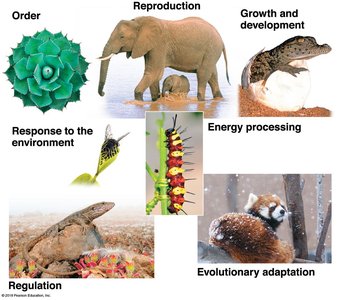
Order: Life is characterized by highly ordered structures, from the molecular to the organismal level.
Reproduction: Organisms have the ability to reproduce their own kind, ensuring the continuation of their species.
Growth and Development: Organisms grow and develop in a consistent manner, controlled by inherited DNA.
Response to the Environment: Living things can respond to environmental stimuli.
Energy Processing: Organisms use chemical energy to power their activities and chemical reactions.
Regulation: Organisms regulate their internal environment to sustain life (homeostasis).
Evolutionary Adaptation: Over generations, traits best suited to the environment become more common in a population.
Diversity of Life
The Three Domains of Life
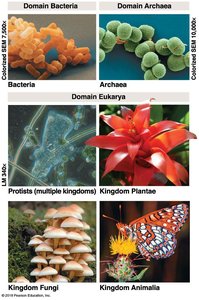
Diversity is a hallmark of life, organized into three domains:
Domain Bacteria: Single-celled prokaryotes, most abundant and diverse, with unparalleled nutritional diversity.
Domain Archaea: Single-celled prokaryotes that often live in extreme environments (e.g., high salt, heat, or acidity).
Domain Eukarya: Organisms with complex, eukaryotic cells; includes single-celled and multicellular organisms (protists, plants, fungi, animals).
Taxonomy and Binomial Nomenclature
Taxonomy: The branch of biology that classifies and names organisms.
Binomial Nomenclature: A two-part scientific naming system using genus and species (e.g., Homo sapiens for humans).
Cell Types
Prokaryotic Cells: Lack membrane-bound organelles, simple and small (found in Bacteria and Archaea).
Eukaryotic Cells: Have membrane-bound organelles, larger and more complex (found in Eukarya).
Hierarchy of Life
Levels of Biological Organization
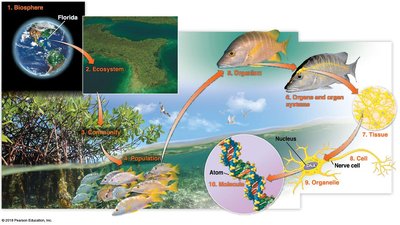
Life is organized in a hierarchy from the smallest to the most complex:
Atoms → Molecules → Organelles → Cells → Tissues → Organs → Organ Systems → Organism → Population → Community → Ecosystem → Landscapes → Biosphere
Five Unifying Themes of Biology
Major Themes
Evolution: The process that has transformed life from its earliest forms to the diversity seen today. Evolution is driven by natural selection, where populations (not individuals) change over time.
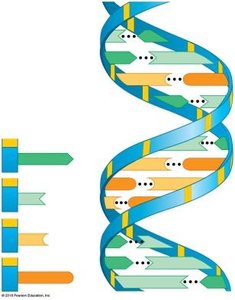
Flow of Information: Genetic information encoded in DNA determines the structure and function of organisms. Gene expression involves transcription of DNA to RNA and translation to protein.
Structure and Function: Biological structures are closely related to their functions at all levels of organization. For example, the structure of hemoglobin enables it to transport oxygen.
Transfer & Transformation of Energy & Matter: Energy flows through ecosystems, entering as sunlight, converted by producers (autotrophs) to chemical energy, passed to consumers (heterotrophs), and lost as heat.
Interactions within & between Systems: Systems biology studies the interactions among parts of biological systems, from molecules to the biosphere.
The Process of Science
The Scientific Method
The scientific method is a logical approach to solving problems and answering questions about the natural world. It involves:
Observation: Noticing and describing phenomena.
Question: Asking why or how something occurs.
Gathering Preliminary Information: Researching existing knowledge.
Hypothesis: Proposing a testable explanation ("If, then" statement).
Experiment: Testing the hypothesis with controlled experiments.
Results: Collecting and analyzing data (quantitative or qualitative).
Discussion: Interpreting data and comparing with other research.
Conclusion: Accepting or rejecting the hypothesis based on data.
Experimental Design
Independent Variable: The factor manipulated by the experimenter.
Dependent Variable: The observed effect or outcome.
Control Group: The group not exposed to the independent variable, used for comparison.
Constants: All other factors kept the same between groups.
Data Presentation
Graphs (especially line graphs) are used to summarize and visualize experimental results.
The independent variable is plotted on the X-axis, and the dependent variable on the Y-axis.
Scientific Theory
A scientific theory is broader than a hypothesis and supported by a large body of evidence.
Science is a collaborative and cumulative process, involving peer review and communication among scientists.
Examples and Applications
Case Study: Praying Mantis Reproduction
Observation: Praying mantis in Florida have a higher reproductive cycle than those in Illinois.
Hypothesis: If the amount of vitamin C is increased in the diet of Chinese mantis, then the number of egg cases laid will increase.
Experiment: Groups of mantis are given different diets, with all other conditions kept constant.
Variables: Independent variable – vitamin C in diet; Dependent variable – number of egg cases; Control group – mantis with standard diet.
Conclusion: Data is used to accept or reject the hypothesis.
Summary Table: Differences Between Domains
Characteristic | Bacteria | Archaea | Eukarya |
|---|---|---|---|
rRNA sequences | Some unique to bacteria | Some unique to archaea; some match eukaryotic sequences | Some unique to eukaryotes; some match archaeal sequences |
RNA polymerase | One kind; relatively small and simple | Several kinds; complex | Several kinds; complex |
Introns | Rare | In some genes | Present |
Histones associated with DNA | Absent | Present in some species | Present |
Peptidoglycan in cell wall | Present | Absent | Absent |
Additional info: These notes provide a comprehensive overview of the foundational concepts in biology, suitable for exam preparation and understanding the scope of biological study.
