 Back
BackBiology Final Exam Review Guidance: Molecular Biology, Genetics, and Bioinformatics
Study Guide - Smart Notes
 Tailored notes based on your materials, expanded with key definitions, examples, and context.
Q1. What is the difference between bioinformatics and computational biology?
Background
Topic: Bioinformatics vs. Computational Biology
This question tests your understanding of two related but distinct fields that use technology and computation to analyze biological data.
Key Terms:
Bioinformatics: The development and application of tools, software, and databases to manage and analyze biological data, especially genetic sequences.
Computational Biology: The use of mathematical models, simulations, and computational techniques to understand biological systems and processes.
Key Concepts:
Bioinformatics often focuses on data processing, storage, and analysis (e.g., sequence alignment, database creation).
Computational biology emphasizes modeling, simulation, and interpretation of biological phenomena (e.g., protein folding, population genetics).
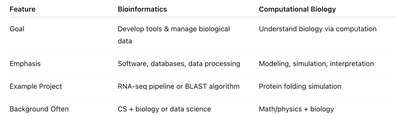
Step-by-Step Guidance
Identify the main goal of each field: Bioinformatics is about developing tools and managing biological data, while computational biology is about understanding biology through computation.
Compare the emphasis: Bioinformatics emphasizes software, databases, and data processing; computational biology emphasizes modeling, simulation, and interpretation.
Think of example projects: Bioinformatics might involve creating a BLAST algorithm or RNA-seq pipeline; computational biology might involve simulating protein folding.
Consider the typical academic backgrounds: Bioinformatics often combines computer science and biology; computational biology often combines math/physics and biology.
Try solving on your own before revealing the answer!
Final Answer:
Bioinformatics focuses on developing tools and managing biological data, while computational biology uses computation to model and interpret biological systems. Bioinformatics is more about data processing, and computational biology is more about simulation and modeling.
The table shows that bioinformatics projects include sequence analysis pipelines, while computational biology projects include protein folding simulations.
Q2. How does genetic variation contribute to differences between individuals of the same species?
Background
Topic: Genetic Variation
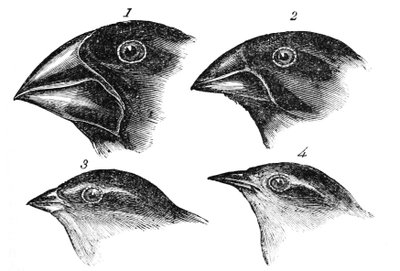
This question is about understanding how differences in DNA sequences among individuals lead to observable differences (phenotypes) within a species.
Key Terms:
Genetic Variation: Differences in DNA sequences among individuals.
Phenotype: Observable traits or characteristics of an organism.

Step-by-Step Guidance
Recall that genetic variation arises from mutations, recombination, and other mechanisms that change DNA sequences.
Understand that these variations can affect gene function, leading to differences in protein production or activity.
Connect genetic variation to phenotypic differences, such as physical appearance, metabolism, or disease susceptibility.
Consider examples: In yeast, different strains may have different growth rates; in dogs, genetic variation leads to differences in size, color, and behavior.
Try solving on your own before revealing the answer!
Final Answer:
Genetic variation leads to differences in traits among individuals by altering gene function and expression. This results in observable phenotypic diversity, such as differences in appearance or health.
For example, yeast strains and dog breeds show variation due to differences in their DNA.
Q3. What is a gene-by-environment interaction (GxE), and why is it important in studying human disease?
Background
Topic: Gene-by-Environment Interaction (GxE)
This question tests your understanding of how genetic and environmental factors combine to influence traits and disease risk.
Key Terms:
Gene-by-Environment Interaction (GxE): When the effect of a gene on a trait depends on the environment.
Phenotype: The observable trait resulting from the interaction of genotype and environment.

Step-by-Step Guidance
Define GxE: It occurs when the impact of a genetic variant on a trait changes depending on environmental conditions.
Understand why GxE is important: Many diseases are influenced by both genetic predisposition and environmental factors (e.g., diet, lifestyle).
Consider examples: Phenylketonuria (PKU) is a classic case where a genetic mutation causes disease only if the individual consumes phenylalanine.
Recognize that studying GxE helps explain why some people develop diseases while others do not, even with similar genetic backgrounds.
Try solving on your own before revealing the answer!
Final Answer:
Gene-by-environment interaction means that the effect of a gene depends on the environment. This is crucial for understanding complex diseases, as both genetics and environment contribute to disease risk.
For example, PKU is only expressed as a disease phenotype if the environment (diet) contains phenylalanine.
Q4. How are fluorescent reporter proteins used to measure gene expression and protein degradation?
Background
Topic: Fluorescent Reporter Proteins
This question is about understanding how scientists use proteins like GFP (green fluorescent protein) to study gene expression and protein degradation in cells.
Key Terms:
Fluorescent Reporter Protein: A protein that emits fluorescence, used to track gene expression or protein levels.
Gene Expression: The process by which information from a gene is used to produce a functional product (protein).
Protein Degradation: The breakdown of proteins, often regulated by cellular mechanisms.

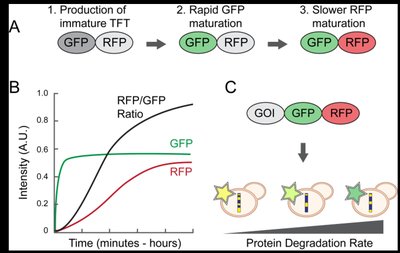
Step-by-Step Guidance
Recall that fluorescent proteins like GFP can be attached to other proteins or expressed under the control of specific genes.
Understand that measuring fluorescence intensity allows scientists to quantify how much of a protein is present, indicating gene expression levels.
Learn about tandem fluorescent timer reporters (TFTs), which use two fluorescent proteins (e.g., GFP and RFP) to measure protein degradation rates.
Recognize that changes in fluorescence over time can indicate how quickly a protein is degraded in the cell.
Try solving on your own before revealing the answer!
Final Answer:
Fluorescent reporter proteins are used to measure gene expression by quantifying fluorescence, and tandem fluorescent timers can measure protein degradation rates by comparing the maturation and decay of different fluorescent signals.
GFP and RFP allow researchers to track protein levels and degradation in real time.
