 Back
BackBiology Study Guide: Carbohydrates, Membranes, and Molecular Transport
Study Guide - Smart Notes
 Tailored notes based on your materials, expanded with key definitions, examples, and context.
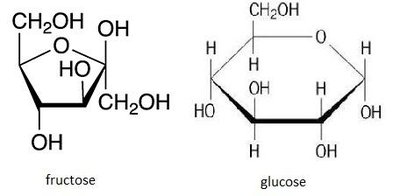
Q1. What can you conclude about fructose and glucose based on their chemical structures?
Background
Topic: Carbohydrates and Molecular Structure
This question tests your understanding of the similarities and differences between two monosaccharides, fructose and glucose, and their classification as carbohydrates.
Key Terms and Formulas:
Monosaccharide: A simple sugar molecule, such as glucose or fructose.
General formula for carbohydrates:
Hydroxyl group: functional group found in carbohydrates.
Carbonyl group: functional group present in sugars.
Step-by-Step Guidance
Examine the chemical structures of fructose and glucose. Notice that both have six carbon atoms, twelve hydrogen atoms, and six oxygen atoms.
Identify the functional groups present in each molecule. Both contain multiple hydroxyl () groups and a carbonyl group.
Recall the general formula for carbohydrates: . Check if both molecules fit this formula.
Consider whether fructose and glucose are the same molecule or structural isomers (same formula, different arrangement).
Try solving on your own before revealing the answer!
Final Answer:
Fructose and glucose both have the general formula , are carbohydrates, and contain multiple hydroxyl groups. They are structural isomers, not the same molecule.
They differ in the arrangement of their atoms, which gives them different properties.
Q2. Which statement accurately explains why humans can use the energy in pasta but not in the box it comes in?
Background
Topic: Digestion and Enzyme Specificity
This question tests your understanding of how enzymes enable the digestion of carbohydrates and why some forms (like cellulose) cannot be digested by humans.
Key Terms:
Starch: A carbohydrate found in pasta, digestible by humans.
Cellulose: A carbohydrate found in plant cell walls (like the box), indigestible by humans.
Enzyme: A protein that catalyzes biochemical reactions (e.g., amylase for starch, cellulase for cellulose).
Step-by-Step Guidance
Recall that both pasta and the box are made of carbohydrates, but in different forms (starch vs. cellulose).
Consider the enzymes present in humans: we have amylase to digest starch, but lack cellulase to digest cellulose.
Think about the implications for energy extraction: only molecules that can be broken down by our enzymes can be used for energy.
Evaluate why the box, despite being a carbohydrate, cannot be used for energy by humans.
Try solving on your own before revealing the answer!
Final Answer:
Humans can use the energy in pasta because we have the enzymes to break down starch, but not the energy in the box because we lack the enzyme cellulase needed to digest cellulose.
Enzyme specificity determines which carbohydrates can be metabolized for energy.
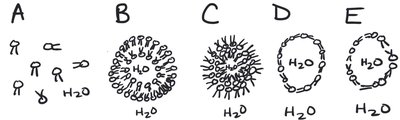
Q3. Which image best illustrates the arrangement of phospholipids in water?
Background
Topic: Membrane Structure and Phospholipid Behavior
This question tests your understanding of how phospholipids arrange themselves in aqueous environments to form bilayers.
Key Terms:
Phospholipid: A molecule with a hydrophilic head and hydrophobic tail.
Hydrophilic: Water-loving; interacts with water.
Hydrophobic: Water-fearing; avoids water.
Bilayer: Double layer structure formed by phospholipids in water.
Step-by-Step Guidance
Recall that phospholipids have a hydrophilic head and hydrophobic tail.
In water, hydrophilic heads face outward toward water, while hydrophobic tails face inward, away from water.
Examine the images and identify which arrangement shows hydrophilic heads in contact with water and hydrophobic tails shielded from water.
Consider which arrangement forms a stable bilayer structure.
Try solving on your own before revealing the answer!
Final Answer:
Image B best illustrates the arrangement of phospholipids in water, with hydrophilic heads facing water and hydrophobic tails interacting with each other.
This arrangement forms the basis of biological membranes.
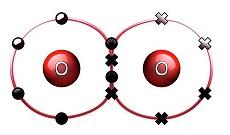
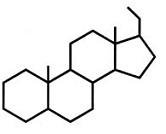
Q4. Which molecules can freely diffuse across a pure phospholipid bilayer?
Background
Topic: Membrane Permeability
This question tests your understanding of which types of molecules can cross cell membranes without the help of transport proteins.
Key Terms:
Simple diffusion: Movement of molecules across a membrane without energy or proteins.
Non-polar molecule: Molecule without a strong charge or partial charge (e.g., O2, steroids).
Polar/charged molecule: Molecule with a strong charge or partial charge (e.g., ions, sugars).
Step-by-Step Guidance
Recall that the phospholipid bilayer is selectively permeable, allowing non-polar molecules to cross freely.
Identify which molecules in the list are non-polar (e.g., O2, steroids).
Consider why ions (e.g., sodium, chloride) and polar molecules (e.g., fructose) cannot cross freely.
Review the molecular structures to confirm their polarity or charge.
Try solving on your own before revealing the answer!
Final Answer:
O2 and steroid molecules can freely diffuse across a pure phospholipid bilayer because they are non-polar.
Charged or strongly polar molecules require transport proteins to cross.
Q5. Which statement about a phospholipid bilayer is correct?
Background
Topic: Membrane Formation and Properties
This question tests your understanding of how phospholipid bilayers form and their properties.
Key Terms:
Spontaneous formation: Occurs without energy input.
Hydrophilic head: Interacts with water.
Hydrophobic tail: Avoids water.
Step-by-Step Guidance
Recall that phospholipids spontaneously form bilayers in water due to their amphipathic nature.
Consider whether energy input is required for bilayer formation.
Evaluate the other statements for accuracy (e.g., covalent bonds, protein composition).
Identify the correct statement based on your understanding of membrane structure.
Try solving on your own before revealing the answer!
Final Answer:
The phospholipid bilayer forms spontaneously due to the way phospholipids interact with water and does not require energy input from the cell.
This arrangement is driven by the hydrophilic and hydrophobic properties of phospholipids.
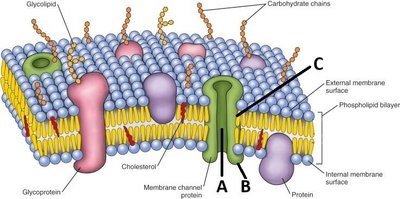
Q6. In a phospholipid bilayer, which regions of a channel protein are hydrophilic or hydrophobic?
Background
Topic: Membrane Proteins and Their Structure
This question tests your understanding of how membrane proteins interact with different regions of the phospholipid bilayer.
Key Terms:
Hydrophilic: Attracts water; found in regions exposed to water.
Hydrophobic: Repels water; found in regions exposed to membrane interior.
Aquaporin: Channel protein that allows water to cross the membrane.
Step-by-Step Guidance
Identify which regions of the protein are exposed to water (interior channel and membrane exterior).
Recall that hydrophilic regions interact with water, while hydrophobic regions interact with the membrane's interior.
Assign hydrophilic or hydrophobic properties to regions A, B, and C based on their location.
Review the diagram to confirm your assignments.
Try solving on your own before revealing the answer!
Final Answer:
Region A (interior channel) and Region B (membrane exterior) are hydrophilic, while Region C (membrane interior) is hydrophobic.
This arrangement allows the protein to function properly within the membrane.
Q7. Most transmembrane pumps, channels, and carriers are ____________.
Background
Topic: Membrane Transport Proteins
This question tests your understanding of the molecular composition of membrane transport structures.
Key Terms:
Transmembrane protein: Protein that spans the membrane and facilitates transport.
Pump, channel, carrier: Types of transport proteins.
Step-by-Step Guidance
Recall the types of molecules that can form transmembrane structures.
Consider the function of pumps, channels, and carriers in the membrane.
Identify which macromolecule (protein, nucleic acid, lipid, carbohydrate) is most commonly involved.
Review examples of membrane transport proteins.
Try solving on your own before revealing the answer!
Final Answer:
Most transmembrane pumps, channels, and carriers are proteins.
Proteins are uniquely suited to form complex structures and facilitate transport across membranes.
Q8. What must be true for sodium ion transport from low to high concentration in the kidney?
Background
Topic: Active Transport and Membrane Proteins
This question tests your understanding of active transport mechanisms and the requirements for moving ions against their concentration gradient.
Key Terms:
Active transport: Movement of molecules against their concentration gradient, requiring energy.
Transmembrane protein: Facilitates transport across the membrane.
Concentration gradient: Difference in concentration across a membrane.
Step-by-Step Guidance
Recall that moving ions from low to high concentration requires energy (active transport).
Identify the need for a transmembrane protein to facilitate this process.
Consider why passive transport cannot accomplish this movement.
Review examples of active transport in the kidney (e.g., sodium-potassium pump).
Try solving on your own before revealing the answer!
Final Answer:
Sodium ion transport from low to high concentration requires energy input, a transmembrane protein, and active transport.
This process is essential for maintaining proper ion balance in the kidney.
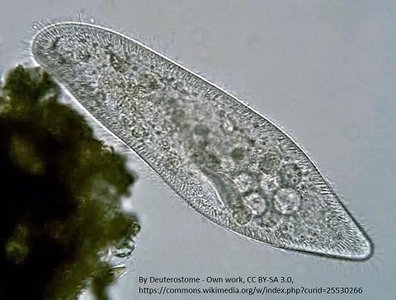
Q9. What is the net direction of water movement in a Paramecium caudatum living in fresh water, and what does the contractile vacuole do?
Background
Topic: Osmosis and Cellular Adaptations
This question tests your understanding of osmosis and how single-celled organisms regulate water balance.
Key Terms:
Hypertonic: Higher solute concentration inside the cell than outside.
Osmosis: Movement of water across a membrane toward higher solute concentration.
Contractile vacuole: Organelle that pumps excess water out of the cell.
Step-by-Step Guidance
Recall that a hypertonic cell in fresh water will gain water by osmosis.
Consider the function of the contractile vacuole in maintaining internal solute concentrations.
Determine the net direction of water movement and the role of the vacuole.
Review the diagram to confirm your understanding.
Try solving on your own before revealing the answer!
Final Answer:
Water moves into the cell, and the contractile vacuole pumps water out to maintain internal solute concentrations.
This adaptation prevents the cell from bursting in a hypotonic environment.
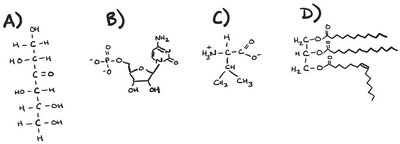
Q10. Identify the type of molecule and its features for each image (A–D).
Background
Topic: Biological Macromolecules
This question tests your ability to recognize and classify different types of biological molecules based on their structure.
Key Terms:
Monosaccharide: Simple sugar with formula .
Ribonucleotide: Nucleotide with a 5-carbon sugar, phosphate, and nitrogenous base.
Amino acid: Molecule with a central carbon, amino group, carboxyl group, hydrogen, and R-group.
Fat: Molecule with non-polar fatty acid chains attached to glycerol.
Step-by-Step Guidance
Examine each molecular structure and identify key features (e.g., functional groups, backbone).
Match each structure to its category (monosaccharide, ribonucleotide, amino acid, fat).
List the features that distinguish each molecule (e.g., hydroxyl groups, phosphate, amino/carboxyl groups, fatty acid chains).
Review the diagram to confirm your classifications.
Try solving on your own before revealing the answer!
Final Answer:
A: Monosaccharide (general formula , many hydroxyl groups, carbonyl group)
B: Ribonucleotide (5-carbon sugar, phosphate, nitrogenous base, 2'-OH group)
C: Amino acid (central carbon, amino group, carboxyl group, hydrogen, R-group)
D: Fat (non-polar fatty acid chains attached to glycerol)
Q11. Match each molecule to its function or description.
Background
Topic: Biological Macromolecule Functions
This question tests your knowledge of the roles of various macromolecules in cells and organisms.
Key Terms:
Glycogen: Energy storage in animals.
Cellulose: Structural polysaccharide in plants.
DNA: Stores genetic information.
Starch: Energy storage in plants.
Peptidoglycan: Structural polysaccharide in bacteria.
Fats: Primary energy storage in animals.
Step-by-Step Guidance
Review the descriptions and match each to the correct molecule based on its function.
Recall the structural and storage roles of polysaccharides in different organisms.
Identify which molecule stores genetic information.
Match primary energy storage molecules to plants and animals.
Try solving on your own before revealing the answer!
Final Answer:
Glycogen: Energy storage in animals
Cellulose: Structural polysaccharide in plants
DNA: Stores genetic information
Starch: Energy storage in plants
Peptidoglycan: Structural polysaccharide in bacteria
Fats: Primary energy storage in animals
Q12. Match each category of molecule to the monomer it is composed of.
Background
Topic: Macromolecule Structure
This question tests your understanding of the building blocks of biological macromolecules.
Key Terms:
Lipids: Not built from monomers.
Carbohydrates: Built from monosaccharides.
Proteins: Built from amino acids.
Nucleic acids: Built from nucleotides.
Step-by-Step Guidance
Recall the monomer for each macromolecule category.
Match each category to its monomer or "none" as appropriate.
Review your matches for accuracy.
Try solving on your own before revealing the answer!
Final Answer:
Lipids: none
Carbohydrates: monosaccharides
Proteins: amino acids
Nucleic acids: nucleotides
