 Back
BackBiology Study Guide: Energy, Enzymes, and Metabolism
Study Guide - Smart Notes
 Tailored notes based on your materials, expanded with key definitions, examples, and context.
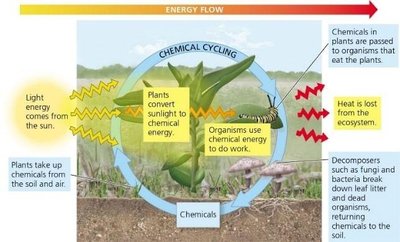
Q1. Explain the flow of energy and chemical recycling in the universe and the role of light energy.
Background
Topic: Energy Flow and Chemical Cycling in Biological Systems
This question tests your understanding of how energy moves through ecosystems and how chemicals are recycled, with a focus on the importance of light energy in these processes.
Key Terms:
Energy flow: The movement of energy through living systems, typically from the sun to producers and then to consumers.
Chemical cycling: The reuse and recycling of chemical elements (like carbon, nitrogen) within ecosystems.
Light energy: Energy from the sun that is captured by plants during photosynthesis.
Step-by-Step Guidance
Start by identifying the main source of energy for most ecosystems: sunlight.
Describe how plants (producers) convert light energy into chemical energy through photosynthesis.
Explain how chemical energy stored in plants is transferred to consumers (animals) when they eat plants.
Discuss how decomposers break down dead organisms, returning chemicals to the soil for reuse by plants.
Consider how energy is lost as heat at each step, and how chemicals are cycled but energy flows in one direction.
Try solving on your own before revealing the answer!
Final Answer:
Energy flows from the sun to plants, then to animals, and is lost as heat. Chemicals are recycled by decomposers, allowing plants to reuse them. Light energy is essential for photosynthesis, which drives the entire process.
Q2. Define metabolism.
Background
Topic: Metabolism
This question is about the definition and scope of metabolism in biological systems.
Key Terms:
Metabolism: The sum of all chemical reactions that occur within a living organism.
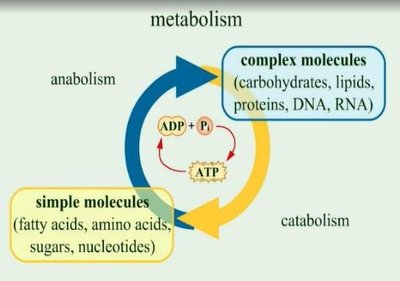
Anabolism: Building up complex molecules from simpler ones.
Catabolism: Breaking down complex molecules into simpler ones.
Step-by-Step Guidance
Begin by stating that metabolism includes all chemical reactions in the cell.
Explain that these reactions are organized into metabolic pathways.
Describe how metabolism includes both anabolic (building) and catabolic (breaking down) processes.
Try solving on your own before revealing the answer!
Final Answer:
Metabolism is the total of all chemical reactions in an organism, including both anabolic and catabolic pathways.
Q3. Describe the difference between anabolic and catabolic pathways. Give an example.
Background
Topic: Metabolic Pathways
This question tests your understanding of the two main types of metabolic pathways and their roles in cells.
Key Terms:
Anabolic pathway: Builds complex molecules from simpler ones, requiring energy.
Catabolic pathway: Breaks down complex molecules into simpler ones, releasing energy.
Step-by-Step Guidance
Define anabolic pathways and describe their function in cells.
Define catabolic pathways and describe their function in cells.
Provide an example of each pathway (e.g., protein synthesis for anabolism, cellular respiration for catabolism).
Explain how these pathways are interconnected through energy transfer (ATP).
Try solving on your own before revealing the answer!
Final Answer:
Anabolic pathways build molecules (e.g., protein synthesis), while catabolic pathways break them down (e.g., cellular respiration).
Q4. What is energy? Describe the difference between kinetic, potential, and chemical energy. Give an example.
Background
Topic: Types of Energy in Biology
This question tests your understanding of energy forms relevant to biological systems.
Key Terms:
Kinetic energy: Energy of motion.
Potential energy: Stored energy due to position or structure.
Chemical energy: Energy stored in chemical bonds.
Step-by-Step Guidance
Define energy as the capacity to do work or cause change.
Describe kinetic energy and provide a biological example (e.g., movement of molecules).
Describe potential energy and provide a biological example (e.g., concentration gradient across a membrane).
Describe chemical energy and provide a biological example (e.g., ATP molecules).
Try solving on your own before revealing the answer!
Final Answer:
Kinetic energy is motion (e.g., muscle contraction), potential energy is stored (e.g., in gradients), and chemical energy is in bonds (e.g., ATP).
Q5. Using the figure above, describe which processes are anabolic and catabolic and the types of energy for each.
Background
Topic: Metabolic Pathways and Energy Types
This question asks you to interpret a diagram showing the relationship between anabolic and catabolic processes and their energy forms.
Key Terms:
Anabolism: Building complex molecules, requires energy (usually ATP).
Catabolism: Breaking down complex molecules, releases energy (produces ATP).
ATP: Adenosine triphosphate, the main energy currency in cells.
Step-by-Step Guidance
Identify which direction in the diagram represents anabolism (building up) and which represents catabolism (breaking down).
Describe the types of molecules involved in each process (simple vs. complex).
Explain how ATP is used or produced in each pathway.
Discuss the energy transformations that occur during these processes.
Try solving on your own before revealing the answer!
Final Answer:
Anabolism uses ATP to build complex molecules; catabolism breaks down complex molecules, releasing energy and producing ATP.
Q6. Describe the structure of ATP and how it is able to drive biological reactions.
Background
Topic: ATP Structure and Function
This question tests your knowledge of ATP's molecular structure and its role in cellular energy transfer.
Key Terms:
ATP: Adenosine triphosphate, consists of adenine, ribose, and three phosphate groups.
Phosphorylation: Addition of a phosphate group to a molecule.
Energy coupling: Using energy released from ATP hydrolysis to drive other reactions.
Step-by-Step Guidance
Describe the three main components of ATP: adenine, ribose, and three phosphate groups.
Explain how the bonds between phosphate groups store energy.
Discuss how ATP hydrolysis releases energy for cellular work.
Describe how ATP is used to drive endergonic (energy-requiring) reactions.
Try solving on your own before revealing the answer!
Final Answer:
ATP has three phosphate groups; breaking the bond releases energy, which is used to drive biological reactions.
Q7. Describe how ATP is regenerated.
Background
Topic: ATP Regeneration
This question tests your understanding of how cells replenish ATP after it is used.
Key Terms:
ATP regeneration: The process of reattaching a phosphate group to ADP to form ATP.
Cellular respiration: The main pathway for ATP regeneration in cells.
Step-by-Step Guidance
Explain that ATP is regenerated from ADP and inorganic phosphate ().
Describe how energy from catabolic reactions (like glucose breakdown) is used for this process.
Discuss the role of cellular respiration in ATP regeneration.
Try solving on your own before revealing the answer!
Final Answer:
ATP is regenerated by adding a phosphate to ADP, using energy from catabolic reactions like cellular respiration.
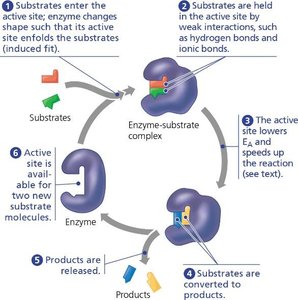
Q8. What are enzymes and describe how they work. Use the figure to the left.
Background
Topic: Enzyme Structure and Function
This question tests your understanding of enzymes as biological catalysts and their mechanism of action.
Key Terms:
Enzyme: Protein that speeds up chemical reactions by lowering activation energy.
Active site: Region of the enzyme where substrate binds.
Substrate: The molecule upon which an enzyme acts.
Step-by-Step Guidance
Describe how substrates enter the active site of the enzyme.
Explain how the enzyme changes shape to fit the substrate (induced fit).
Discuss how the enzyme lowers activation energy and speeds up the reaction.
Describe how products are released and the enzyme is ready for another cycle.
Try solving on your own before revealing the answer!
Final Answer:
Enzymes bind substrates at the active site, change shape, lower activation energy, and release products.
Q9. Based on what you know about protein structure, how are enzymes able to bind only specific substrates?
Background
Topic: Enzyme Specificity and Protein Structure
This question tests your understanding of how the three-dimensional structure of enzymes determines their specificity.
Key Terms:
Active site: The region of the enzyme with a specific shape for substrate binding.
Induced fit: The enzyme changes shape to better fit the substrate.
Protein structure: The sequence and folding of amino acids determines enzyme shape.
Step-by-Step Guidance
Explain that the active site of an enzyme is shaped to fit only certain substrates.
Discuss how amino acid sequence and folding create this specific shape.
Describe how weak interactions (hydrogen bonds, ionic bonds) help bind the substrate.
Try solving on your own before revealing the answer!
Final Answer:
Enzyme specificity is due to the unique shape of the active site, determined by protein structure.
