 Back
BackBiology Study Guide: Energy, Enzymes, and Metabolism
Study Guide - Smart Notes
 Tailored notes based on your materials, expanded with key definitions, examples, and context.
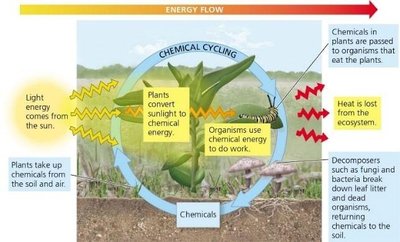
Q1. Explain the flow of energy and chemical recycling in the universe and the role of light energy.
Background
Topic: Energy Flow and Chemical Cycling in Biological Systems
This question tests your understanding of how energy moves through ecosystems and how chemicals are recycled, with a focus on the importance of light energy.
Key Terms:
Energy flow: The movement of energy through living systems, typically from the sun to producers and then to consumers.
Chemical cycling: The reuse of chemical elements (like carbon, nitrogen) within ecosystems.
Light energy: Energy from the sun used by plants for photosynthesis.
Step-by-Step Guidance
Start by identifying the main source of energy for most ecosystems: sunlight.
Describe how plants convert light energy into chemical energy through photosynthesis.
Explain how chemical energy stored in plants is transferred to organisms that eat them (consumers).
Discuss how decomposers break down dead organisms, returning chemicals to the soil for reuse by plants.
Consider how energy is lost as heat at each step, and how chemicals are recycled but energy is not.
Try solving on your own before revealing the answer!
Final Answer:
Energy flows from the sun to plants, which convert it to chemical energy. This energy is transferred to consumers and decomposers, with heat lost at each step. Chemicals are recycled within the ecosystem, but energy is not.
Q2. Define metabolism.
Background
Topic: Metabolism
This question is about the definition and scope of metabolism in biological systems.
Key Terms:
Metabolism: All chemical reactions that occur within living organisms to maintain life.
Step-by-Step Guidance
Recall that metabolism includes both the breakdown and synthesis of molecules.
Think about how metabolism encompasses catabolic and anabolic pathways.
Consider the role of enzymes in facilitating metabolic reactions.
Try solving on your own before revealing the answer!
Final Answer:
Metabolism is the sum of all chemical reactions in a cell, including both anabolic (building up) and catabolic (breaking down) processes.
Q3. Describe the difference between anabolic and catabolic pathways. Give an example.
Background
Topic: Metabolic Pathways
This question tests your understanding of the two main types of metabolic pathways: anabolic and catabolic.
Key Terms:
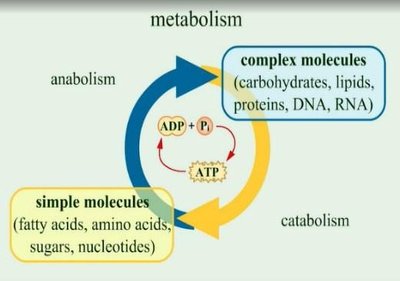
Anabolic pathway: Builds complex molecules from simpler ones, requiring energy.
Catabolic pathway: Breaks down complex molecules into simpler ones, releasing energy.
Step-by-Step Guidance
Define anabolic pathways and provide an example (e.g., protein synthesis).
Define catabolic pathways and provide an example (e.g., cellular respiration).
Explain how energy is involved in each pathway.
Use the diagram to identify which processes are anabolic and which are catabolic.
Try solving on your own before revealing the answer!
Final Answer:
Anabolic pathways build complex molecules (e.g., protein synthesis), while catabolic pathways break down molecules (e.g., cellular respiration). Anabolism requires energy; catabolism releases energy.
Q4. What is energy? Describe the difference between kinetic, potential, and chemical energy. Give an example.
Background
Topic: Types of Energy in Biology
This question is about understanding different forms of energy relevant to biological systems.
Key Terms:
Kinetic energy: Energy of motion.
Potential energy: Stored energy due to position or structure.
Chemical energy: Energy stored in chemical bonds.
Step-by-Step Guidance
Define energy as the capacity to do work or cause change.
Describe kinetic energy and give a biological example (e.g., movement of molecules).
Describe potential energy and give a biological example (e.g., concentration gradient across a membrane).
Describe chemical energy and give a biological example (e.g., ATP molecules).
Try solving on your own before revealing the answer!
Final Answer:
Kinetic energy is motion (e.g., muscle contraction), potential energy is stored (e.g., in gradients), and chemical energy is in bonds (e.g., ATP).
Q5. Using the figure above, describe which processes are anabolic and catabolic and the types of energy for each.
Background
Topic: Metabolic Pathways and Energy Types
This question asks you to interpret a diagram showing the relationship between anabolic and catabolic processes and their energy types.
Key Terms:
Anabolism: Building up molecules, requires energy.
Catabolism: Breaking down molecules, releases energy.
ATP: Main energy carrier in cells.
Step-by-Step Guidance
Identify which arrow in the diagram represents anabolism and which represents catabolism.
Describe the types of molecules involved in each process (simple vs. complex).
Explain how ATP is used or produced in each pathway.
Discuss the types of energy involved (chemical energy in ATP, etc.).
Try solving on your own before revealing the answer!
Final Answer:
Anabolic processes build complex molecules using ATP, while catabolic processes break down molecules and release energy, often producing ATP.
Q6. Describe the structure of ATP and how it is able to drive biological reactions.
Background
Topic: ATP Structure and Function
This question tests your knowledge of ATP's molecular structure and its role in cellular energy transfer.
Key Terms:
ATP (Adenosine Triphosphate): A molecule consisting of adenine, ribose, and three phosphate groups.
Phosphorylation: Transfer of a phosphate group to another molecule.
Step-by-Step Guidance
Describe the three main components of ATP: adenine, ribose, and three phosphate groups.
Explain how the bonds between phosphate groups store energy.
Discuss how ATP hydrolysis releases energy for cellular work.
Describe how ATP can transfer a phosphate group to another molecule (phosphorylation), driving reactions.
Try solving on your own before revealing the answer!
Final Answer:
ATP consists of adenine, ribose, and three phosphates. Breaking its phosphate bonds releases energy, which is used to drive biological reactions.
Q7. Describe how ATP is regenerated.
Background
Topic: ATP Regeneration
This question is about the cellular processes that restore ATP after it is used.
Key Terms:
ATP regeneration: The process of reattaching a phosphate group to ADP to form ATP.
Cellular respiration: The main pathway for ATP regeneration.
Step-by-Step Guidance
Recall that ATP is regenerated from ADP and inorganic phosphate ().
Describe how energy from catabolic reactions (like glucose breakdown) is used to reattach the phosphate.
Explain the role of mitochondria in ATP regeneration.
Try solving on your own before revealing the answer!
Final Answer:
ATP is regenerated by adding a phosphate to ADP, using energy from catabolic reactions, mainly in the mitochondria.
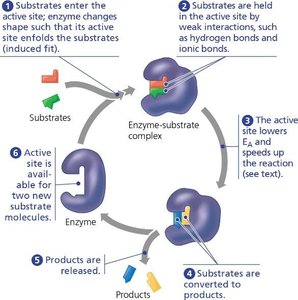
Q8. What are enzymes and describe how they work. Use the figure to the left.
Background
Topic: Enzyme Function
This question tests your understanding of enzymes as biological catalysts and their mechanism of action.
Key Terms:
Enzyme: Protein that speeds up chemical reactions.
Active site: Region of the enzyme where substrate binds.
Substrate: Molecule acted upon by the enzyme.
Step-by-Step Guidance
Describe how substrates bind to the enzyme's active site.
Explain how the enzyme changes shape to fit the substrate (induced fit).
Discuss how the enzyme lowers activation energy, speeding up the reaction.
Describe how products are released and the enzyme is ready for another cycle.
Try solving on your own before revealing the answer!
Final Answer:
Enzymes bind substrates at the active site, change shape to facilitate the reaction, lower activation energy, and release products.
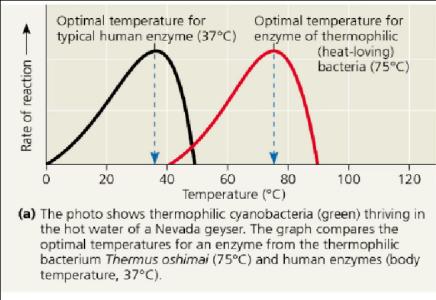
Q20. Below is a graph of a human enzyme at its optimal temperature. Write a detailed description of this figure below. Be sure to describe what is happening on the x axis with respect to the y-axis. Also compare both lines. How does this agree with the concept that environmental factors affect protein structure? (fig 6.16)
Background
Topic: Enzyme Activity and Environmental Factors
This question asks you to interpret a graph showing enzyme activity at different temperatures and relate it to protein structure.
Key Terms:
Optimal temperature: The temperature at which enzyme activity is highest.
Denaturation: Loss of protein structure and function at extreme temperatures.
Step-by-Step Guidance
Examine the x-axis (temperature) and y-axis (rate of reaction) of the graph.
Identify the optimal temperature for the human enzyme and the thermophilic bacterial enzyme.
Compare the shape and peak of both curves.
Discuss how enzyme activity drops at temperatures above or below the optimum, relating this to protein denaturation.
Try solving on your own before revealing the answer!
Final Answer:
The human enzyme peaks at 37°C, while the thermophilic enzyme peaks at 75°C. Activity drops outside these temperatures due to denaturation, showing environmental factors affect protein structure.
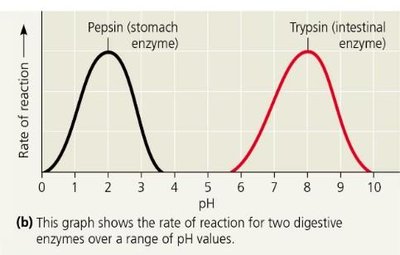
Q21. This graph shows the enzyme activity for an enzyme at various pH values. Label which line would represent an enzyme in the stomach under acidic conditions? What about the small intestine at basic conditions?
Background
Topic: Enzyme Activity and pH
This question tests your ability to interpret enzyme activity graphs and relate them to physiological conditions.
Key Terms:
Optimal pH: The pH at which enzyme activity is highest.
Pepsin: Stomach enzyme, optimal at acidic pH.
Trypsin: Intestinal enzyme, optimal at basic pH.
Step-by-Step Guidance
Examine the x-axis (pH) and y-axis (rate of reaction) of the graph.
Identify which curve peaks at low pH (acidic) and which at high pH (basic).
Label the curve for pepsin (stomach) and trypsin (intestine).
Explain why each enzyme is adapted to its environment.
Try solving on your own before revealing the answer!
Final Answer:
The black curve represents pepsin (stomach, acidic pH), and the red curve represents trypsin (intestine, basic pH).
