 Back
BackBiology Study Guide: Molecular Bonds, Water Properties, pH, Functional Groups, Protein Structure, Enzyme Activity, and Transport Proteins
Study Guide - Smart Notes
 Tailored notes based on your materials, expanded with key definitions, examples, and context.
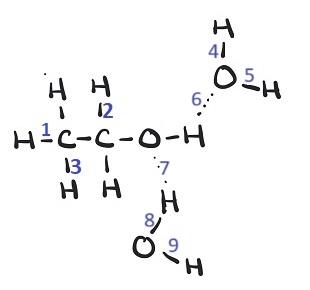
Q1. Of the labeled bonds in the diagram, which are hydrogen bonds?
Background
Topic: Hydrogen Bonding
This question tests your understanding of hydrogen bonds, which are weak interactions between a hydrogen atom with a partial positive charge and another atom (often oxygen or nitrogen) with a partial negative charge. These bonds are crucial for the structure and properties of water and biological molecules.
Key Terms and Concepts:
Hydrogen bond: An attraction between a hydrogen atom (attached to an electronegative atom like O or N) and another electronegative atom.
Polar covalent bond: A bond where electrons are shared unequally, creating partial charges.
Step-by-Step Guidance
Examine the diagram and identify which bonds are between a hydrogen atom and an electronegative atom (such as oxygen) from different molecules.
Recall that hydrogen bonds are typically represented by dashed lines, while covalent bonds are solid lines.
Look for bonds labeled between a hydrogen atom attached to oxygen and another oxygen atom from a different molecule.
Compare the labeled bonds to see which ones fit the criteria for hydrogen bonds (not covalent bonds within a molecule).
Try solving on your own before revealing the answer!
Final Answer: Bonds 6, 7, 8, and 9 are hydrogen bonds.
Hydrogen bonds are shown as dashed lines between hydrogen and oxygen atoms from different molecules. These bonds are responsible for many properties of water, such as cohesion and high specific heat.
Q2. Which properties of water are produced as a result of water being a polar molecule?
Background
Topic: Properties of Water
This question tests your understanding of how water's polarity leads to unique properties, such as cohesion, adhesion, high specific heat, and high heat of vaporization.
Key Terms:
Polarity: Water molecules have a partial positive charge on hydrogen and partial negative charge on oxygen.
Cohesion: Attraction between water molecules.
Adhesion: Attraction between water and other substances.
Specific heat: Amount of heat needed to raise the temperature of water.
Heat of vaporization: Energy required to convert water from liquid to gas.
Step-by-Step Guidance
Recall that water's polarity allows it to form hydrogen bonds with other water molecules and with other substances.
Think about how these hydrogen bonds contribute to water's properties, such as cohesion (water sticking to itself) and adhesion (water sticking to other surfaces).
Consider how hydrogen bonding affects water's ability to absorb heat (high specific heat) and its resistance to temperature changes.
Reflect on how hydrogen bonds must be broken for water to evaporate, leading to a high heat of vaporization.
Try solving on your own before revealing the answer!
Final Answer: All of these properties are produced by water's polarity.
Water's polarity and hydrogen bonding are responsible for cohesion, adhesion, high specific heat, and high heat of vaporization.
Q3. As the pH of a solution goes from 7 to 5, what happens in that solution?
Background
Topic: pH and Hydrogen Ion Concentration
This question tests your understanding of the pH scale and how changes in pH affect hydrogen ion concentration and acidity.
Key Terms and Formulas:
pH: A measure of hydrogen ion concentration, calculated as
Acidic solution: Lower pH, higher
Logarithmic scale: Each unit change in pH represents a tenfold change in
Step-by-Step Guidance
Recall that as pH decreases, the solution becomes more acidic.
Calculate the change in hydrogen ion concentration: a decrease from pH 7 to pH 5 is a change of 2 units.
Since the pH scale is logarithmic, a change of 2 units means times increase in .
Think about how this affects the acidity of the solution.
Try solving on your own before revealing the answer!
Final Answer: The solution becomes more acidic, and the hydrogen ion concentration increases by 100X.
Lower pH means higher acidity and a 100-fold increase in hydrogen ion concentration.
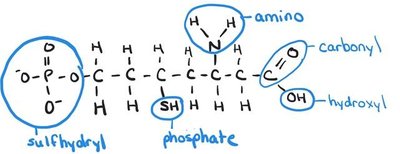
Q4. Which functional group did the students label correctly on the molecule?
Background
Topic: Functional Groups in Organic Molecules
This question tests your ability to identify and label functional groups such as amino, carboxyl, carbonyl, phosphate, sulfhydryl, and hydroxyl.
Key Terms:
Amino group:
Carboxyl group:
Carbonyl group:
Phosphate group:
Sulfhydryl group:
Hydroxyl group:
Step-by-Step Guidance
Examine the molecule and the labels provided by the students.
Recall the structure of each functional group and compare it to the labeled regions.
Identify which label matches the correct structure for its functional group.
Remember that each atom can only belong to one functional group at a time.
Try solving on your own before revealing the answer!
Final Answer: The amino group was labeled correctly.
The amino group is and can gain a hydrogen to become .
Q5. Match the functional group to its formula and property.
Background
Topic: Functional Groups and Their Properties
This question tests your knowledge of the chemical formulas and properties of common functional groups found in biological molecules.
Key Terms and Formulas:
Sulfhydryl:
Phosphate:
Methyl:
Hydroxyl:
Carboxyl:
Carbonyl:
Amino:
Step-by-Step Guidance
Review the formulas for each functional group.
Recall the properties associated with each group (e.g., polarity, acid/base behavior, ability to form bonds).
Match each formula to its property based on your knowledge.
Remember that each answer is only used once; one formula and one property will not be used.
Try solving on your own before revealing the answer!
Final Answer: Each functional group matches its formula and property as described in the table.
For example, sulfhydryl () is nonpolar and can form disulfide bonds, phosphate () carries two negative charges, etc.
Q6. The energy in a covalent bond is an example of ______.
Background
Topic: Types of Energy in Biological Molecules
This question tests your understanding of the different forms of energy, specifically the energy stored in chemical bonds.
Key Terms:
Chemical potential energy: Energy stored in the bonds of molecules.
Covalent bond: A bond formed by the sharing of electrons between atoms.
Step-by-Step Guidance
Recall that covalent bonds store energy that can be released during chemical reactions.
Compare this to other forms of energy, such as kinetic or thermal energy.
Identify which type of energy is most directly associated with the energy in covalent bonds.
Try solving on your own before revealing the answer!
Final Answer: Chemical potential energy.
Covalent bonds store energy that is released during reactions, which is chemical potential energy.
Q7. What is true of energy transformations in living organisms?
Background
Topic: Energy Transformations in Biology
This question tests your understanding of how energy is transformed and lost in biological systems.
Key Terms:
Energy transformation: Conversion of energy from one form to another.
Useful energy: Energy available to do work.
Heat: Energy released that is not useful for work.
Step-by-Step Guidance
Recall that during each energy transformation, some energy is lost as heat.
Think about how this affects the efficiency of biological processes.
Consider the implications for organisms and their energy needs.
Try solving on your own before revealing the answer!
Final Answer: At each transformation, some energy is converted to forms that are no longer useful to do work in the organism.
Energy is often lost as heat and cannot be used for work.
Q8. Can Reaction A (G = 3.85 kJ/mol) and Reaction B (G = -1.54 kJ/mol) be coupled?
Background
Topic: Coupled Reactions and Gibbs Free Energy
This question tests your understanding of how reactions can be coupled based on their Gibbs free energy changes.
Key Terms and Formulas:
Gibbs free energy ():
Coupled reactions: One reaction releases energy (negative ), which can drive another reaction that requires energy (positive ).
Step-by-Step Guidance
Identify which reaction releases energy (negative ) and which requires energy (positive ).
Compare the magnitude of energy released and required.
Determine if the energy released by one reaction is sufficient to drive the other.
Try solving on your own before revealing the answer!
Final Answer: No, Reaction B releases less energy than Reaction A requires, so they cannot be coupled.
Coupling requires that the energy released is greater than or equal to the energy required.
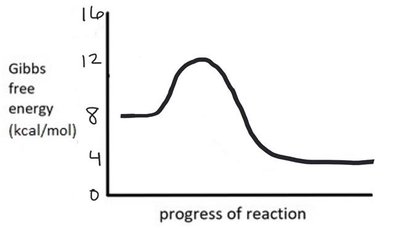
Q9. A graph shows the free energy changes during a reaction: reactants at 8 kcal/mol, peak at 12 kcal/mol, products at 4 kcal/mol. What type of reaction is this, and what is the value of G?
Background
Topic: Gibbs Free Energy and Reaction Types
This question tests your ability to interpret energy diagrams and calculate .
Key Terms and Formulas:
Exergonic reaction: Energy is released; products have lower free energy than reactants.
Gibbs free energy change ():
Step-by-Step Guidance
Identify the free energy of reactants and products from the graph.
Calculate using .
Determine if the reaction is exergonic (energy released) or endergonic (energy required).
Try solving on your own before revealing the answer!
Final Answer: The reaction is exergonic, and kcal/mol.
Products are at lower energy than reactants, so energy is released.
Q10. Which of the molecules pictured below is a single amino acid, one of the building blocks of proteins?
Background
Topic: Amino Acid Structure
This question tests your ability to recognize the structure of amino acids, which have a central carbon, an amino group, a carboxyl group, a hydrogen, and a variable R group.

Key Terms:
Amino acid: Contains a central carbon, amino group (), carboxyl group (), hydrogen, and R group.
Step-by-Step Guidance
Examine each molecule for the presence of the central carbon, amino group, carboxyl group, hydrogen, and R group.
Identify which molecules fit the criteria for a single amino acid.
Remember that amino acids are the monomers of proteins.
Try solving on your own before revealing the answer!
Final Answer: Molecules 1 and 2 are single amino acids.
They have the correct structure for amino acids.
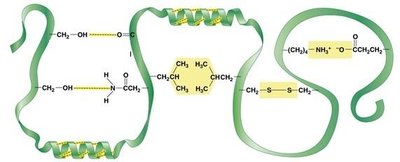
Q11. Match the level of protein structure to its description.
Background
Topic: Protein Structure Levels
This question tests your knowledge of the four levels of protein structure: primary, secondary, tertiary, and quaternary.
Key Terms:
Primary structure: Sequence of amino acids.
Secondary structure: Alpha helices and beta sheets.
Tertiary structure: Three-dimensional folding of a single polypeptide.
Quaternary structure: Three-dimensional folding of two or more polypeptides.
Step-by-Step Guidance
Recall the definitions of each level of protein structure.
Match each description to the correct level.
Use the diagram to visualize the different levels.
Try solving on your own before revealing the answer!
Final Answer: Primary = sequence, Secondary = alpha helices/beta sheets, Tertiary = folded shape of one polypeptide, Quaternary = folded shape of two or more polypeptides.
Each level describes a different aspect of protein structure.
Q12. What interactions are generally the most important in determining the secondary structure of a protein?
Background
Topic: Protein Secondary Structure
This question tests your understanding of the forces that stabilize secondary structures like alpha helices and beta sheets.
Key Terms:
Secondary structure: Stabilized by hydrogen bonds between backbone atoms.
Backbone: The repeating sequence of atoms in the polypeptide chain.
Step-by-Step Guidance
Recall that secondary structure is formed by interactions between backbone atoms, not side chains.
Identify the type of interaction (hydrogen bonding) that stabilizes these structures.
Consider why side chain interactions are more important for tertiary structure.
Try solving on your own before revealing the answer!
Final Answer: Interactions between partially charged regions of the backbone.
Hydrogen bonds between backbone atoms stabilize secondary structure.
Q13. What is the new method for predicting protein structure that was considered a major breakthrough?
Background
Topic: Protein Structure Prediction
This question tests your knowledge of recent advances in predicting protein folding, especially the use of artificial intelligence.
Key Terms:
Artificial intelligence (AI): Software that can predict protein structure based on sequence data.
Cryo-electron microscopy: Imaging technique for protein structure.
X-ray crystallography: Traditional method for determining protein structure.
Step-by-Step Guidance
Recall the limitations of traditional methods for protein structure determination.
Consider how AI-driven software can use sequence data to predict folding.
Think about why this is considered a breakthrough.
Try solving on your own before revealing the answer!
Final Answer: Software that utilizes artificial intelligence.
AI-driven software can predict protein structure with high accuracy.
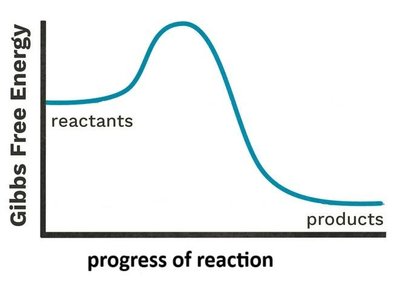
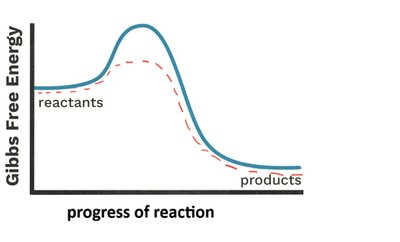
Q14. How does the addition of an enzyme enable a reaction to proceed more rapidly, as shown on a Gibbs free energy graph?
Background
Topic: Enzyme Catalysis and Activation Energy
This question tests your understanding of how enzymes lower the activation energy of a reaction, speeding up the rate without changing the free energy of reactants or products.
Key Terms and Formulas:
Activation energy: The energy barrier that must be overcome for a reaction to proceed.
Enzyme: A protein that catalyzes reactions by lowering activation energy.
Gibbs free energy (): Not changed by the enzyme.
Step-by-Step Guidance
Examine the graph and identify the activation energy (the peak between reactants and products).
Recall that enzymes lower the activation energy, making the reaction proceed faster.
Draw or visualize a dashed line showing a lower peak for the enzyme-catalyzed pathway, but the reactants and products remain at the same energy levels.
Understand that the enzyme does not change the overall of the reaction.
Try solving on your own before revealing the answer!
Final Answer: The enzyme lowers the activation energy, shown as a lower peak on the graph, but the reactants and products stay the same.
This enables the reaction to proceed more rapidly without changing the free energy difference.
Q15. Which mechanisms can be used by the cell to regulate the activity of an enzyme?
Background
Topic: Enzyme Regulation
This question tests your understanding of how cells regulate enzyme activity through various mechanisms.
Key Terms:
Allosteric regulation: Regulator binds to enzyme, changing its shape and activity.
Competitive inhibition: Inhibitor binds to active site, preventing substrate binding.
Covalent modification: Addition of functional groups (e.g., phosphate) changes enzyme activity.
Step-by-Step Guidance
Recall the different ways enzymes can be regulated: allosteric, competitive, and covalent modification.
Consider how each mechanism affects enzyme activity and reaction rate.
Think about why regulation is important for cellular function.
Try solving on your own before revealing the answer!
Final Answer: All of these mechanisms can be used to regulate enzyme activity.
Cells use multiple methods to control enzyme function and reaction rates.
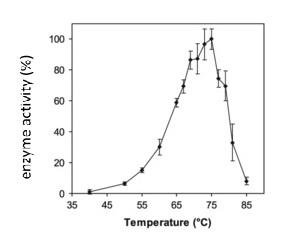
Q16. What happens to the activity of the enzyme as temperature goes from 55°C to 75°C?
Background
Topic: Enzyme Activity and Temperature
This question tests your understanding of how temperature affects enzyme activity, especially for enzymes from thermophilic organisms.
Key Terms:
Enzyme activity: Rate at which an enzyme catalyzes a reaction.
Optimal temperature: Temperature at which enzyme activity is highest.
Step-by-Step Guidance
Examine the graph to see how enzyme activity changes with temperature.
Identify the trend between 55°C and 75°C.
Recall that enzymes from thermophilic organisms often have higher activity at elevated temperatures.
Try solving on your own before revealing the answer!
Final Answer: The activity of the enzyme increases because the enzyme functions more effectively at 75°C.
Enzyme activity peaks at higher temperatures for thermophilic enzymes.
Q17. Which levels of protein structure would be affected by the addition of chloride ions to a single polypeptide strand?
Background
Topic: Protein Structure and Ionic Interactions
This question tests your understanding of how changes in ion concentration affect protein structure.
Key Terms:
Primary structure: Sequence of amino acids (not affected by ions).
Secondary structure: Stabilized by hydrogen bonds, can be affected by ions.
Tertiary structure: Stabilized by various interactions, including ionic bonds.
Quaternary structure: Only present if multiple polypeptides are involved.
Step-by-Step Guidance
Recall that primary structure is not affected by changes in ion concentration.
Consider how ions can disrupt hydrogen bonds and ionic interactions in secondary and tertiary structure.
Determine which levels of structure are present in a single polypeptide strand.
Try solving on your own before revealing the answer!
Final Answer: Secondary and tertiary structure would be affected.
Ions can disrupt interactions that stabilize these levels of structure.
Q18. Which statements about transport proteins are accurate?
Background
Topic: Transport Proteins and Health Impacts
This question tests your understanding of how changes in protein structure and function can affect health.
Key Terms:
Transport protein: Moves molecules or ions across membranes or within organisms.
Protein misfolding: Can lead to loss of function and disease.
Step-by-Step Guidance
Recall the function of each protein mentioned (CFTR, hemoglobin, aquaporin 2, beta hexosaminidase A).
Consider how changes in structure or function can lead to disease.
Identify which statements accurately describe the impact of altered protein function.
Try solving on your own before revealing the answer!
Final Answer: The statements about hemoglobin, CFTR, and aquaporin 2 are accurate.
Altered structure or function of these proteins can lead to sickle cell disease, cystic fibrosis, and dehydration, respectively.
