 Back
Biology Study Guide: Plant Physiology, Evolution, and Genetics
Study Guide - Smart Notes
 Tailored notes based on your materials, expanded with key definitions, examples, and context.
Q1. What do plants need and what are those things used for?
Background
Topic: Plant Physiology & Ecology
This question explores the essential requirements for plant survival and their roles in plant biology, connecting to ecological principles.
Key Terms:
Photosynthesis
Respiration
Mineral uptake
Transport systems (xylem, phloem)
Step-by-Step Guidance
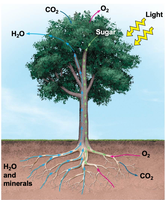
Identify the main resources plants require: light, water, carbon dioxide (CO2), oxygen (O2), and minerals.
Consider how each resource is acquired: light from the sun, water and minerals from the soil, CO2 from the air.
Think about the processes these resources are used in: photosynthesis (light, CO2, water), respiration (O2), and growth (minerals).
Reflect on how these requirements relate to ecological interactions, such as nutrient cycling and energy flow.
Try solving on your own before revealing the answer!
Final Answer:
Plants need light, water, CO2, O2, and minerals. Light is used for photosynthesis, water and CO2 are reactants in photosynthesis, O2 is used in respiration, and minerals are essential for growth and metabolic processes.
Q2. Where do plants get carbon, how is it regulated, what is it used to make, and how is it transported once it is sugar?
Background
Topic: Photosynthesis & Carbon Transport
This question focuses on carbon acquisition, regulation, utilization, and transport in plants.
Key Terms and Formulas:
Stomata: pores for gas exchange
Photosynthesis:
Phloem: tissue for sugar transport
Step-by-Step Guidance
Recall that plants obtain carbon from atmospheric CO2 via stomata in their leaves.
Understand that stomatal opening and closing regulate CO2 uptake, influenced by environmental factors and plant hormones.
Recognize that CO2 is used in photosynthesis to produce glucose (sugar).
Know that glucose is transported throughout the plant via the phloem to areas of growth or storage.
Try solving on your own before revealing the answer!
Final Answer:
Plants get carbon from CO2 in the air, regulated by stomata. It is used to make sugars via photosynthesis, and sugars are transported through the phloem.
Q3. What is the principle of alternation of generations in plants?
Background
Topic: Plant Life Cycle
This question tests your understanding of the alternation of generations, a fundamental concept in plant biology.
Key Terms:
Gametophyte (haploid, n)
Sporophyte (diploid, 2n)
Meiosis and fertilization
Step-by-Step Guidance
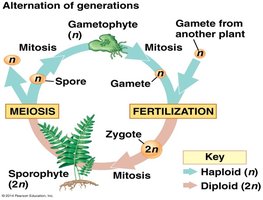
Identify the two main stages: gametophyte (produces gametes) and sporophyte (produces spores).
Understand that meiosis produces haploid spores from the diploid sporophyte.
Recognize that fertilization restores diploidy, forming the sporophyte from gametes.
Note the cyclical nature of the process, alternating between haploid and diploid stages.
Try solving on your own before revealing the answer!
Final Answer:
Alternation of generations describes the plant life cycle alternating between a haploid gametophyte and a diploid sporophyte, with meiosis and fertilization connecting the stages.
Q4. What are the characteristics of the 4 major plant groups and what derived traits appeared at each point in plant evolution?
Background
Topic: Plant Evolution
This question examines the evolutionary history of plants and the appearance of key traits.
Key Terms:
Bryophytes, Seedless vascular plants, Gymnosperms, Angiosperms
Derived traits: vascular tissue, seeds, flowers
Step-by-Step Guidance
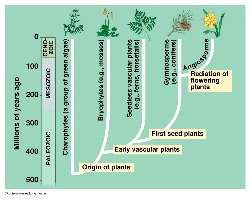
List the four major plant groups: bryophytes, seedless vascular plants, gymnosperms, angiosperms.
Identify the key derived traits: bryophytes lack vascular tissue; seedless vascular plants have vascular tissue; gymnosperms have seeds; angiosperms have flowers and fruits.
Place these traits in evolutionary order, noting when each appeared.
Connect these traits to adaptations for terrestrial life.
Try solving on your own before revealing the answer!
Final Answer:
Bryophytes lack vascular tissue, seedless vascular plants have vascular tissue, gymnosperms have seeds, and angiosperms have flowers and fruits. Each trait represents a key evolutionary adaptation.
Q5. What is the difference between artificial selection and GMOs, and what are two benefits and one concern of GMOs?
Background
Topic: Plant Breeding & Genetic Modification
This question compares traditional breeding (artificial selection) and genetic modification (GMOs), and asks for examples of GMO benefits and concerns.
Key Terms:
Artificial selection: selective breeding for desired traits
GMOs: organisms with genes modified or inserted via biotechnology
Step-by-Step Guidance
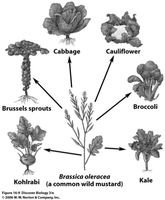
Define artificial selection and GMOs, noting the methods used for each.
Compare artificial selection to natural selection, focusing on human involvement.
List two benefits of GMOs, such as increased nutrition or pest resistance.
Identify a real concern, such as environmental impact or gene flow to wild species.
Try solving on your own before revealing the answer!
Final Answer:
Artificial selection involves breeding for traits, while GMOs involve direct genetic modification. Benefits include improved nutrition and pest resistance; concerns include environmental risks.
Q6. What is the principle of diffusion and osmosis in plant transport?
Background
Topic: Transport in Biology
This question tests your understanding of diffusion and osmosis, especially in plant water and solute transport.
Key Terms and Formulas:
Diffusion: movement of molecules from high to low concentration
Osmosis: movement of water across a membrane
Water potential ():
Step-by-Step Guidance
Recall that diffusion is passive movement down a concentration gradient.
Osmosis is the movement of water across a semipermeable membrane, driven by differences in water potential.
Understand that water potential combines solute potential and pressure potential.
Apply these principles to water uptake in roots and guard cell regulation.
Try solving on your own before revealing the answer!
Final Answer:
Diffusion moves solutes down a gradient; osmosis moves water based on water potential. These principles drive water uptake and stomatal regulation in plants.
