 Back
BackBiology Study Guide: Terrestrial Biomes, Population Growth, and Age Structure
Study Guide - Smart Notes
 Tailored notes based on your materials, expanded with key definitions, examples, and context.
Q1. What is the name of the terrestrial biome described by or associated with the terms below?
Background
Topic: Terrestrial Biomes
This question tests your knowledge of the characteristics and names of Earth's major terrestrial biomes, which are defined by climate, vegetation, and animal life.
Key Terms:
Biome: A large ecological area with distinct climate, plants, and animals.
Deciduous: Trees that shed their leaves annually.
Permafrost: Permanently frozen ground.
Mediterranean climate: Mild, wet winters and hot, dry summers.
Step-by-Step Guidance
Read each description carefully and identify the key climate or vegetation features mentioned (e.g., "permanently frozen ground" or "deciduous trees").
Recall the main terrestrial biomes: tropical rainforest, tundra, temperate deciduous forest, chaparral, taiga (boreal forest), savanna, grassland, desert, etc.
Match each description to the biome that best fits those features. For example, "ground permanently frozen" is characteristic of the tundra biome.
For each term, think about the climate and typical organisms found in that biome.
Try solving on your own before revealing the answer!
Final Answer:
1. Tropical Rainforest
2. Tundra
3. Temperate Deciduous Forest
4. Chaparral
5. Taiga (Boreal Forest)
6. Savanna
7. Temperate Grassland
Each biome is matched to its characteristic description based on climate and vegetation.
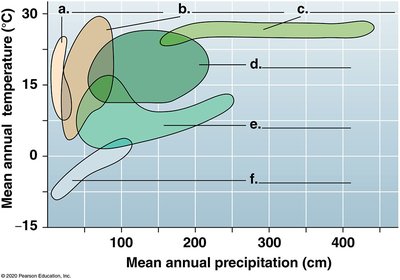
Q2. Identify the terrestrial biome depicted by each lettered region in the graph.
Background
Topic: Biome Distribution and Climate
This question asks you to interpret a climate graph showing mean annual temperature and precipitation, and to identify which biome corresponds to each labeled region.
Key Terms:
Mean annual temperature: Average temperature over a year.
Mean annual precipitation: Average rainfall over a year.
Biomes: Defined by their climate and vegetation.
Step-by-Step Guidance
Examine the graph and note the temperature and precipitation ranges for each labeled region (a–f).
Recall which biomes are found in high, medium, or low temperature and precipitation zones (e.g., deserts have low precipitation, tropical rainforests have high precipitation and temperature).
Match each region to the biome that fits its climate profile.
Use your knowledge of biome climate characteristics to make educated guesses for each letter.
Try solving on your own before revealing the answer!
Final Answer:
a. Desert
b. Savanna
c. Tropical Rainforest
d. Temperate Deciduous Forest
e. Taiga (Boreal Forest)
f. Tundra
The biomes are identified based on their typical temperature and precipitation ranges.
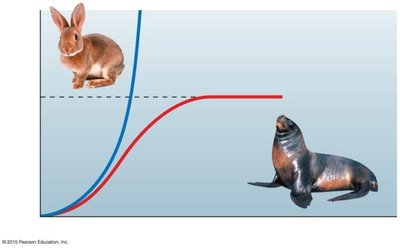
Q3. Use this graph of idealized exponential and logistic growth curves to answer the following:
Background
Topic: Population Growth Models
This question tests your understanding of population growth patterns, including exponential and logistic growth, and their mathematical descriptions.
Key Terms and Formulas:
Exponential growth: Population increases rapidly without limiting factors.
Logistic growth: Population growth slows as it approaches carrying capacity.
Carrying capacity (): Maximum population size the environment can sustain.
Key formulas:
Exponential growth:
Logistic growth:
Step-by-Step Guidance
Identify which curve (A or B) represents exponential and which represents logistic growth based on their shapes.
Write down the formula for each type of growth.
Determine what the dotted line represents (hint: it is related to carrying capacity).
For each curve, locate the region where the slope is steepest—this is where population growth is most rapid.
Consider which curve best models global human population growth and explain your reasoning.
Try solving on your own before revealing the answer!
Final Answer:
Curve A: Exponential growth ()
Curve B: Logistic growth ()
Dotted line: Carrying capacity ()
Most rapid growth: Exponential—early stages; Logistic—midway before reaching
Global human population: Exponential, because humans have not yet reached environmental limits globally.
Each curve and concept is matched to its description and formula.
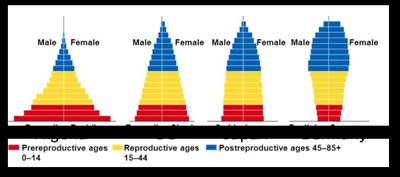
Q4. Study the age structures below and answer the following questions.
Background
Topic: Population Age Structure and Demographic Predictions
This question tests your ability to interpret age structure diagrams and predict future population growth and societal needs.
Key Terms:
Age structure: Distribution of individuals among age groups in a population.
Pre-reproductive, reproductive, post-reproductive: Age categories used in demographic studies.
Step-by-Step Guidance
Examine the age structure diagrams for Nigeria, the US, Japan, and Germany. Note the shape and proportion of each age group.
Predict future population growth based on the proportion of young individuals (pre-reproductive ages).
Consider how a politician might plan for societal needs based on the age structure (e.g., education, healthcare, retirement).
Think about the implications of a large elderly population versus a large young population.
Try solving on your own before revealing the answer!
Final Answer:
Nigeria: Rapid growth expected; focus on education and jobs.
US: Slow growth; balance needs for youth and elderly.
Japan & Germany: Declining or stable population; prepare for aging population, healthcare, and pensions.
Predictions and policy suggestions are based on the age structure shapes and demographic trends.
