 Back
BackBiology: The Study of Life & Nature of Science – The Three-Domain System and Scientific Inquiry
Study Guide - Smart Notes
 Tailored notes based on your materials, expanded with key definitions, examples, and context.
Biology: The Study of Life
Nature of Science
Biology is the scientific study of life, encompassing the structure, function, growth, origin, evolution, and distribution of living organisms. The nature of science involves systematic inquiry based on observation, experimentation, and reasoning.
The Three-Domain System
Overview of Domains
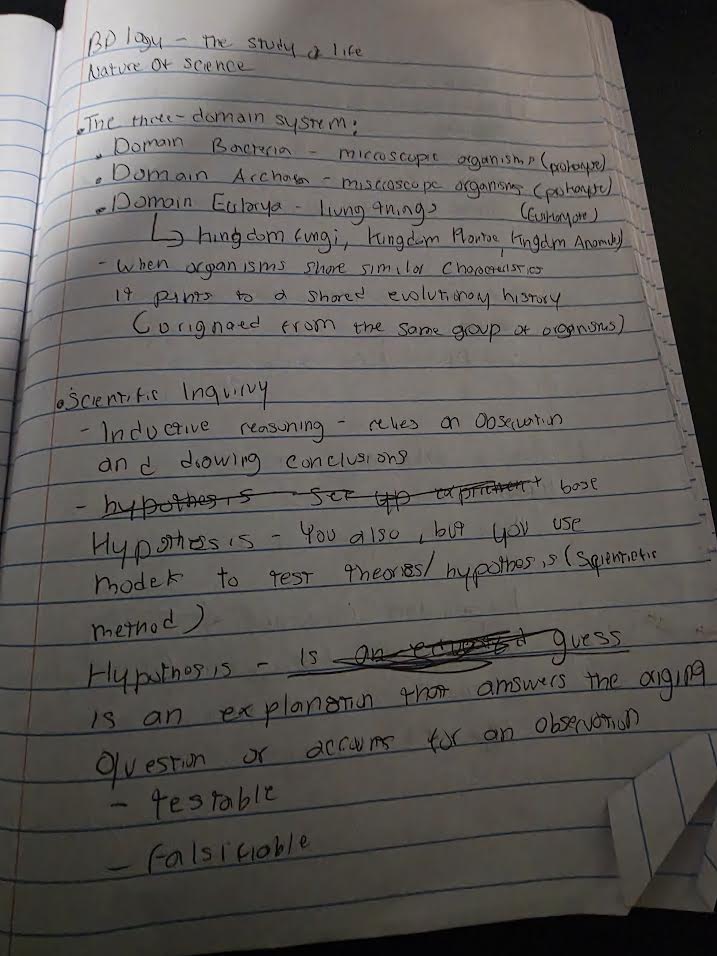
The three-domain system is a classification scheme that organizes all life into three major domains based on cellular structure and evolutionary relationships:
Domain Bacteria: Microscopic organisms known as prokaryotes. These lack a nucleus and membrane-bound organelles.
Domain Archaea: Also microscopic prokaryotes, but genetically distinct from bacteria. Often found in extreme environments.
Domain Eukarya: Includes all living things with eukaryotic cells (cells containing a nucleus and organelles). This domain encompasses multiple kingdoms:
Kingdom Fungi
Kingdom Plantae
Kingdom Animalia
When organisms share similar characteristics, it often points to a shared evolutionary history, meaning they originated from the same group of organisms.
Scientific Inquiry
Methods and Reasoning
Scientific inquiry is the process by which scientists investigate the natural world. It relies on observation, reasoning, and drawing conclusions. Two main types of reasoning are used:
Inductive reasoning: Making generalizations based on specific observations.
Deductive reasoning: Making predictions based on general principles or theories (not explicitly mentioned, but relevant for context).
Hypothesis Formation
A hypothesis is an explanation that answers a scientific question or accounts for an observation. It is not simply a guess, but a testable statement that can be evaluated through experimentation or modeling. Key properties of a hypothesis:
Testable: The hypothesis must be able to be tested through experiments or observations.
Falsifiable: There must be a possible outcome that could prove the hypothesis wrong.
Scientists use hypotheses to set up experiments and models to test theories and predictions, following the scientific method.
Example
For example, a hypothesis might state: "If plants are given more sunlight, then they will grow faster." This can be tested and potentially falsified by experimentation.
Additional info: Deductive reasoning is also a fundamental part of scientific inquiry, though not explicitly mentioned in the notes. The three-domain system is foundational to modern biological classification and is covered in introductory biology courses.
