 Back
Biology: The Study of Life – Chapter 1 Study Notes
Study Guide - Smart Notes
 Tailored notes based on your materials, expanded with key definitions, examples, and context.
Biology: The Study of Life
The Nature of Life
Biology is the scientific study of life, focusing on the characteristics, processes, and diversity of living organisms. Understanding what makes something alive is foundational to all biological sciences.
Cells: All living organisms are composed of membrane-bound cells.
Replication: Organisms have the ability to reproduce.
Information: Hereditary information is encoded in genes.
Energy: Organisms acquire and use energy to maintain life.
Evolution: Populations of organisms evolve over time.
Three Foundational Theories in Biology
Biology is built upon three major theories that answer fundamental questions about life:
Cell Theory: All organisms are made of cells; all cells arise from pre-existing cells.
Evolution by Natural Selection: Species share common ancestry and change over time through differential reproduction.
Chromosome Theory of Inheritance: Hereditary information is transmitted via genes located on chromosomes.
Key Terminology in Science
Understanding scientific language is essential for studying biology:
Theory: An explanation for a broad class of phenomena, supported by extensive evidence.
Hypothesis: A testable, falsifiable statement explaining specific observations.
Prediction: A measurable or observable result that must be true if the hypothesis is correct.
Experiment: A controlled test isolating the effect of a single factor.
Life is Cellular
Cell Theory and Its Historical Development
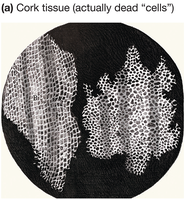
Cell theory is the first foundational theory in biology, stating that all organisms are made up of cells and all cells come from pre-existing cells. This theory challenged the idea of spontaneous generation.
Robert Hooke (1665): Observed cork tissue and named the compartments "cells."
Anton van Leeuwenhoek: First to observe single-celled organisms.
Cell Theory Formalized (1800s): All organisms are made up of cells; all cells come from pre-existing cells.
Testing Cell Theory: Pasteur's Experiment
Pasteur's experiment provided strong evidence against spontaneous generation, supporting the all-cells-from-cells hypothesis.
Swan-neck flask experiment: Allowed air in but trapped microbes; broth stayed clear until neck was broken.
Conclusion: Cells do not arise spontaneously; they come from pre-existing cells.
Life Processes Information
Chromosome Theory of Inheritance and the Central Dogma
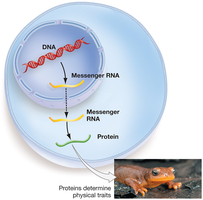
The chromosome theory of inheritance explains how hereditary information is encoded in genes located on chromosomes. The central dogma describes the flow of genetic information within a cell.
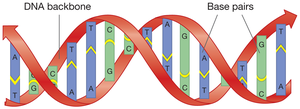
DNA: The hereditary material, structured as a double helix with base pairs (A-T, C-G).
Central Dogma: DNA is transcribed to RNA, which is translated to protein.
Mutations: Changes in DNA can lead to heritable variation.
Life Requires Energy
Energy Acquisition and Ecological Diversity
All chemical reactions in cells require energy. Organisms acquire energy in different ways, which drives ecological diversity.
ATP: The universal energy currency of cells.
Autotrophs: Capture energy from sunlight (photosynthesis) and produce their own organic molecules.
Heterotrophs: Obtain energy by consuming other organisms.
Life Evolves
Evolution and Natural Selection
Evolution is the change in characteristics of a population over time. Natural selection is the mechanism by which evolution occurs.
Common Ancestry: Species are related by common ancestry.
Descent with Modification: Characteristics change through generations.
Natural Selection: Individuals with advantageous traits reproduce more successfully, increasing the frequency of those traits in the population.
Fitness: The ability to produce surviving offspring.
Adaptation: A trait that increases fitness in a given environment.
Natural Selection in Action: Galápagos Finches
The Galápagos finches provide a classic example of evolution by natural selection.
Variation exists: Finch beak sizes vary and are heritable.
Environment changes: More small, soft seeds become available.
Differential reproduction: Finches with small, pointed beaks have higher fitness.
Selection acts on individuals: Small-beaked finches survive and reproduce more.
Evolution acts on populations: Small, pointed beaks become more common over generations.
The Tree of Life
Phylogeny and Domains of Life
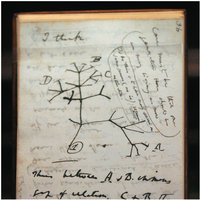
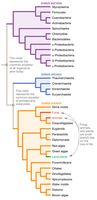
The tree of life illustrates the genealogical relationships among all organisms, built from genetic sequence data. It shows three major domains of life.
Phylogeny: Actual genealogical relationships among organisms.
Phylogenetic Tree: Diagram showing evolutionary relationships.
Domains: Eukarya (cells with nucleus), Bacteria (prokaryotes), Archaea (prokaryotes, often in extreme environments).
Eukaryotic and Prokaryotic Cells
Structural Differences
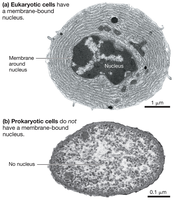
The distinction between eukaryotic and prokaryotic cells is fundamental in cell biology.
Feature | Prokaryotes | Eukaryotes |
|---|---|---|
Nucleus | No membrane-bound nucleus | Membrane-bound nucleus |
Organelles | No membrane-bound organelles | Membrane-bound organelles |
Size | 1–10 µm | 10–100 µm |
Chromosomes | Single circular chromosome | Multiple linear chromosomes |
Examples | Bacteria & Archaea | Plants, animals, fungi, protists |
Taxonomy: Naming and Classifying Life
Linnaean System and Modern Classification
Taxonomy is the science of naming and classifying organisms. The Linnaean system uses binomial nomenclature and a hierarchical structure.
Binomial Nomenclature: Each organism has a unique two-part name: Genus species.
Taxonomic Hierarchy: Domain → Kingdom → Phylum → Class → Order → Family → Genus → Species.
Three Domains: Bacteria, Archaea, Eukarya (based on rRNA sequence data).
Example: Homo sapiens, Apis mellifera (the honey bee).
Day 1 Summary
All living things share five characteristics: cells, replication, information, energy, evolution.
Three foundational theories answer biology's biggest questions.
Cell theory: all organisms are made of cells; all cells from pre-existing cells (Pasteur).
Central dogma: DNA → RNA → Protein; mutations create heritable variation.
Natural selection acts on individuals; evolutionary change occurs in populations.
The tree of life reflects common ancestry; three domains: Bacteria, Archaea, Eukarya.
Next class: Chemicals of Life
