 Back
Biology: The Study of Life – Chapter 1 Study Notes
Study Guide - Smart Notes
 Tailored notes based on your materials, expanded with key definitions, examples, and context.
Biology: The Study of Life
Introduction to Biology
Biology is the scientific study of life, encompassing the structure, function, growth, origin, evolution, and distribution of living organisms. It explores living systems at every level—from microscopic cells and molecules to entire ecosystems and the planet.
Definition: Biology comes from the Greek words 'bios' (life) and 'logos' (study).
Diversity: Life is incredibly diverse, ranging from bacteria and fungi to plants and animals.
Scope: Biology examines structure, function, diversity, evolution, interaction, and environment.
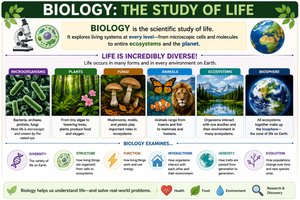
Diversity of Life
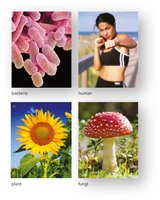
Life occurs in many forms and in nearly every environment on Earth. Organisms are classified into major groups such as bacteria, plants, fungi, and animals, each with unique characteristics.
Bacteria: Microscopic, single-celled organisms.
Plants: Multicellular, photosynthetic organisms.
Fungi: Multicellular or unicellular, absorb nutrients.
Animals: Multicellular, ingest food.
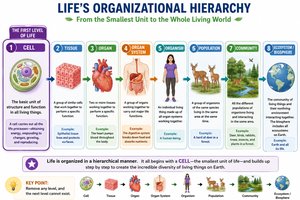
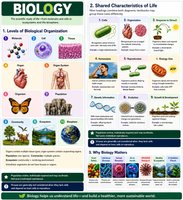
Levels of Biological Organization
Life's Organizational Hierarchy
Life is organized in a hierarchical manner, beginning with the cell—the smallest unit of life—and building up step by step to create the incredible diversity of living things on Earth.
Cell: Basic unit of structure and function.
Tissue: Group of similar cells performing a function.
Organ: Structure composed of tissues working together.
Organ System: Group of organs performing major functions.
Organism: Individual living thing.
Population: Group of organisms of the same species.
Community: All populations in a given area.
Ecosystem: Community plus its physical environment.
Biosphere: All ecosystems on Earth.
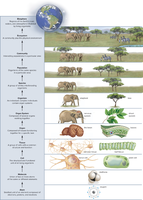
Levels of Biological Organization (Illustration)
This illustration shows the progression from molecules to the biosphere, highlighting the complexity and interconnectedness of life.
Characteristics of Life
Shared Characteristics of Living Organisms
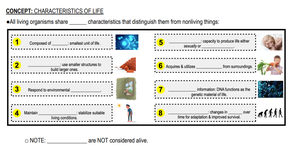
All living organisms share certain characteristics that distinguish them from nonliving things.
Composed of cells: The smallest unit of life.
Use energy: Metabolism to build and maintain structure.
Respond to environment: React to stimuli.
Maintain homeostasis: Stable internal conditions.
Capacity to reproduce: Produce offspring.
Acquire nutrients: From surroundings.
Information: DNA functions as the genetic material.
Change over time: Evolution increases survival.
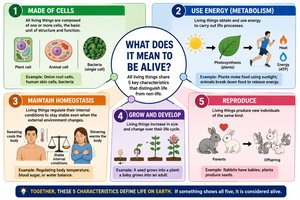
What Does It Mean to Be Alive?
Five key characteristics define life on Earth. If something shows all five, it is considered alive.
Made of cells
Use energy (metabolism)
Maintain homeostasis
Grow and develop
Reproduce
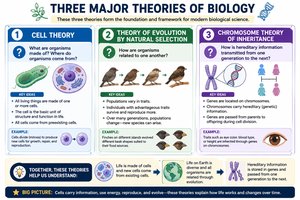
Major Theories of Biology
Cell Theory
Cell theory states that all living things are composed of cells, and all cells come from preexisting cells. Cells are the basic unit of life.
All organisms are made of cells.
Cells arise from preexisting cells.
Theory of Evolution by Natural Selection
This theory explains how populations change over time and why organisms are adapted to their environments.
Species are related by common ancestry.
Characteristics can change from generation to generation.
Natural selection: Traits that improve survival and reproduction become more common.
Chromosome Theory of Inheritance
Genes, which determine traits, are located on chromosomes and are passed from one generation to the next.
Genes are located on chromosomes.
Chromosomes are inherited during reproduction.
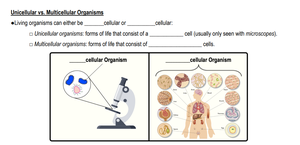
Unicellular vs. Multicellular Organisms
Types of Cellular Organization
Living organisms can be unicellular (single-celled) or multicellular (many cells). Unicellular organisms consist of one cell, while multicellular organisms consist of many specialized cells.
Unicellular: Bacteria, some algae.
Multicellular: Plants, animals, fungi.
Why Biology Matters
Applications and Importance
Biology helps us understand life and solve real-world problems, such as disease, environmental issues, and food production.
Medicine: Understanding biology is essential for health and disease treatment.
Ecology: Helps protect ecosystems and biodiversity.
Biotechnology: Advances in genetics and molecular biology.
Summary Table: Levels of Biological Organization
Level | Description | Example |
|---|---|---|
Cell | Basic unit of life | Neuron, plant cell |
Tissue | Group of similar cells | Muscle tissue |
Organ | Structure with specific function | Heart, leaf |
Organ System | Group of organs | Digestive system |
Organism | Individual living thing | Human, tree |
Population | Group of same species | Elephants in savanna |
Community | All populations in area | Forest community |
Ecosystem | Community + environment | Lake ecosystem |
Biosphere | All ecosystems on Earth | Earth |
Conclusion
Biology is a foundational science that helps us understand the living world, from the smallest cell to the entire biosphere. Its principles guide research, medicine, environmental stewardship, and our understanding of life’s diversity and complexity.
