 Back
Biology: The Study of Life – Chapter 1 Study Notes
Study Guide - Smart Notes
 Tailored notes based on your materials, expanded with key definitions, examples, and context.
Biology: The Study of Life
Introduction to Biology
Biology is the scientific study of life, encompassing living systems at every level—from microscopic cells and molecules to entire ecosystems and the planet. It explores the structure, function, growth, origin, evolution, and distribution of living organisms.
Definition: Biology comes from the Greek words 'bios' (life) and 'logos' (study).
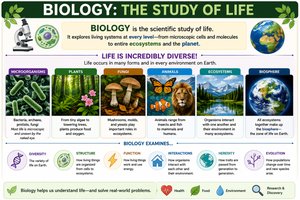
Diversity: Life is incredibly diverse, including microorganisms, plants, fungi, animals, and entire ecosystems.
Scope: Biology examines structure, function, diversity, evolution, interaction, and environment.
Diversity of Life
Life occurs in many forms and in nearly every environment on Earth. Organisms range from bacteria and fungi to plants and animals, each adapted to their specific habitats.
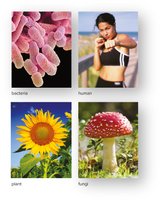
Microorganisms: Bacteria, archaea, and protists.
Plants: Producers that photosynthesize.
Fungi: Decomposers and recyclers.
Animals: Consumers with complex behaviors.
Ecosystems: Communities of organisms interacting with their environment.
Levels of Biological Organization
Organizational Hierarchy
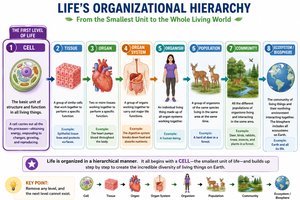
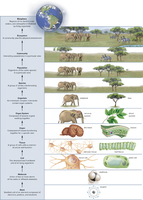
Life is organized in a hierarchical manner, from the smallest unit (cell) to the entire biosphere. Each level builds upon the previous, creating complexity and diversity.
Cell: Basic unit of structure and function.
Tissue: Group of similar cells performing a function.
Organ: Structure composed of tissues.
Organ System: Group of organs working together.
Organism: Individual living entity.
Population: Group of organisms of the same species.
Community: Multiple populations interacting.
Ecosystem: Community plus environment.
Biosphere: All ecosystems on Earth.
Characteristics of Life
Shared Characteristics
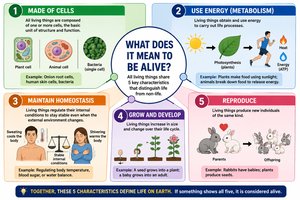
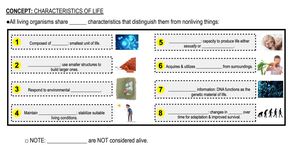
All living organisms share certain characteristics that distinguish them from nonliving things.
Cellular Organization: Composed of one or more cells.
Metabolism: Use energy and materials to build and maintain structure.
Response to Environment: React to environmental stimuli.
Homeostasis: Maintain stable internal conditions.
Reproduction: Capacity to produce offspring.
Growth and Development: Acquire and utilize energy for growth.
Information: DNA functions as the genetic material of life.
Evolution: Changes in DNA lead to improved survival and adaptation.
Major Theories in Biology
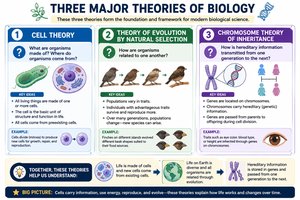
Cell Theory
Cell theory states that all living things are composed of cells, and new cells arise only from preexisting cells. Cells are the basic unit of life.
Implication: Life replicates through cell division.
Example: Skin healing after a cut involves cell division.
Theory of Evolution by Natural Selection
Evolution explains how populations change over time. Natural selection acts on heritable traits, leading to adaptation and speciation.
Common Ancestry: All species are related by common ancestry.
Descent with Modification: Species change from generation to generation.
Natural Selection: Traits that improve survival and reproduction become more common.
Chromosome Theory of Inheritance
Genes, which determine traits, are located on chromosomes and are passed from one generation to the next. DNA is the molecule of heredity.
DNA Structure: Double helix with sugar-phosphate backbone and base pairs (A–T, C–G).
Central Dogma:
Unicellular vs. Multicellular Organisms
Cellular Organization
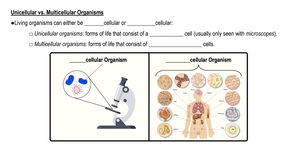
Living organisms can be unicellular (single cell) or multicellular (many cells). Unicellular organisms include bacteria and protists, while multicellular organisms include plants, animals, and fungi.
Unicellular: Forms of life that consist of a single cell.
Multicellular: Forms of life that consist of many cells.
Summary Table: Levels of Classification
Classification Categories
Organisms are classified into hierarchical categories, from species to domain. Each successive category includes more types of organisms than the preceding one.
Level | Description |
|---|---|
Species | Individuals that regularly breed together |
Genus | Closely related group of species |
Family | Group of related genera |
Order | Group of related families |
Class | Group of related orders |
Phylum | Major lineage within domain |
Kingdom | Group of related phyla |
Domain | Most inclusive category |
Conclusion
Biology is a vast and dynamic field that helps us understand life at all levels. It provides the foundation for advances in medicine, environmental science, genetics, and biotechnology. The study of biology is essential for solving real-world problems and improving human health and the environment.
