 Back
Biology: The Study of Life – Foundations and Core Concepts
Study Guide - Smart Notes
 Tailored notes based on your materials, expanded with key definitions, examples, and context.
Biology: The Study of Life
Introduction to Biology
Biology is the scientific study of life and living organisms. It encompasses a wide range of topics, from the molecular mechanisms within cells to the interactions of populations and ecosystems. Understanding what defines life and how living things function is foundational to all biological sciences.
The Five Characteristics of Life
Defining Life
To distinguish living organisms from non-living things, biologists generally agree on five key characteristics:
Cells: All living things are composed of one or more membrane-bound units called cells.
Replication: Living organisms have the ability to reproduce or replicate themselves.
Information: Organisms possess hereditary information encoded in genes and can respond to environmental stimuli to maintain homeostasis.
Energy Acquisition and Usage: All organisms must acquire and use energy for metabolism and maintenance (e.g., phototrophs, chemotrophs, heterotrophs, autotrophs).
Evolution: Populations of organisms evolve over generations through changes in heritable traits.
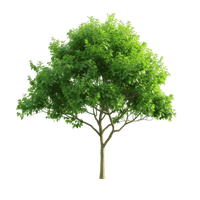
These characteristics help differentiate living things (such as trees and elephants) from non-living things (such as houses and cars).


Theories Forming the Basis of Modern Biology
The Cell Theory
The cell theory is a fundamental concept in biology, stating that all living organisms are made of cells and that all cells arise from preexisting cells. This theory was developed through the work of several scientists:
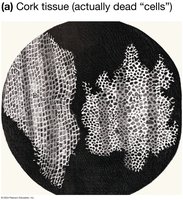
Robert Hooke (1665): Coined the term "cell" after observing cork tissue.
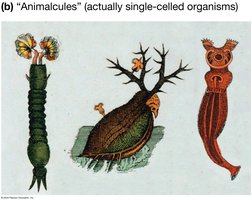
Anton van Leeuwenhoek: Improved the microscope and observed single-celled organisms ("animalcules").
Matthias Schleiden (1838): Concluded that plants are made of cells.
Theodor Schwann (1839): Extended the cell theory to animals.
Rudolf Virchow (1855): Stated that all cells come from preexisting cells ("omnis cellula e cellula").
Experimental Evidence: Pasteur’s Experiment
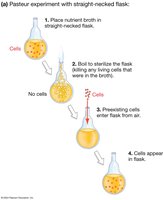
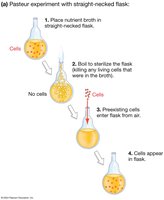
Louis Pasteur’s experiments in the 1860s provided strong evidence against spontaneous generation and supported the cell theory. He showed that cells arise only from preexisting cells, not from non-living material.
Straight-necked flask: Cells appeared in broth when exposed to air.
Swan-necked flask: No cells appeared in broth, as airborne cells were trapped in the neck.
The Chromosome Theory of Inheritance
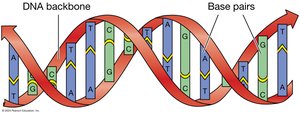
This theory connects the principles of genetics with cell biology. It states that hereditary information is encoded in genes, which are located on chromosomes. Key contributors include:
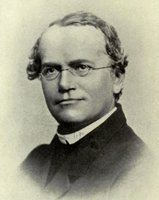
Gregor Mendel (1865): Discovered that heredity is determined by discrete factors (genes).
Walter Sutton and Theodor Boveri (1902-1903): Demonstrated that chromosomes behave like Mendel’s hereditary factors during meiosis.
1950s: Chromosomes were found to be composed of DNA and protein; DNA was identified as the hereditary material.
The Theory of Evolution by Natural Selection
Foundations of Evolutionary Theory
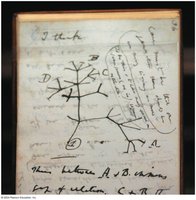
Proposed independently by Charles Darwin and Alfred Russel Wallace in 1858, the theory of evolution by natural selection is central to biology. It makes two main claims:
Common Ancestry: All species are related by common ancestry.
Descent with Modification: Species can change over generations, with heritable traits that enhance survival and reproduction becoming more common.
Key Terms in Evolution
Evolution: A change in allele frequency in a population over time.
Natural Selection: Individuals with advantageous heritable traits produce more surviving offspring, causing those traits to become more common.
Fitness: An individual’s ability to produce surviving, fertile offspring relative to others in the population.
Adaptation: A heritable trait that increases an individual’s fitness in a particular environment.
Population: All organisms of a specific species living in a geographic region at the same time.
The Three Domains of Life
Classification of Life
Genetic data has revealed that all life can be classified into three domains:
Bacteria: Prokaryotes without a nucleus or membrane-bound organelles.
Archaea: Prokaryotes distinct from bacteria, also lacking a nucleus.
Eukarya: Eukaryotes with a nucleus and membrane-bound organelles.
Further classification includes Kingdom, Phylum, Class, Order, Family, Genus, and Species.
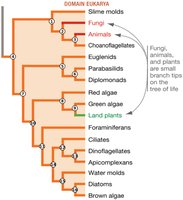
Phylogenetic Trees and Evolutionary Relationships
Understanding Phylogenetic Trees
A phylogenetic tree is a model that depicts the evolutionary history and relationships among organisms. It is based on genetic, physical, and biochemical characteristics. The more recent the common ancestor (depicted by nodes), the more closely related two groups are.
Scientific Naming of Organisms
Binomial Nomenclature
Each species is given a unique scientific name consisting of two parts: the genus and the species. This system, known as binomial nomenclature, uses Latin or Latinized words. For example:
Humans: Homo sapiens ("man" "wise")
Yeast: Saccharomyces cerevisiae ("sugar" "fungus" "beer")
The Central Dogma of Biology
Flow of Genetic Information
The central dogma describes the flow of genetic information within a biological system:
DNA is transcribed into RNA.
RNA is translated into protein.
This process explains how genetic information is expressed as cellular functions and traits.
Summary Table: Characteristics of Life vs. Non-Living Things
Characteristic | Living Organism (e.g., Tree) | Non-Living Object (e.g., Car) |
|---|---|---|
Cellular Structure | Yes | No |
Replication | Yes | No |
Genetic Information | Yes | No |
Energy Use | Yes | No |
Evolution | Yes | No |
Additional info: These notes provide foundational concepts for understanding all subsequent topics in general biology, including genetics, evolution, and cellular biology.
