 Back
BackBiology: The Study of Scientific Life – Chapter 1 Study Notes
Study Guide - Smart Notes
 Tailored notes based on your materials, expanded with key definitions, examples, and context.
Biology: The Scientific Study of Life
What is Life?
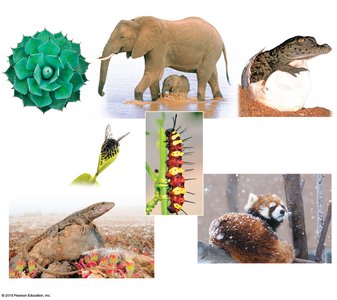
Biology is defined as the scientific study of life. Life is characterized by several fundamental properties that distinguish living organisms from non-living matter. These properties include:
Order: Living things exhibit complex organization, from molecules to cells to entire organisms.
Reproduction: Organisms reproduce their own kind, ensuring the continuation of species.
Growth and Development: Organisms grow and develop according to inherited instructions encoded in their DNA.
Energy Processing: Living things obtain and use energy to power their activities.
Regulation: Organisms regulate their internal environment to maintain stable conditions (homeostasis).
Response to the Environment: Living things respond to environmental stimuli.
Evolutionary Adaptation: Populations evolve over generations, adapting to their environments.
The cell is the structural and functional unit of life, forming the basis for all living organisms.
Biological Diversity and Classification
The Three Domains of Life
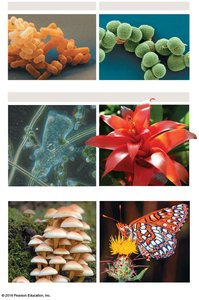
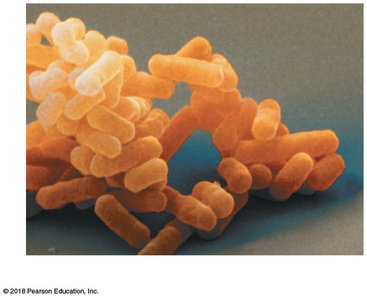
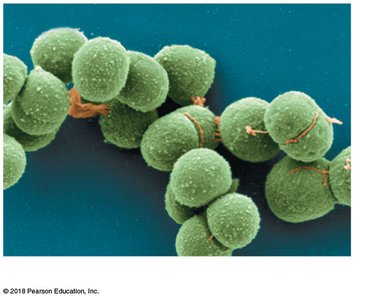
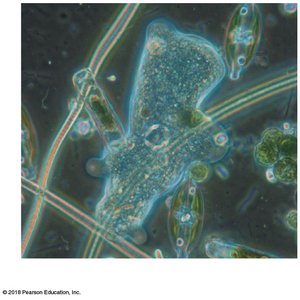
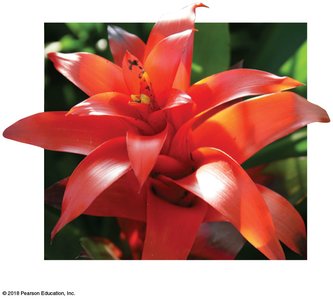
Taxonomists classify organisms into hierarchical groups. The broadest classification divides life into three domains:
Domain Bacteria: Composed of prokaryotic cells, these organisms are found in many environments.
Domain Archaea: Also prokaryotic, Archaea often inhabit extreme environments.
Domain Eukarya: Includes all eukaryotic organisms, such as protists, fungi, plants, and animals.
Each domain contains unique characteristics and evolutionary histories.
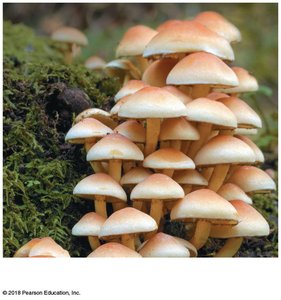
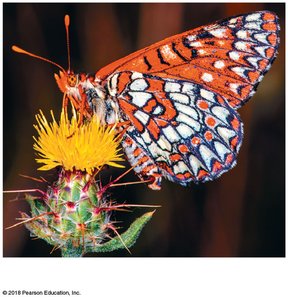
Hierarchy of Biological Organization
Emergent Properties and Levels of Organization
Biologists study life at multiple levels, from molecules to the biosphere. Each level exhibits emergent properties—new characteristics that arise from the arrangement and interaction of parts:
Molecule → Organelle → Cell → Tissue → Organ → Organ System → Organism → Population → Community → Ecosystem → Biosphere
Emergent properties are not present in the individual components but arise when those components interact.
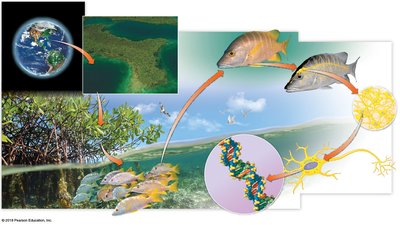
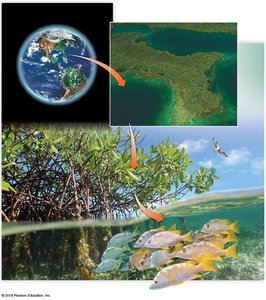
The Process of Science
Scientific Inquiry and Hypothesis Testing
Science is an evidence-based approach to understanding the natural world. The scientific method involves:
Observation: Gathering information about phenomena.
Hypothesis: Formulating a testable explanation.
Prediction: Making logical predictions based on the hypothesis.
Experimentation: Testing predictions through controlled experiments or further observations.
Analysis: Interpreting data to support or refute the hypothesis.
A scientific theory is broader than a hypothesis and supported by extensive evidence.
Controlled Experiments
Controlled experiments manipulate one variable (independent variable) and measure its effect on another (dependent variable). Experimental and control groups are compared to isolate the effect of the variable.
Independent Variable: The factor manipulated by the researcher.
Dependent Variable: The outcome measured.
Control Group: The group not exposed to the independent variable, used for comparison.
Matching factors such as age, sex, and health in groups helps reduce confounding variables.
Five Unifying Themes in Biology
Theme 1: Evolution
Evolution is the central theme of biology, explaining both the unity and diversity of life. Darwin's theory of evolution by natural selection describes how populations change over time:
Variation: Individuals in a population vary in traits.
Inheritance: Traits are passed from parents to offspring.
Unequal Reproductive Success: Individuals with advantageous traits are more likely to survive and reproduce.
Adaptation: Over generations, beneficial traits become more common.
Theme 2: Information Flow
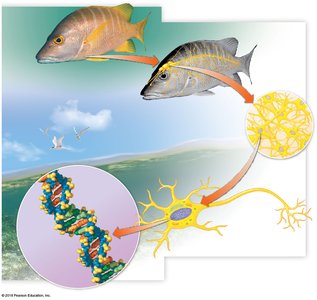
Life depends on the flow of information, primarily through DNA. DNA encodes genetic instructions for building proteins and regulating cellular activities. Environmental signals also influence gene expression and cellular responses.
DNA: The molecule of heredity, composed of nucleotide sequences.
Gene Expression: The process by which information from a gene is used to synthesize proteins.
Signaling: Internal and external signals regulate body processes and gene activity.
Theme 3: Structure and Function
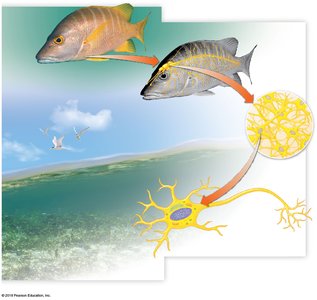
Biological structure and function are closely related at all levels. The shape and arrangement of molecules, cells, and organs determine their roles in the organism.
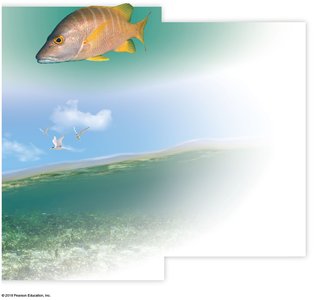
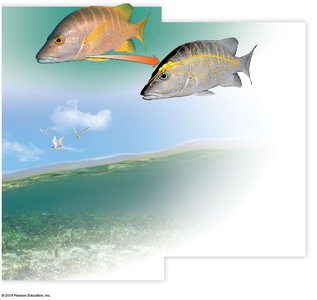
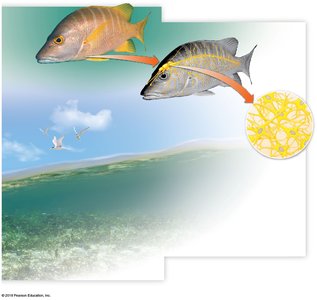
Example: Hemoglobin's structure enables it to transport oxygen; nerve cells' extensions allow signal transmission.
Theme 4: Energy and Matter
Life depends on the transfer and transformation of energy and matter. Energy flows through ecosystems, entering as sunlight, converted by producers, passed to consumers, and lost as heat. Matter cycles through the ecosystem via producers, consumers, and decomposers.
Photosynthesis: Converts solar energy to chemical energy in plants.
Decomposition: Returns nutrients to the environment.
Theme 5: Interactions Within and Between Systems
Biological systems are composed of interacting parts. Emergent properties arise from these interactions. Systems biology models these complex interactions to understand the behavior of entire systems.
Example: The assembly of bicycle parts illustrates emergent properties—only when parts interact does the system function.
Summary Table: The Three Domains of Life
Domain | Cell Type | Examples |
|---|---|---|
Bacteria | Prokaryotic | Streptococcus, Escherichia coli |
Archaea | Prokaryotic | Halophiles, Thermophiles |
Eukarya | Eukaryotic | Animals, Plants, Fungi, Protists |
Key Equations
Photosynthesis:
Cellular Respiration:
Conclusion
Biology is a dynamic and integrative science, exploring life from molecules to ecosystems. Understanding the unifying themes and scientific process provides a foundation for further study in all biological disciplines.
