 Back
Lecture 3 Notes: Biomolecules and Cell Membranes: Structure and Function
Study Guide - Smart Notes
 Tailored notes based on your materials, expanded with key definitions, examples, and context.
Biomolecules: Structure and Classification
Introduction to Biomolecules
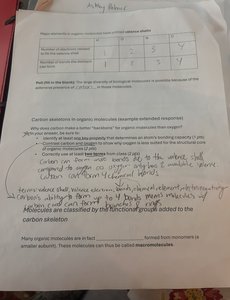
Biomolecules are organic molecules essential for life, primarily composed of carbon atoms bonded to other elements. Their diversity and function are determined by the arrangement of their carbon skeletons and the functional groups attached to them.
Organic molecules are carbon-based compounds found in living organisms.
Carbon atoms can form four covalent bonds, allowing for a variety of stable structures such as chains, rings, and branches.
Functional groups attached to carbon skeletons determine the chemical properties and reactivity of biomolecules.
Macromolecules are large molecules formed from smaller subunits called monomers. The four major classes of biomolecules are carbohydrates, lipids, proteins, and nucleic acids.
Classification of Biomolecules
Carbohydrates: Serve as energy sources and structural components. Examples include glucose and cellulose.
Lipids: Hydrophobic molecules important for energy storage, membrane structure, and signaling. Examples include fats, oils, and phospholipids.
Proteins: Polymers of amino acids that perform a wide range of functions, including catalysis (enzymes), structure, and transport.
Nucleic acids: Polymers of nucleotides that store and transmit genetic information (DNA and RNA).
Example: Glucose (C6H12O6) is a carbohydrate monomer that serves as a primary energy source in cells.
Cell Membranes: Structure, Diffusion, and Osmosis
Proteins
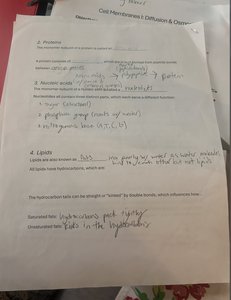
Proteins are polymers made from amino acid monomers. They are essential for cell structure and function, acting as enzymes, transporters, and signaling molecules.
Amino acids are the building blocks of proteins, each containing an amino group, a carboxyl group, and a unique side chain (R group).
Proteins are formed by peptide bonds linking amino acids in a specific sequence, which determines the protein's structure and function.
Example: Hemoglobin is a protein that transports oxygen in the blood.
Nucleic Acids
Nucleic acids are polymers of nucleotides, which store and transmit genetic information.
Nucleotides consist of a phosphate group, a five-carbon sugar (ribose or deoxyribose), and a nitrogenous base (A, T, C, G, or U).
DNA and RNA are the two main types of nucleic acids.
Example: DNA contains the genetic blueprint for the synthesis of proteins.
Lipids
Lipids are hydrophobic molecules that play key roles in energy storage, membrane structure, and signaling.
Fats are composed of glycerol and fatty acids. They can be saturated (no double bonds, solid at room temperature) or unsaturated (one or more double bonds, liquid at room temperature).
Phospholipids are major components of cell membranes, forming bilayers that separate the cell from its environment.
Type of Fatty Acid | Structure | Physical State |
|---|---|---|
Saturated | No double bonds; hydrocarbon chains pack tightly | Solid at room temperature |
Unsaturated | One or more double bonds; kinks in hydrocarbon chains | Liquid at room temperature |
Example: Olive oil is rich in unsaturated fats, while butter contains mostly saturated fats.
Additional info:
Macromolecules are synthesized through dehydration reactions and broken down by hydrolysis.
Functional groups such as hydroxyl, carboxyl, amino, and phosphate groups are critical for the properties of biomolecules.
